



The Role of Adiposity in Cardiometabolic Traits: A Mendelian Randomization Analysis
Supporting Files

-
Jun 25 2013
File Language:
English
Details
-
Alternative Title:PLoS Med
-
Personal Author:Fall, Tove ; Hägg, Sara ; Mägi, Reedik ; Ploner, Alexander ; Fischer, Krista ; Horikoshi, Momoko ; Sarin, Antti-Pekka ; Thorleifsson, Gudmar ; Ladenvall, Claes ; Kals, Mart ; Kuningas, Maris ; Draisma, Harmen H. M. ; Ried, Janina S. ; van Zuydam, Natalie R. ; Huikari, Ville ; Mangino, Massimo ; Sonestedt, Emily ; Benyamin, Beben ; Nelson, Christopher P. ; Rivera, Natalia V. ; Kristiansson, Kati ; Shen, Huei-yi ; Havulinna, Aki S. ; Dehghan, Abbas ; Donnelly, Louise A. ; Kaakinen, Marika ; Nuotio, Marja-Liisa ; Robertson, Neil ; de Bruijn, Renée F. A. G. ; Ikram, M. Arfan ; Amin, Najaf ; Balmforth, Anthony J. ; Braund, Peter S. ; Doney, Alexander S. F. ; Döring, Angela ; Elliott, Paul ; Esko, Tõnu ; Franco, Oscar H. ; Gretarsdottir, Solveig ; Hartikainen, Anna-Liisa ; Heikkilä, Kauko ; Herzig, Karl-Heinz ; Holm, Hilma ; Hottenga, Jouke Jan ; Hyppönen, Elina ; Illig, Thomas ; Isaacs, Aaron ; Isomaa, Bo ; Karssen, Lennart C. ; Kettunen, Johannes ; Koenig, Wolfgang ; Kuulasmaa, Kari ; Laatikainen, Tiina ; Laitinen, Jaana ; Lindgren, Cecilia ; Lyssenko, Valeriya ; Läärä, Esa ; Rayner, Nigel W. ; Männistö, Satu ; Pouta, Anneli ; Rathmann, Wolfgang ; Rivadeneira, Fernando ; Ruokonen, Aimo ; Savolainen, Markku J. ; Sijbrands, Eric J. G. ; Small, Kerrin S. ; Smit, Jan H. ; Steinthorsdottir, Valgerdur ; Syvänen, Ann-Christine ; Taanila, Anja ; Tobin, Martin D. ; Uitterlinden, Andre G. ; Willems, Sara M. ; Willemsen, Gonneke ; Witteman, Jacqueline ; Perola, Markus ; Evans, Alun ; Ferrières, Jean ; Virtamo, Jarmo ; Kee, Frank ; Tregouet, David-Alexandre ; Arveiler, Dominique ; Amouyel, Philippe ; Ferrario, Marco M. ; Brambilla, Paolo ; Hall, Alistair S. ; Heath, Andrew C. ; Madden, Pamela A. F. ; Martin, Nicholas G. ; Montgomery, Grant W. ; Whitfield, John B. ; Jula, Antti ; Knekt, Paul ; Oostra, Ben ; van Duijn, Cornelia M. ; Penninx, Brenda W. J. H. ; Davey Smith, George ; Kaprio, Jaakko ; Samani, Nilesh J. ; Gieger, Christian ; Peters, Annette ; Wichmann, H.-Erich ; Boomsma, Dorret I. ; de Geus, Eco J. C. ; Tuomi, TiinaMaija ; Power, Chris ; Hammond, Christopher J. ; Spector, Tim D. ; Lind, Lars ; Orho-Melander, Marju ; Palmer, Colin Neil Alexander ; Morris, Andrew D. ; Groop, Leif ; Järvelin, Marjo-Riitta ; Salomaa, Veikko ; Vartiainen, Erkki ; Hofman, Albert ; Ripatti, Samuli ; Metspalu, Andres ; Thorsteinsdottir, Unnur ; Stefansson, Kari ; Pedersen, Nancy L. ; McCarthy, Mark I. ; Ingelsson, Erik ; Prokopenko, Inga
-
Corporate Authors:
-
Description:In this study, Prokopenko and colleagues provide novel evidence for causal relationship between adiposity and heart failure and increased liver enzymes using a Mendelian randomization study design.
Background
The association between adiposity and cardiometabolic traits is well known from epidemiological studies. Whilst the causal relationship is clear for some of these traits, for others it is not. We aimed to determine whether adiposity is causally related to various cardiometabolic traits using the Mendelian randomization approach.
Methods and Findings
We used the adiposity-associated variant rs9939609 at the FTO locus as an instrumental variable (IV) for body mass index (BMI) in a Mendelian randomization design. Thirty-six population-based studies of individuals of European descent contributed to the analyses.
Conclusions
We provide novel evidence for a causal relationship between adiposity and heart failure as well as between adiposity and increased liver enzymes.
Why Was This Study Done?
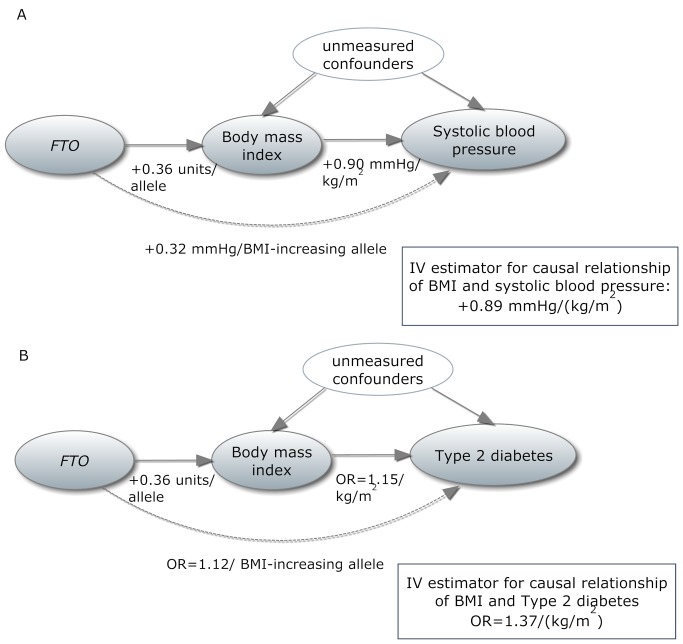
Epidemiological studies—investigations that record the patterns and causes of disease in populations—have reported an association between adiposity (indicated by an increased body mass index BMI, which is calculated by dividing body weight in kilograms by height in meters squared) and cardiometabolic traits such as coronary heart disease, stroke, heart failure (a condition in which the heart is incapable of pumping sufficient amounts of blood around the body), diabetes, high blood pressure (hypertension), and high blood cholesterol (dyslipidemia). However, observational studies cannot prove that adiposity causes any particular cardiometabolic trait because overweight individuals may share other characteristics (confounding factors) that are the real causes of both obesity and the cardiometabolic disease. Moreover, it is possible that having CVD or a metabolic disease causes obesity (reverse causation). For example, individuals with heart failure cannot do much exercise, so heart failure may cause obesity rather than vice versa. Here, the researchers use “Mendelian randomization” to examine whether adiposity is causally related to various cardiometabolic traits. Because gene variants are inherited randomly, they are not prone to confounding and are free from reverse causation. It is known that a genetic variant (rs9939609) within the genome region that encodes the fat-mass- and obesity-associated gene (FTO) is associated with increased BMI. Thus, an investigation of the associations between rs9939609 and cardiometabolic traits can indicate whether obesity is causally related to these traits.
What Did the Researchers Do and Find?
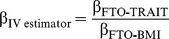
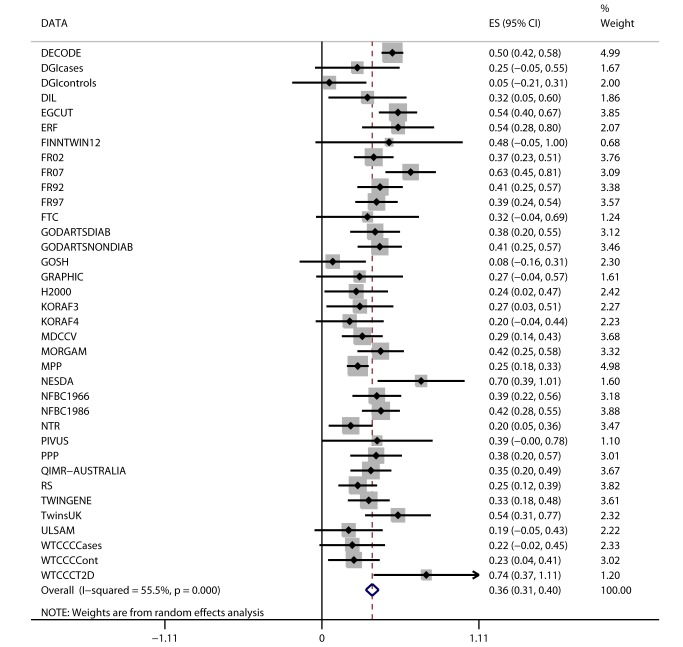
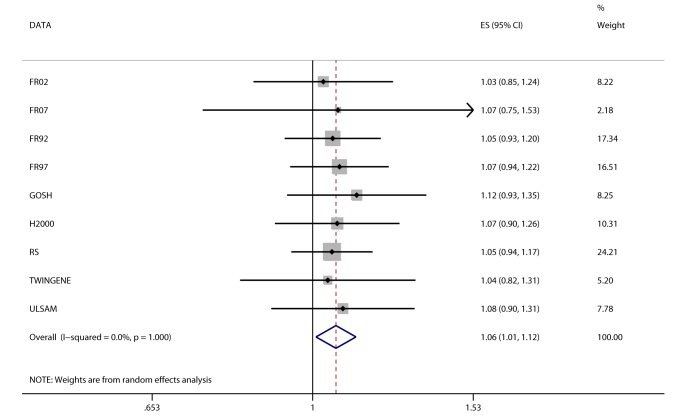
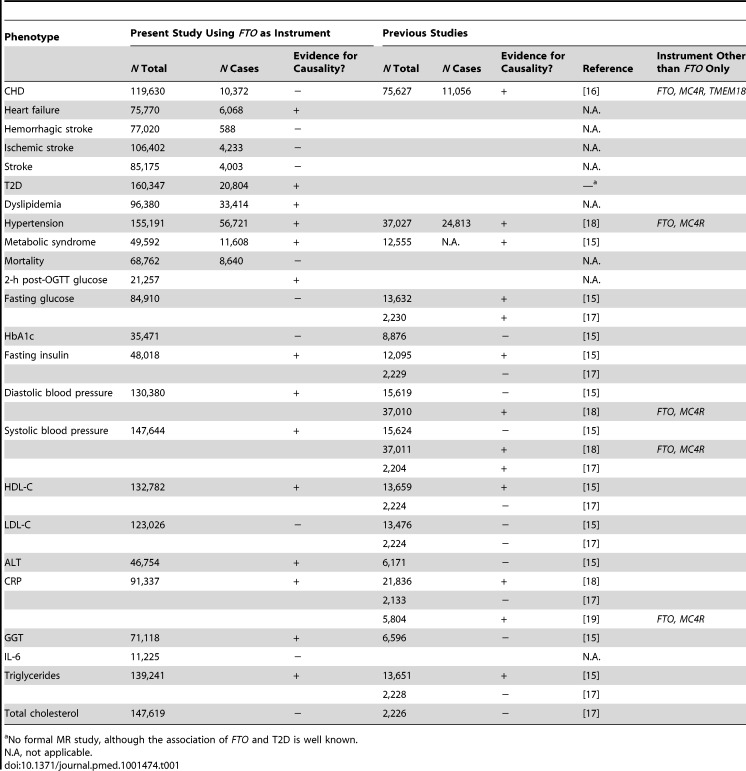
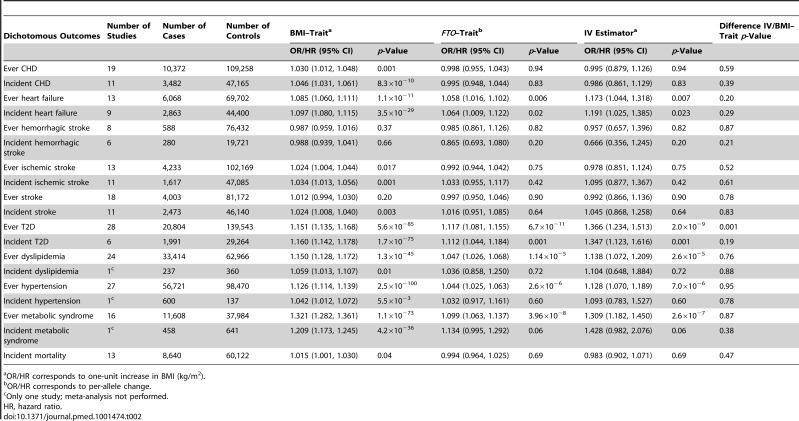
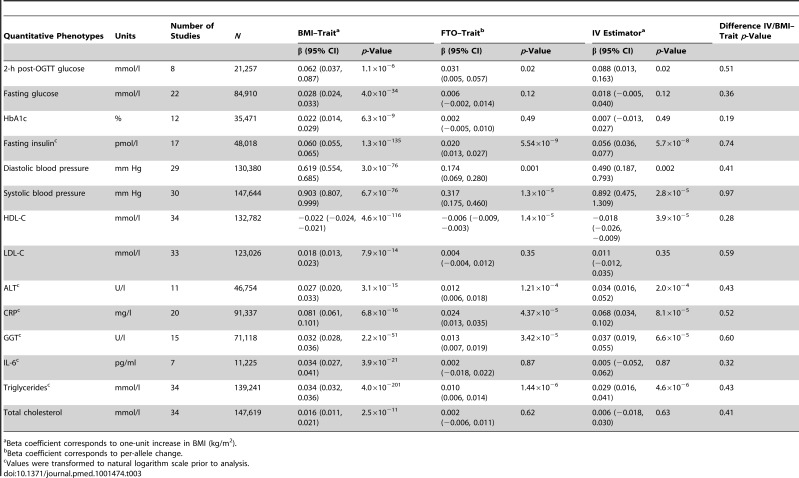
The researchers analyzed the association between rs9939609 (the “instrumental variable,” or IV) and BMI, between rs9939609 and 24 cardiometabolic traits, and between BMI and the same traits using genetic and health data collected in 36 population-based studies of nearly 200,000 individuals of European descent. They then quantified the strength of the causal association between BMI and the cardiometabolic traits by calculating “IV estimators.” Higher BMI showed a causal relationship with heart failure, metabolic syndrome (a combination of medical disorders that increases the risk of developing CVD), type 2 diabetes, dyslipidemia, hypertension, increased blood levels of liver enzymes (an indicator of liver damage; some metabolic disorders involve liver damage), and several other cardiometabolic traits. All the IV estimators were similar to the BMI–cardiovascular trait associations (observational estimates) derived from the same individuals, with the exception of diabetes, where the causal estimate was higher than the observational estimate, probably because the observational estimate is based on a single BMI measurement, whereas the causal estimate considers lifetime changes in BMI.
What Do These Findings Mean?
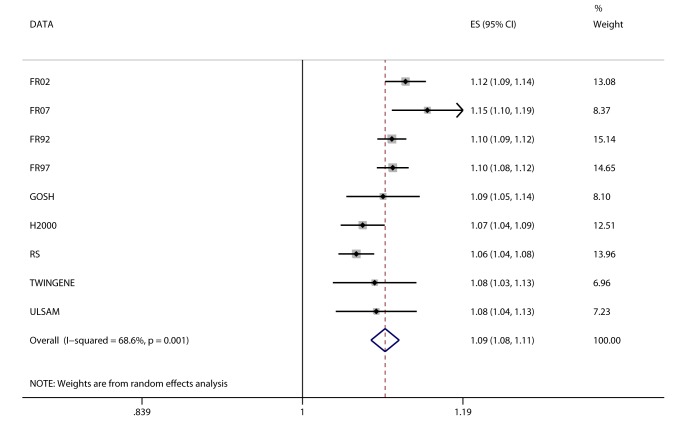
Like all Mendelian randomization studies, the reliability of the causal associations reported here depends on several assumptions made by the researchers. Nevertheless, these findings provide support for many previously suspected and biologically plausible causal relationships, such as that between adiposity and hypertension. They also provide new insights into the causal effect of obesity on liver enzyme levels and on heart failure. In the latter case, these findings suggest that a one-unit increase in BMI might increase the incidence of heart failure by 17%. In the US, this corresponds to 113,000 additional cases of heart failure for every unit increase in BMI at the population level. Although additional studies are needed to confirm and extend these findings, these results suggest that global efforts to reduce the burden of obesity will likely also reduce the occurrence of CVD and metabolic disorders.
Additional Information
Please access these websites via the online version of this summary at http://dx.doi.org/10.1371/journal.pmed.1001474. -
Subjects:
-
Source:PLoS Med. 2013; 10(6).
-
Pubmed ID:23824655
-
Pubmed Central ID:PMC3692470
-
Document Type:
-
Funding:01GS0834/PHS HHS/United States ; 050-060-810/PHS HHS/United States ; 090532/Wellcome Trust/United Kingdom ; 10-000-1002/PHS HHS/United States ; 104781/PHS HHS/United States ; 11-0312/PHS HHS/United States ; 120315/PHS HHS/United States ; 129418/PHS HHS/United States ; 129494/PHS HHS/United States ; 129680/PHS HHS/United States ; 139635/PHS HHS/United States ; 141054/PHS HHS/United States ; 17155/2004/PHS HHS/United States ; 1RC2 MH089995-01/MH/NIMH NIH HHS/United States ; 1RC2MH089951-01/MH/NIMH NIH HHS/United States ; 1RL1MH083268-01/MH/NIMH NIH HHS/United States ; 201413/PHS HHS/United States ; 213506/PHS HHS/United States ; 230374/PHS HHS/United States ; 241944/Medical Research Council/United Kingdom ; 31160008/PHS HHS/United States ; 31737/1997/PHS HHS/United States ; 339462/Medical Research Council/United Kingdom ; 389875/Medical Research Council/United Kingdom ; 389891/Medical Research Council/United Kingdom ; 389892/Medical Research Council/United Kingdom ; 389927/Medical Research Council/United Kingdom ; 389938/Medical Research Council/United Kingdom ; 400-05-717/PHS HHS/United States ; 41795/1993/PHS HHS/United States ; 442915/Medical Research Council/United Kingdom ; 442981/Medical Research Council/United Kingdom ; 480-04-004/PHS HHS/United States ; 496739/Medical Research Council/United Kingdom ; 552485/Medical Research Council/United Kingdom ; 552498/Medical Research Council/United Kingdom ; 56-464-14192/PHS HHS/United States ; 5R01HL087679-02/HL/NHLBI NIH HHS/United States ; 5R01MH63706/MH/NIMH NIH HHS/United States ; 904-61-090/PHS HHS/United States ; 904-61-193/PHS HHS/United States ; 911-03-012/PHS HHS/United States ; 911-09-032/PHS HHS/United States ; 918-76-619/PHS HHS/United States ; 9783/1986/PHS HHS/United States ; 985-10-002/PHS HHS/United States ; A7960034/PHS HHS/United States ; A79801419/PHS HHS/United States ; A79906588/PHS HHS/United States ; AA07535/AA/NIAAA NIH HHS/United States ; AA10248/AA/NIAAA NIH HHS/United States ; AA11998/AA/NIAAA NIH HHS/United States ; AA13320/AA/NIAAA NIH HHS/United States ; AA13321/AA/NIAAA NIH HHS/United States ; AA13326/AA/NIAAA NIH HHS/United States ; AA14041/AA/NIAAA NIH HHS/United States ; AA15416/AA/NIAAA NIH HHS/United States ; AA17688/AA/NIAAA NIH HHS/United States ; AG028555/AG/NIA NIH HHS/United States ; AG04563/AG/NIA NIH HHS/United States ; AG08724/AG/NIA NIH HHS/United States ; AG08861/AG/NIA NIH HHS/United States ; AG10175/AG/NIA NIH HHS/United States ; CEED3 223211/PHS HHS/United States ; CT-2006-019473/CT/CIT NIH HHS/United States ; CT-2006-037593/CT/CIT NIH HHS/United States ; DA12854/DA/NIDA NIH HHS/United States ; DK U01-066134/DK/NIDDK NIH HHS/United States ; DP0212016/DP/NCCDPHP CDC HHS/United States ; DP0343921/DP/NCCDPHP CDC HHS/United States ; DP0770096/DP/NCCDPHP CDC HHS/United States ; ETF9353/PHS HHS/United States ; EU/QLRT-2001-01254/PHS HHS/United States ; EU/WLRT-2001-01254/PHS HHS/United States ; FP6 STRP 018947/FP/OFP OPHS HHS/United States ; FP7-HEALTH-F4-2007/FP/OFP OPHS HHS/United States ; FP7/2007-2013/FP/OFP OPHS HHS/United States ; G0500539/Medical Research Council/United Kingdom ; G0600705/Medical Research Council/United Kingdom ; G0801056/Medical Research Council/United Kingdom ; G0902313/Medical Research Council/United Kingdom ; GR072960/PHS HHS/United States ; GR072960/Wellcome Trust/United Kingdom ; I 480-05-003/PHS HHS/United States ; K05 AA017688/AA/NIAAA NIH HHS/United States ; MH66206/MH/NIMH NIH HHS/United States ; N01-CN-45165/CN/NCI NIH HHS/United States ; N01-RC-37004/RC/CCR NIH HHS/United States ; N01-RC-45035/RC/CCR NIH HHS/United States ; PG/09/023/26806/British Heart Foundation/United Kingdom ; QLG1-CT-2000-0164/CT/CIT NIH HHS/United States ; QLG2-CT-2002-01254/CT/CIT NIH HHS/United States ; R01 MH059160/MH/NIMH NIH HHS/United States ; R01D0042157-01A/PHS HHS/United States ; R01EY018246-01-1 PI/EY/NEI NIH HHS/United States ; R01HL089650-02/HL/NHLBI NIH HHS/United States ; SF0180142S08/SF/SBRP NIH HHS/United States ; SRF/01/010/Department of Health/United Kingdom ; U24 MH068457-06/MH/NIMH NIH HHS/United States ; Biotechnology and Biological Sciences Research Council/United Kingdom ; British Heart Foundation/United Kingdom
-
Volume:10
-
Issue:6
-
Download URL:
-
File Type:
 [PDF - 605.03 KB]
 -
Collection(s):
-
Main Document Checksum:urn:sha256:2c66882204f7706603bb70c4e015f72d7a753b182447dbd88b634b091d61d69d
Supporting Files


File Language:
English
 Was this page helpful?
 Found an issue?





CDC STACKS serves as an archival repository of CDC-published products including
scientific findings, journal articles, guidelines, recommendations, or other public health information authored or
co-authored by CDC or funded partners.
As a repository, CDC STACKS retains documents in their original published format to ensure public access to scientific information.
As a repository, CDC STACKS retains documents in their original published format to ensure public access to scientific information.
You May Also Like
COLLECTION
CDC Public Access