



Impact of Florida’s prescription drug monitoring program and pill mill law on high-risk patients: A comparative interrupted time series analysis
Supporting Files

-
February 28 2018
-
File Language:
English
Details
-
Alternative Title:Pharmacoepidemiol Drug Saf
-
Personal Author:
-
Description:Purpose:
We quantified the effects of Florida’s prescription drug monitoring program and pill mill law on high-risk patients.
Methods:
We used QuintilesIMS LRx Lifelink data to identify patients receiving prescription opioids in Florida (intervention state, N: 1.13 million) and Georgia (control state, N: 0.54 million). The preintervention, intervention, and postintervention periods were July 2010 to June 2011, July 2011 to September 2011, and October 2011 to September 2012. We identified 3 types of high-risk patients: (1) concomitant users: patients with concomitant use of benzodiazepines and opioids; (2) chronic users: long-term, high-dose, opioid users; and (3) opioid shoppers: patients receiving opioids from multiple sources. We compared changes in opioid prescriptions between Florida and Georgia before and after policy implementation among high-risk/low-risk patients. Our monthly measures included (1) average morphine milligram equivalent per transaction, (2) total opioid volume across all prescriptions, (3) average days supplied per transaction, and (4) total number of opioid prescriptions dispensed.
Results:
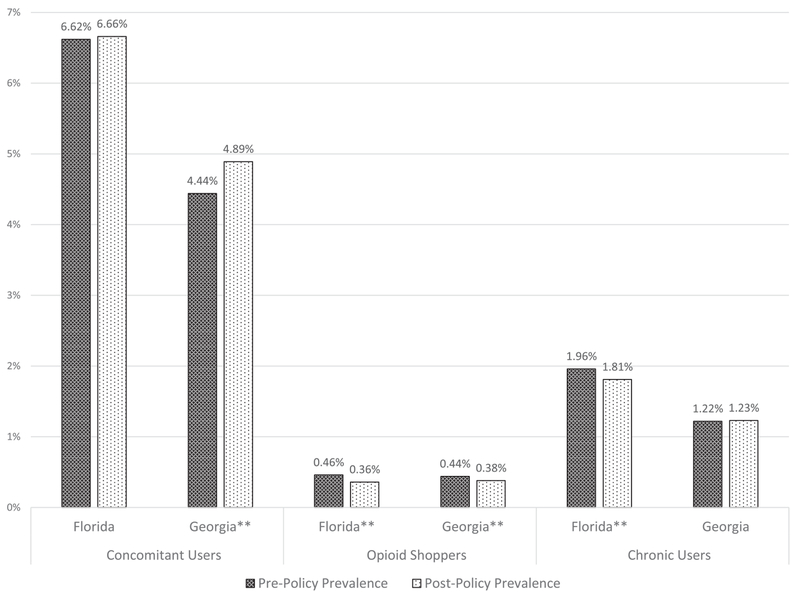
Among opioid-receiving individuals in Florida, 6.62% were concomitant users, 1.96% were chronic users, and 0.46% were opioid shoppers. Following policy implementation, Florida’s high-risk patients experienced relative reductions in morphine milligram equivalent (opioid shoppers: −1.08 mg/month, 95% confidence interval [CI] −1.62 to −0.54), total opioid volume (chronic users: −4.58 kg/month, CI −5.41 to −3.76), and number of dispensed opioid prescriptions (concomitant users: −640 prescriptions/month, CI −950 to −340). Low-risk patients generally did not experience statistically significantly relative reductions.
Conclusions:
Compared with Georgia, Florida’s prescription drug monitoring program and pill mill law were associated with large relative reductions in prescription opioid utilization among high-risk patients.
-
Subjects:
-
Source:Pharmacoepidemiol Drug Saf. 27(4):422-429
-
Pubmed ID:29488663
-
Pubmed Central ID:PMC6664298
-
Document Type:
-
Funding:
-
Volume:27
-
Issue:4
-
Collection(s):
-
Main Document Checksum:urn:sha256:114fec2ca3550e9a62b4bd09f32438a9eb93078304328efefaefbbe94014455a
-
Download URL:
-
File Type:
 [PDF
- 659.77 KB
]
[PDF
- 659.77 KB
]
Supporting Files


File Language:
English
 Was this page helpful?
 Found an issue?
CDC STACKS serves as an archival repository of CDC-published products including
scientific findings,
journal articles, guidelines, recommendations, or other public health information authored or
co-authored by CDC or funded partners.
As a repository, CDC STACKS retains documents in their original published format to ensure public access to scientific information.
As a repository, CDC STACKS retains documents in their original published format to ensure public access to scientific information.
You May Also Like
COLLECTION
CDC Public Access