



Effect of a “pill mill” law on opioid prescribing and utilization: The case of Texas
Supporting Files

-
Dec 31 2015
-
Details
-
Alternative Title:Drug Alcohol Depend
-
Personal Author:
-
Description:Background
States have attempted to reduce prescription opioid abuse through strengthening the regulation of pain management clinics; however, the effect of such measures remains unclear. We quantified the impact of Texas’s September 2010 “pill mill” law on opioid prescribing and utilization.
Methods
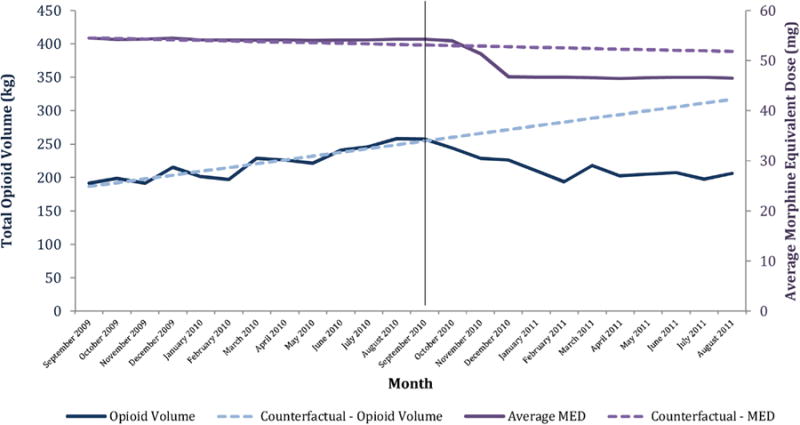
We used the IMS Health LRx LifeLink database to examine anonymized, patient-level pharmacy claims for a closed cohort of individuals filling prescription opioids in Texas between September 2009 and August 2011. Our primary outcomes were derived at a monthly level and included: (1) average morphine equivalent dose (MED) per transaction; (2) aggregate opioid volume; (3) number of opioid prescriptions; and (4) quantity of opioid pills dispensed. We compared observed values with the counterfactual, which we estimated from pre-intervention levels and trends.
Results
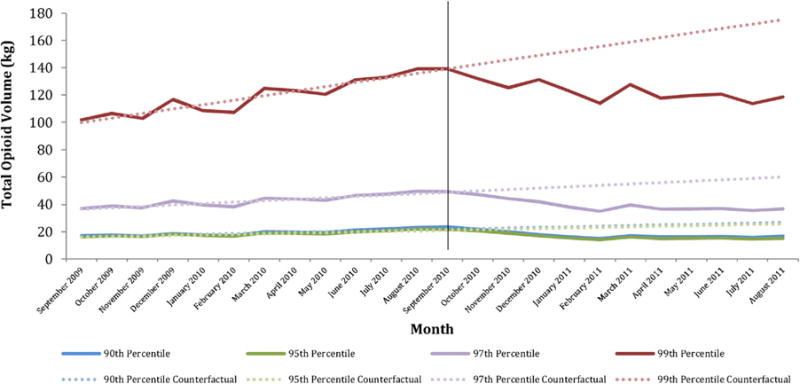
Texas’s pill mill law was associated with declines in average MED per transaction (−0.57 mg/month, 95% confidence interval [CI] −1.09, −0.057), monthly opioid volume (−9.99 kg/month, CI −12.86, −7.11), monthly number of opioid prescriptions (−12,200 prescriptions/month, CI −15,300, −9,150) and monthly quantity of opioid pills dispensed (−714,000 pills/month, CI −877,000, −550,000). These reductions reflected decreases of 8.1–24.3% across the outcomes at one year compared with the counterfactual, and they were concentrated among prescribers and patients with the highest opioid prescribing and utilization at baseline.
Conclusions
Following the implementation of Texas’s 2010 pill mill law, there were clinically significant reductions in opioid dose, volume, prescriptions and pills dispensed within the state, which were limited to individuals with higher levels of baseline opioid prescribing and utilization.
-
Subjects:
-
Source:Drug Alcohol Depend. 159:190-197.
-
Pubmed ID:26778760
-
Pubmed Central ID:PMC4976392
-
Document Type:
-
Funding:
-
Volume:159
-
Collection(s):
-
Main Document Checksum:urn:sha256:01eafe44a6b527cefa098935e48667819e2ba01975b7b501a0314fbcf196358c
-
Download URL:
-
File Type:
 [PDF
- 302.91 KB
]
[PDF
- 302.91 KB
]
Supporting Files


 Was this page helpful?
 Found an issue?


CDC STACKS serves as an archival repository of CDC-published products including
scientific findings,
journal articles, guidelines, recommendations, or other public health information authored or
co-authored by CDC or funded partners.
As a repository, CDC STACKS retains documents in their original published format to ensure public access to scientific information.
As a repository, CDC STACKS retains documents in their original published format to ensure public access to scientific information.
You May Also Like
COLLECTION
CDC Public Access