



A ten-year retrospective evaluation of acute flaccid myelitis at 5 pediatric centers in the United States, 2005–2014
Supporting Files
Public Domain

-
2020
File Language:
English
Details
-
Alternative Title:PLoS One
-
Personal Author:Cortese, Margaret M. ; Kambhampati, Anita K. ; Schuster, Jennifer E. ; Alhinai, Zaid ; Nelson, Gary R. ; Guzman Perez-Carrillo, Gloria J. ; Vossough, Arastoo ; Smit, Michael A. ; McKinstry, Robert C. ; Zinkus, Timothy ; Moore, Kevin R. ; Rogg, Jeffrey M. ; Candee, Meghan S. ; Sejvar, James J. ; Hopkins, Sarah E.
-
Description:Background
Acute flaccid myelitis (AFM) is a severe illness similar to paralytic poliomyelitis. It is unclear how frequently AFM occurred in U.S. children after poliovirus elimination. In 2014, an AFM cluster was identified in Colorado, prompting passive US surveillance that yielded 120 AFM cases of unconfirmed etiology. Subsequently, increased reports were received in 2016 and 2018. To help inform investigations on causality of the recent AFM outbreaks, our objective was to determine how frequently AFM had occurred before 2014, and if 2014 cases had different characteristics.
Methods
We conducted a retrospective study covering 2005–2014 at 5 pediatric centers in 3 U.S. regions. Possible AFM cases aged ≤18 years were identified by searching discharge ICD-9 codes and spinal cord MRI reports (>37,000). Neuroradiologists assessed MR images, and medical charts were reviewed; possible cases were classified as AFM, not AFM, or indeterminate.
Results
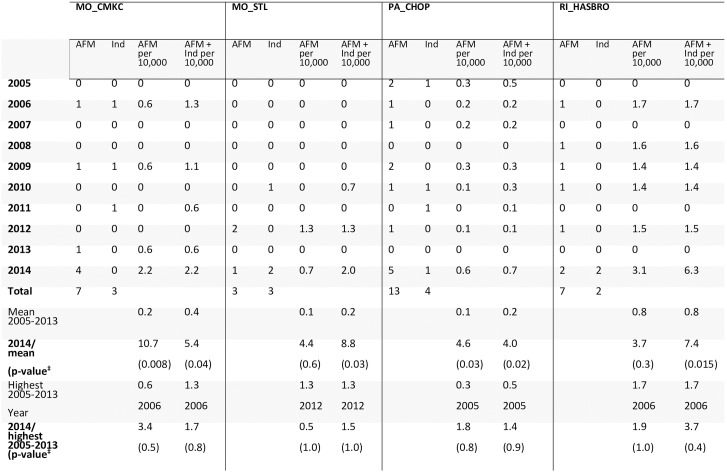
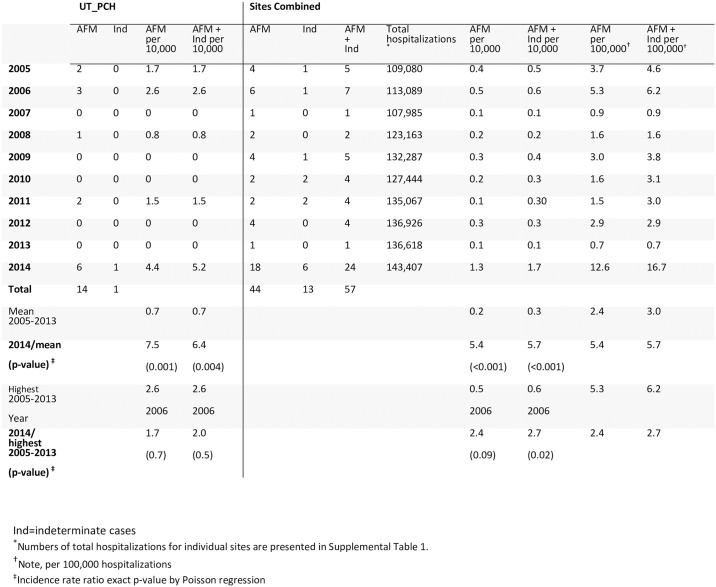
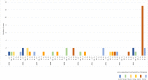
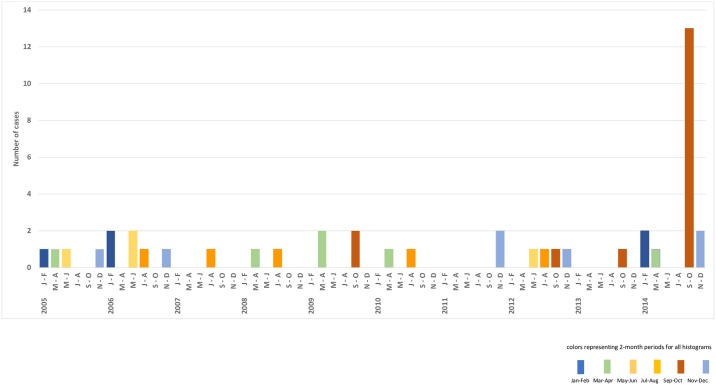
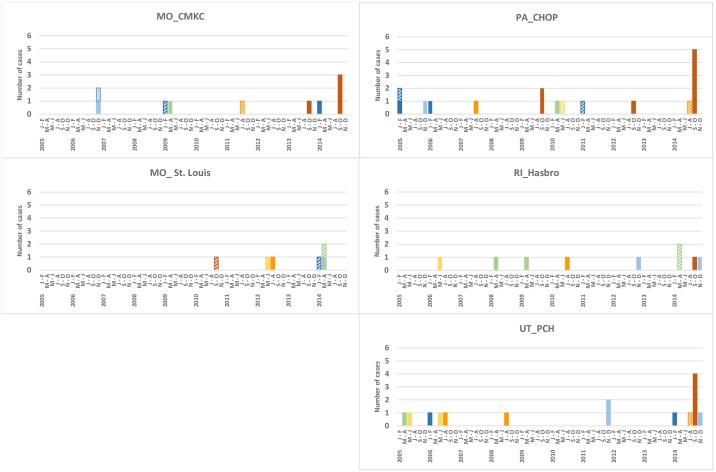
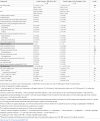
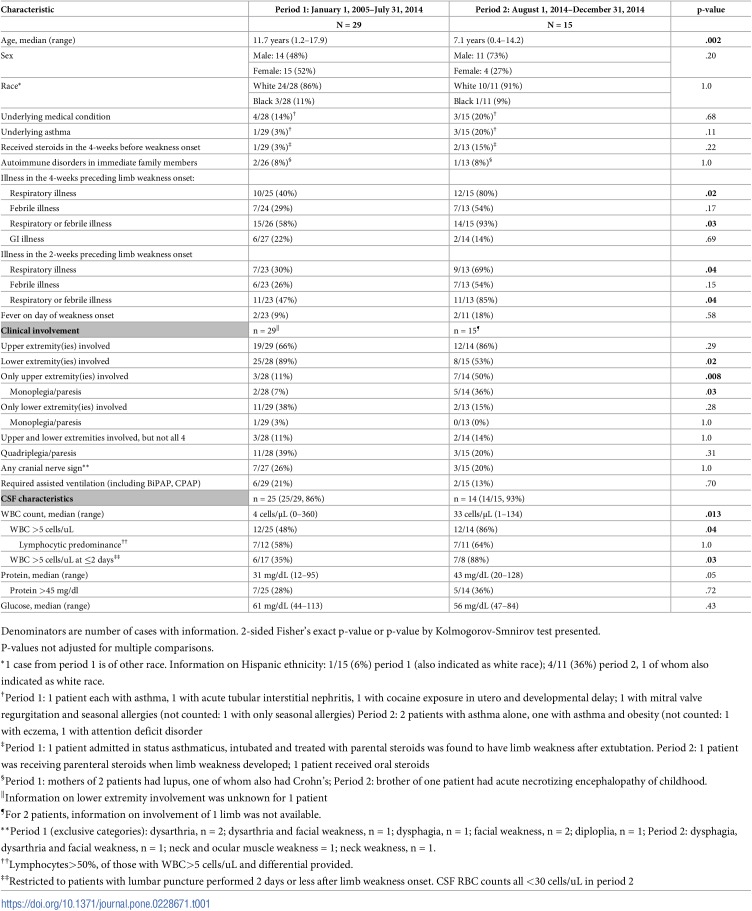
At 5 sites combined, 26 AFM cases were identified from 2005–2013 (average annual number, 3 2.4 cases/100,000 pediatric hospitalizations) and 18 from 2014 (12.6 cases/100,000 hospitalizations; Poisson exact p<0.0001). A cluster of 13 cases was identified in September–October 2014 (temporal scan p = 0.0001). No other temporal or seasonal trend was observed. Compared with cases from January 2005–July 2014 (n = 29), cases from August–December 2014 (n = 15) were younger (p = 0.002), more frequently had a preceding respiratory/febrile illness (p = 0.03), had only upper extremities involved (p = 0.008), and had upper extremity monoplegia (p = 0.03). The cases had higher WBC counts in cerebrospinal fluid (p = 0.013).
Conclusion
Our data support emergence of AFM in 2014 in the United States, and those cases demonstrated distinctive features compared with preceding sporadic cases. -
Subjects:
- Adolescent
- Age Factors
- Central Nervous System Viral Diseases
- Child
- Child, Preschool
- Disease Outbreaks
- Enterovirus D, Human
- Female
- Hospitalization
- Hospitals, Pediatric
- Humans
- Infant
- International Classification of Diseases
- Magnetic Resonance Imaging
- Male
- Myelitis
- Neuromuscular Diseases
- Retrospective Studies
- Seasons
-
Source:PLoS One. 15(2)
-
Pubmed ID:32053652
-
Pubmed Central ID:PMC7018000
-
Document Type:
-
Place as Subject:
-
Volume:15
-
Issue:2
-
Download URL:
-
File Type:
 [PDF - 1.46 MB]
 -
Collection(s):
-
Main Document Checksum:urn:sha256:9c3e859c5e1c5995eb424996776a8604fc94d6283e95f4b0d2024d11513e38f3
Supporting Files


File Language:
English
 Was this page helpful?
 Found an issue?


CDC STACKS serves as an archival repository of CDC-published products including
scientific findings, journal articles, guidelines, recommendations, or other public health information authored or
co-authored by CDC or funded partners.
As a repository, CDC STACKS retains documents in their original published format to ensure public access to scientific information.
As a repository, CDC STACKS retains documents in their original published format to ensure public access to scientific information.
You May Also Like
COLLECTION
CDC Public Access