


Prevalence of Weakness and its Relationship with Limitations based on the Foundations for the National Institutes for Health Project: Data from the Health & Retirement Study
Supporting Files

-
10 2016
-
File Language:
English
Details
-
Alternative Title:Eur J Clin Nutr
-
Personal Author:
-
Description:Background/Objectives
Determine the prevalence of muscle weakness using the two 2014 Foundation for the National Institutes of Health (FNIH) Sarcopenia Project criteria and its relationship to physical limitations, basic and instrumental activities of daily living (ADL).
Subjects/Methods
We performed a cross-sectional analysis of community-dwelling adults from the Health and Retirement Study 2006-2008 and identified a subsample of 5,092 adults aged ≥60 years with grip strength data. Self-reported physical limitations, basic and instrumental activities of daily living (ADL) were assessed. Criteria for grip strength (GS) (men<26kg; women <16kg), and GS adjusted for body mass index (GS/BMI) (men <1.0; women <0.56) were applied to the sample. We determined prevalence of muscle weakness in each sex. Multivariable logistic regression was used to calculate the association of physical limitations, basic and instrument ADLs with weakness definitions e in each sex.
Results
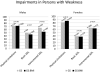
Mean age was 72.1 years (54.9% female).Mean GS was 38.3 and 22.9 kg and mean BMI was 29 kg/m2, respectively in males and females. Weakness prevalence using GS and GS:BMI definitions were 7.8 and 15.2 (p<0.001), respectively in males, and 11.4 and 13.3% (p=0.04), in females. Overall prevalence of physical limitations, basic and instrumental ADL limitations was 52.9%, 28.1%, and 35.9%. In those with weakness, prevalence of physical limitations, basic ADL and instrumental ADL was 78.5%, 42.3% and 65.3% using the GS definition, and 79.7%, 40.7%, and 58.8% using the GS/BMI definition. GS and the GS/BMI definitions of weakness were strongly associated with physical limitations (OR 2.19 [95%CI:1.67-2.87] and 2.52 [2.01-3.17]), basic ADL (OR 1.59 [1.22-2.07] and 1.66 [1.32-2.07]), and instrumental ADLs (OR 1.98 [1.28-2.54] and 1.78 [1.44-2.20]).
Conclusions
The new FNIH guidelines for weakness are associated with higher prevalence of physical limitations basic and instrumental ADL impairments as compared to individuals without weakness
-
Subjects:
-
Source:Eur J Clin Nutr. 70(10):1168-1173
-
Pubmed ID:27245209
-
Pubmed Central ID:PMC5052111
-
Document Type:
-
Funding:R01 MH078052/MH/NIMH NIH HHSUnited States/ ; R24 MH102794/MH/NIMH NIH HHSUnited States/ ; T32 MH073553/MH/NIMH NIH HHSUnited States/ ; R01 MH089811/MH/NIMH NIH HHSUnited States/ ; U48 DP005018/DP/NCCDPHP CDC HHSUnited States/ ; U48DP005018/ACL/ACL HHSUnited States/ ; R01 DD000140/DD/NCBDD CDC HHSUnited States/
-
Volume:70
-
Issue:10
-
Collection(s):
-
Main Document Checksum:urn:sha256:1f72cffb3521995f7ce7139f0d562c92619526423d3d3d6b7bc649f1a7891f9d
-
Download URL:
-
File Type:
 [PDF
- 443.45 KB
]
[PDF
- 443.45 KB
]
Supporting Files


File Language:
English
ON THIS PAGE


CDC STACKS serves as an archival repository of CDC-published products including
scientific findings,
journal articles, guidelines, recommendations, or other public health information authored or
co-authored by CDC or funded partners.
As a repository, CDC STACKS retains documents in their original published format to ensure public access to scientific information.
As a repository, CDC STACKS retains documents in their original published format to ensure public access to scientific information.
You May Also Like
COLLECTION
CDC Public Access