



Cardiolipin externalization to the outer mitochondrial membrane acts as an elimination signal for mitophagy in neuronal cells
Supporting Files

-
Sep 15 2013
-
Details
-
Alternative Title:Nat Cell Biol
-
Personal Author:Chu, Charleen T. ; Ji, Jing ; Dagda, Ruben K. ; Jiang, Jian Fei ; Tyurina, Yulia Y. ; Kapralov, Alexandr A. ; Tyurin, Vladimir A. ; Yanamala, Naveena ; Shrivastava, Indira H. ; Mohammadyani, Dariush ; Wang, Kent Zhi Qiang ; Zhu, Jianhui ; Klein-Seetharaman, Judith ; Balasubramanian, Krishnakumar ; Amoscato, Andrew A. ; Borisenko, Grigory ; Huang, Zhentai ; Gusdon, Aaron M. ; Cheikhi, Amin ; Steer, Erin K. ; Wang, Ruth ; Baty, Catherine ; Watkins, Simon ; Bahar, Ivet ; Bayir, Hülya ; Kagan, Valerian E.
-
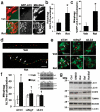
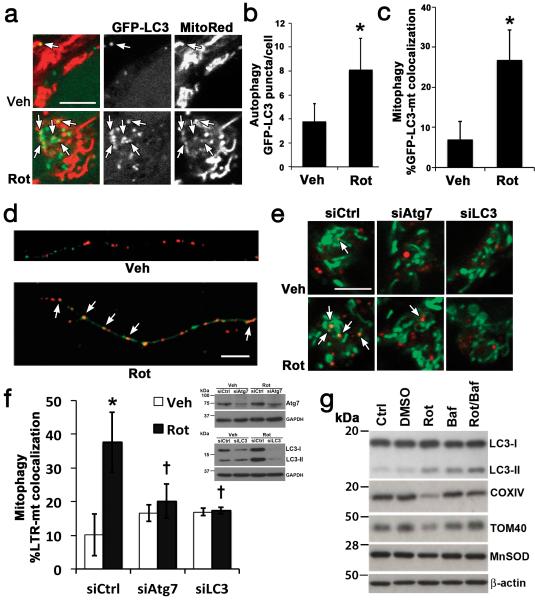
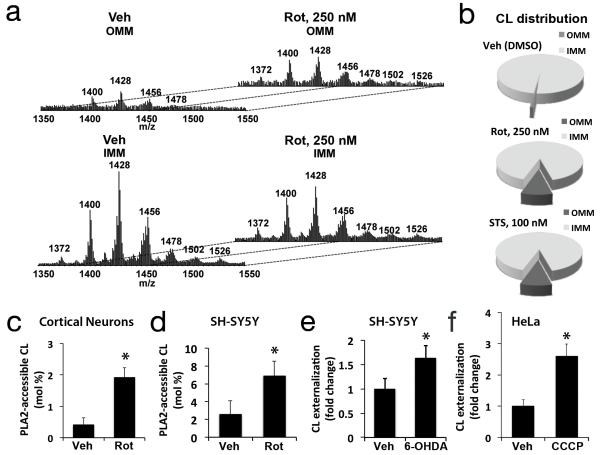
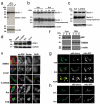
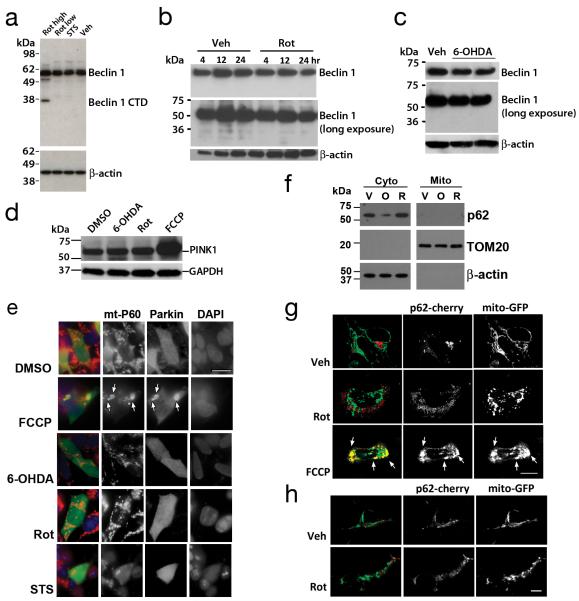
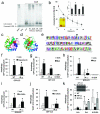
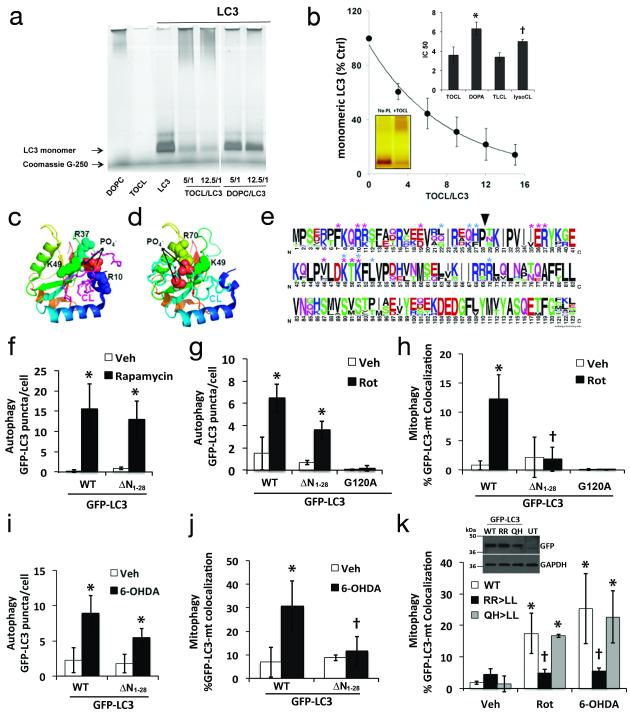
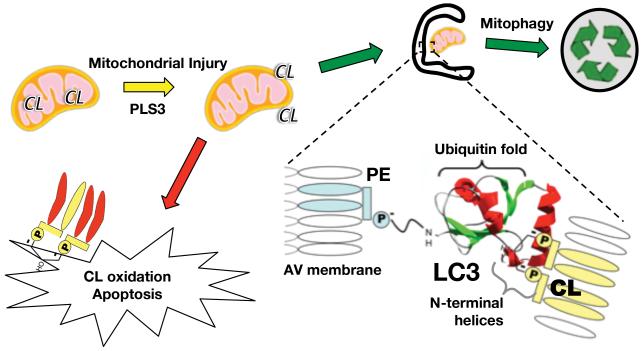
Description:Recognition of injured mitochondria for degradation by macroautophagy is essential for cellular health, but the mechanisms remain poorly understood. Cardiolipin is an inner mitochondrial membrane phospholipid. We found that rotenone, staurosporine, 6-hydroxydopamine and other pro-mitophagy stimuli caused externalization of cardiolipin to the mitochondrial surface in primary cortical neurons and SH-SY5Y cells. RNAi knockdown of cardiolipin synthase or of phospholipid scramblase-3, which transports cardiolipin to the outer mitochondrial membrane, decreased the delivery of mitochondria to autophagosomes. Furthermore, we found that the autophagy protein microtubule-associated-protein-1 light chain 3 (LC3), which mediates both autophagosome formation and cargo recognition, contains cardiolipin-binding sites important for the engulfment of mitochondria by the autophagic system. Mutation of LC3 residues predicted as cardiolipin-interaction sites by computational modelling inhibited its participation in mitophagy. These data indicate that redistribution of cardiolipin serves as an 'eat-me' signal for the elimination of damaged mitochondria from neuronal cells.
-
Subjects:
-
Source:Nat Cell Biol. 15(10):1197-1205.
-
Pubmed ID:24036476
-
Pubmed Central ID:PMC3806088
-
Document Type:
-
Funding:AG026389/AG/NIA NIH HHS/United States ; ES020693/ES/NIEHS NIH HHS/United States ; F32 AG030821/AG/NIA NIH HHS/United States ; F32AG030821/AG/NIA NIH HHS/United States ; HL70755/HL/NHLBI NIH HHS/United States ; NS061817/NS/NINDS NIH HHS/United States ; NS065789/NS/NINDS NIH HHS/United States ; NS076511/NS/NINDS NIH HHS/United States ; OH008282/OH/NIOSH CDC HHS/United States ; P20 GM103554/GM/NIGMS NIH HHS/United States ; P41 GM103712/GM/NIGMS NIH HHS/United States ; P41GM103712/GM/NIGMS NIH HHS/United States ; R01 AG026389/AG/NIA NIH HHS/United States ; R01 ES020693/ES/NIEHS NIH HHS/United States ; R01 HL070755/HL/NHLBI NIH HHS/United States ; R01 HL094488/HL/NHLBI NIH HHS/United States ; R01 NS061817/NS/NINDS NIH HHS/United States ; R01 NS065789/NS/NINDS NIH HHS/United States ; R01 NS076511/NS/NINDS NIH HHS/United States ; R21 ES021068/ES/NIEHS NIH HHS/United States ; R21 HD057587/HD/NICHD NIH HHS/United States ; U19 AI068021/AI/NIAID NIH HHS/United States ; U19AIO68021/PHS HHS/United States
-
Volume:15
-
Issue:10
-
Collection(s):
-
Main Document Checksum:urn:sha256:114a4ec85c3bfc8b1377a567254d04d14bfdd96f499b70303919f715c4a86769
-
Download URL:
-
File Type:
 [PDF
- 1.14 MB
]
[PDF
- 1.14 MB
]
Supporting Files


 Was this page helpful?
 Found an issue?


CDC STACKS serves as an archival repository of CDC-published products including
scientific findings,
journal articles, guidelines, recommendations, or other public health information authored or
co-authored by CDC or funded partners.
As a repository, CDC STACKS retains documents in their original published format to ensure public access to scientific information.
As a repository, CDC STACKS retains documents in their original published format to ensure public access to scientific information.
You May Also Like
COLLECTION
CDC Public Access