



Nipah Virus Detection at Bat Roosts after Spillover Events, Bangladesh, 2012–2019
Supporting Files

-
7-2022
File Language:
English
Details
-
Alternative Title:Emerg Infect Dis
-
Personal Author:McKee, Clifton D. ; Islam, Ausraful ; Rahman, Mohammed Ziaur ; Khan, Salah Uddin ; Rahman, Mahmudur ; Satter, Syed M. ; Islam, Ariful ; Yinda, Claude Kwe ; Epstein, Jonathan H. ; Daszak, Peter ; Munster, Vincent J. ; Hudson, Peter J. ; Plowright, Raina K. ; Luby, Stephen P. ; Gurley, Emily S.
-
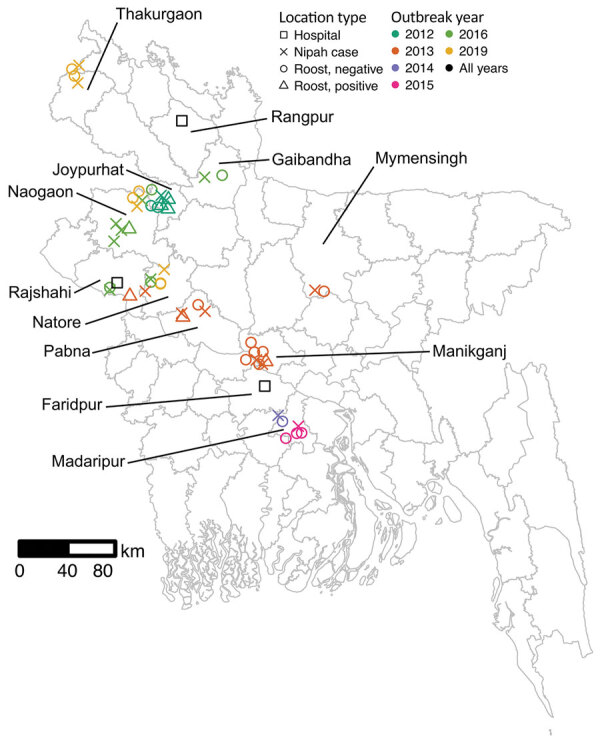
Description:Knowledge of the dynamics and genetic diversity of Nipah virus circulating in bats and at the human-animal interface is limited by current sampling efforts, which produce few detections of viral RNA. We report a series of investigations at Pteropus medius bat roosts identified near the locations of human Nipah cases in Bangladesh during 2012-2019. Pooled bat urine was collected from 23 roosts; 7 roosts (30%) had >1 sample in which Nipah RNA was detected from the first visit. In subsequent visits to these 7 roosts, RNA was detected in bat urine up to 52 days after the presumed exposure of the human case-patient, although the probability of detection declined rapidly with time. These results suggest that rapidly deployed investigations of Nipah virus shedding from bat roosts near human cases could increase the success of viral sequencing compared with background surveillance and could enhance understanding of Nipah virus ecology and evolution.
-
Subjects:
-
Source:Emerg Infect Dis. 2022; 28(7):1384-1392
-
Pubmed ID:35731130
-
Pubmed Central ID:PMC9239894
-
Document Type:
-
Funding:
-
Place as Subject:
-
Volume:28
-
Issue:7
-
Download URL:
-
File Type:
 [PDF - 1.16 MB]
 -
Collection(s):
-
Main Document Checksum:urn:sha256:8f924faf1a7d0094c21b5b5a704f6135e67430236249b569698d3d19d8bc0dbd
Supporting Files


File Language:
English
 Was this page helpful?
 Found an issue?




CDC STACKS serves as an archival repository of CDC-published products including
scientific findings, journal articles, guidelines, recommendations, or other public health information authored or
co-authored by CDC or funded partners.
As a repository, CDC STACKS retains documents in their original published format to ensure public access to scientific information.
As a repository, CDC STACKS retains documents in their original published format to ensure public access to scientific information.
You May Also Like
COLLECTION
Emerging Infectious Diseases