



A population-based case–control study of the association between weather-related extreme heat events and orofacial clefts
Supporting Files

-
October 19 2018
-
Available in CDC Stacks on October 13, 2020, 12:00 AM
File Language:
English
Details
-
Alternative Title:Birth Defects Res
-
Personal Author:
-
Corporate Authors:
-
Description:Background
Limited epidemiologic research exists on the association between weather-related extreme heat events (EHEs) and orofacial clefts (OFCs). We estimated the associations between maternal exposure to EHEs in the summer season and OFCs in offspring and investigated the potential modifying effect of body mass index on these associations.
Methods
We conducted a population-based case-control study among mothers who participated in the National Birth Defects Prevention Study for whom at least 1 day of their first two post-conception months occurred during summer. Cases were live-born infants, stillbirths, and induced terminations with OFCs; controls were live-born infants without major birth defects. We defined EHEs using the 95th and the 90th percentiles of the daily maximum universal apparent temperature distribution. We used unconditional logistic regression with Firth’s penalized likelihood method to estimate adjusted odds ratios and 95% confidence intervals, controlling for maternal sociodemographic and anthropometric variables.
Results
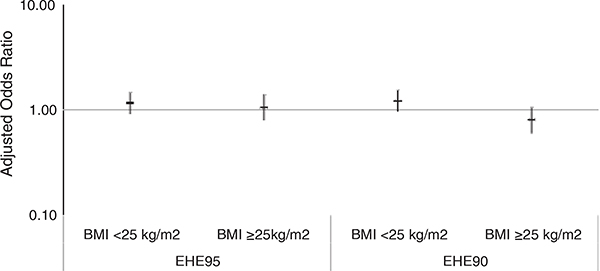
We observed no association between maternal exposure to EHEs and OFCs overall, although prolonged duration of EHEs may increase the risk of OFCs in some study sites located in the Southeast climate region. Analyses by subtypes of OFCs revealed no associations with EHEs. Modifying effect by BMI was not observed.
Conclusions
We did not find a significantly increased risk of OFCs associated with maternal exposure to EHEs during the relevant window of embryogenesis. Future studies should account for maternal indoor and outdoor activities and for characteristics such as hydration and use of air conditioning that could modify the effect of EHEs on pregnant women. -
Subjects:
- Article
- congenital malformations
- cleft lip
- cleft palate
- weather-related extreme heat
- NBDPS
- Adult
- Brain
- Case-Control Studies
- Cleft Lip
- Cleft Palate
- Extreme Heat
- Female
- Humans
- Infant, Newborn
- Logistic Models
- Male
- Maternal Exposure
- Mothers
- Odds Ratio
- Population Surveillance
- Pregnancy
- Pregnancy Trimester, First
- Prenatal Exposure Delayed Effects
- Risk Factors
- Seasons
- Self Report
- Temperature
- Weather
-
Source:Birth Defects Res. 110(19):1468-1477
-
Pubmed ID:30338937
-
Pubmed Central ID:PMC7551893
-
Document Type:
-
Funding:5R21ES021359-02/NH/NIH HHS/United States ; CC999999/ImCDC/Intramural CDC HHS/United States ; U01DD001032/CC/CDC HHS/United States ; U01 DD001223/DD/NCBDD CDC HHS/United States ; U01DD001032/ACL/ACL HHS/United States ; R21 ES021359/ES/NIEHS NIH HHS/United States ; U01 DD001035/DD/NCBDD CDC HHS/United States
-
Volume:110
-
Issue:19
-
Download URL:
-
File Type:
 [PDF - 527.33 KB]
 -
Collection(s):
-
Main Document Checksum:urn:sha256:451c05d74fa75a2647ea03e14433c5cccf9326325556f524bbf78e0212405eee
Supporting Files


File Language:
English
 Was this page helpful?
 Found an issue?

CDC STACKS serves as an archival repository of CDC-published products including
scientific findings, journal articles, guidelines, recommendations, or other public health information authored or
co-authored by CDC or funded partners.
As a repository, CDC STACKS retains documents in their original published format to ensure public access to scientific information.
As a repository, CDC STACKS retains documents in their original published format to ensure public access to scientific information.
You May Also Like
COLLECTION
CDC Public Access