



Association of Low-Frequency Genetic Variants in Regulatory Regions with Non-Syndromic Orofacial Clefts
Supporting Files

-
3 2019 ; 3-2019
-
Available in CDC Stacks on March 01, 2020, 12:00 AM
File Language:
English
Details
-
Alternative Title:Am J Med Genet A
-
Personal Author:Shaffer, John R. ; LeClair, Jessica ; Carlson, Jenna C. ; Feingold, Eleanor ; Buxó, Carmen J. ; Christensen, Kaare ; Deleyiannis, Frederic W.B. ; Field, L. Leigh ; Hecht, Jacqueline T. ; Moreno, Lina ; Orioli, Ieda M. ; Padilla, Carmencita ; Vieira, Alexandre R. ; Wehby, George L. ; Murray, Jeffrey C. ; Weinberg, Seth M. ; Marazita, Mary L. ; Leslie, Elizabeth J.
-
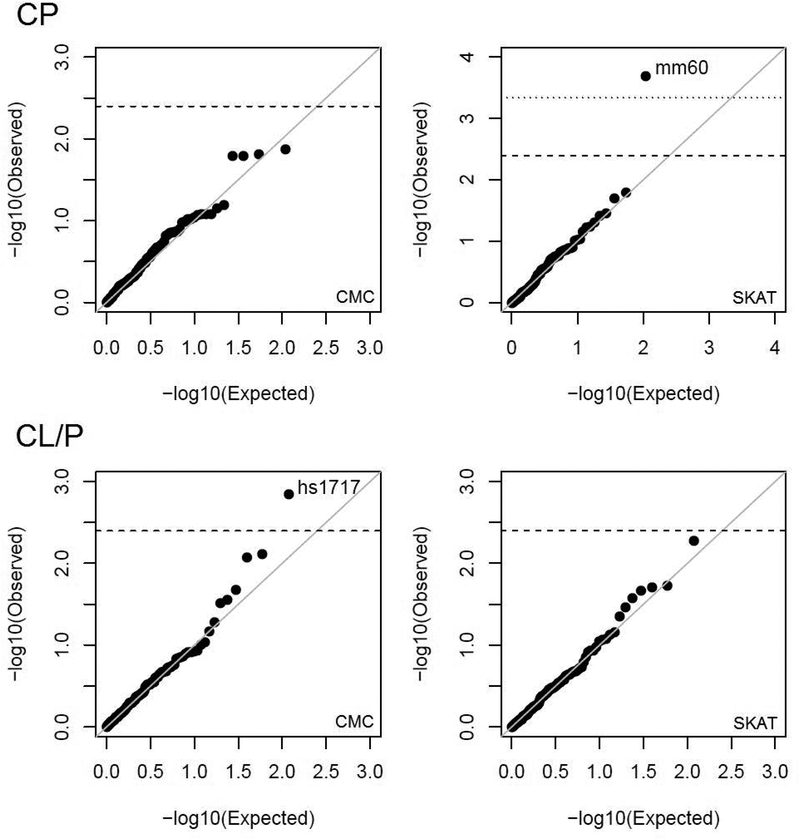
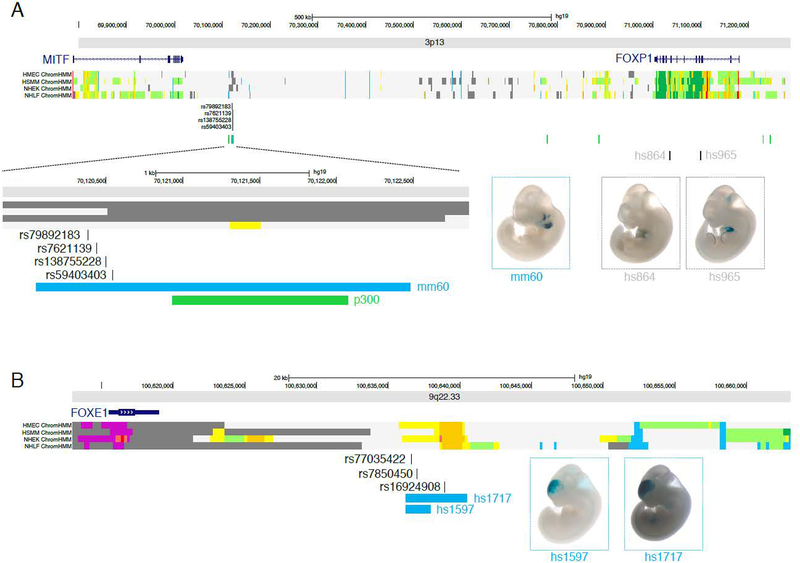
Description:Genome-wide scans have shown that common risk alleles for orofacial clefts (OFC) tend to be located in noncoding regulatory elements and cumulatively explain only part of the heritability of OFCs. Low-frequency variants may account for some of the "missing" heritability. Therefore, we scanned low-frequency variants located within putative craniofacial enhancers to identify novel OFC risk variants and implicate new regulatory elements in OFC pathogenesis. Analyses were performed in a multiethnic sample of 1,995 cases of cleft lip with or without cleft palate (CL/P), 221 cases with cleft palate (CP) only, and 1,576 unaffected controls. One hundred and nineteen putative craniofacial enhancers identified from ChIP-Seq studies in craniofacial tissues or cell lines contained multiple low-frequency (0.01-1%) variants, which we genotyped in participants using a custom Illumina panel. Two complementary statistical approaches, sequence kernel association test and combined multivariate and collapsing, were used to test association of the aggregated low-frequency variants across each enhancer region with CL/P and CP. We discovered a significant association between CP and a branchial arch enhancer near FOXP1 (mm60; p-value = .0002). Additionally, we observed a suggestive association between CL/P and a forebrain enhancer near FOXE1 (hs1717; p-value = .001). These findings suggest that low-frequency variants in craniofacial enhancer regions contribute to the complex etiology of nonsyndromic OFCs.
-
Subjects:
-
Keywords:
-
Source:Am J Med Genet A. 179(3):467-474
-
Pubmed ID:30582786
-
Pubmed Central ID:PMC6374160
-
Document Type:
-
Funding:R01 DE014667/DE/NIDCR NIH HHSUnited States/ ; R25-MD007607/GF/NIH HHSUnited States/ ; R25 MD007607/MD/NIMHD NIH HHSUnited States/ ; R01-DE011931/GF/NIH HHSUnited States/ ; U54 MD007587/MD/NIMHD NIH HHSUnited States/ ; S21 MD001830/MD/NIMHD NIH HHSUnited States/ ; R01-DE016148/GF/NIH HHSUnited States/ ; R01-DE011948/GF/NIH HHSUnited States/ ; R00 DE025060/DE/NIDCR NIH HHSUnited States/ ; R21 DE016930/DE/NIDCR NIH HHSUnited States/ ; K99 DE024571/DE/NIDCR NIH HHSUnited States/ ; R37 DE008559/DE/NIDCR NIH HHSUnited States/ ; R01 DE011931/DE/NIDCR NIH HHSUnited States/ ; X01-HG007485/GF/NIH HHSUnited States/ ; HHSN268201200008C/HL/NHLBI NIH HHSUnited States/ ; R01-DE014667/GF/NIH HHSUnited States/ ; R00 DE024571/DE/NIDCR NIH HHSUnited States/ ; R01 DE016148/DE/NIDCR NIH HHSUnited States/ ; R00-DE025060/GF/NIH HHSUnited States/ ; R01 DE011948/DE/NIDCR NIH HHSUnited States/ ; U01 DE024425/DE/NIDCR NIH HHSUnited States/ ; R01-DE009886/GF/NIH HHSUnited States/ ; R01-DE012472/GF/NIH HHSUnited States/ ; U01-DD000295/GF/NIH HHSUnited States/ ; U01-DE024425/GF/NIH HHSUnited States/ ; HHSN268201200008I/HL/NHLBI NIH HHSUnited States/ ; R01 DE009886/DE/NIDCR NIH HHSUnited States/ ; S21-MD001830/GF/NIH HHSUnited States/ ; U54-MD007587/GF/NIH HHSUnited States/ ; R01 DD000295/DD/NCBDD CDC HHSUnited States/
-
Volume:179
-
Issue:3
-
Download URL:
-
File Type:
 [PDF - 647.32 KB]
 -
Collection(s):
-
Main Document Checksum:urn:sha-512:bf80aa2e950e3b3596bf8fe88324c19331bb9d378bdf507413a00c43c341e86183ebffc7a2f77e4badc3976e681c1bc484b0362429d52c1f349d84faf993f642
Supporting Files


File Language:
English
 Was this page helpful?
 Found an issue?


CDC STACKS serves as an archival repository of CDC-published products including
scientific findings, journal articles, guidelines, recommendations, or other public health information authored or
co-authored by CDC or funded partners.
As a repository, CDC STACKS retains documents in their original published format to ensure public access to scientific information.
As a repository, CDC STACKS retains documents in their original published format to ensure public access to scientific information.
You May Also Like
COLLECTION
CDC Public Access