



Rare variants found in clinical gene panels illuminate the genetic and allelic architecture of orofacial clefting
Supporting Files

-
10 2023 ; 10-2023
-
Available in CDC Stacks on October 01, 2024, 12:00 AM
File Language:
English
Details
-
Alternative Title:Genet Med
-
Personal Author:Perez, Kimberly K. Diaz ; Curtis, Sarah W. ; Sanchis-Juan, Alba ; Zhao, Xuefang ; Head, Taylor ; Ho, Samantha ; Carter, Bridget ; McHenry, Toby ; Bishop, Madison R. ; Valencia-Ramirez, Luz Consuelo ; Restrepo, Claudia ; Hecht, Jacqueline T. ; Uribe, Lina Moreno ; Wehby, George ; Weinberg, Seth M. ; Beaty, Terri H. ; Murray, Jeffrey C. ; Feingold, Eleanor ; Marazita, Mary L. ; Cutler, David J. ; Epstein, Michael P. ; Brand, Harrison ; Leslie, Elizabeth J.
-
Description:Purpose:
Orofacial clefts (OFCs) are common birth defects including cleft lip (CL), cleft lip and palate (CLP), and cleft palate (CP). OFCs have heterogeneous etiologies, complicating clinical diagnostics as it is not always apparent if the cause is Mendelian, environmental, or multifactorial. Sequencing is not currently performed for isolated or sporadic OFCs, so we estimated the diagnostic yield for 418 genes in 841 cases and 294 controls.
Methods:
We evaluated 418 genes using genome sequencing and curated variants to assess their pathogenicity using American College of Medical Genetics criteria.
Results:
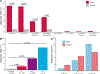
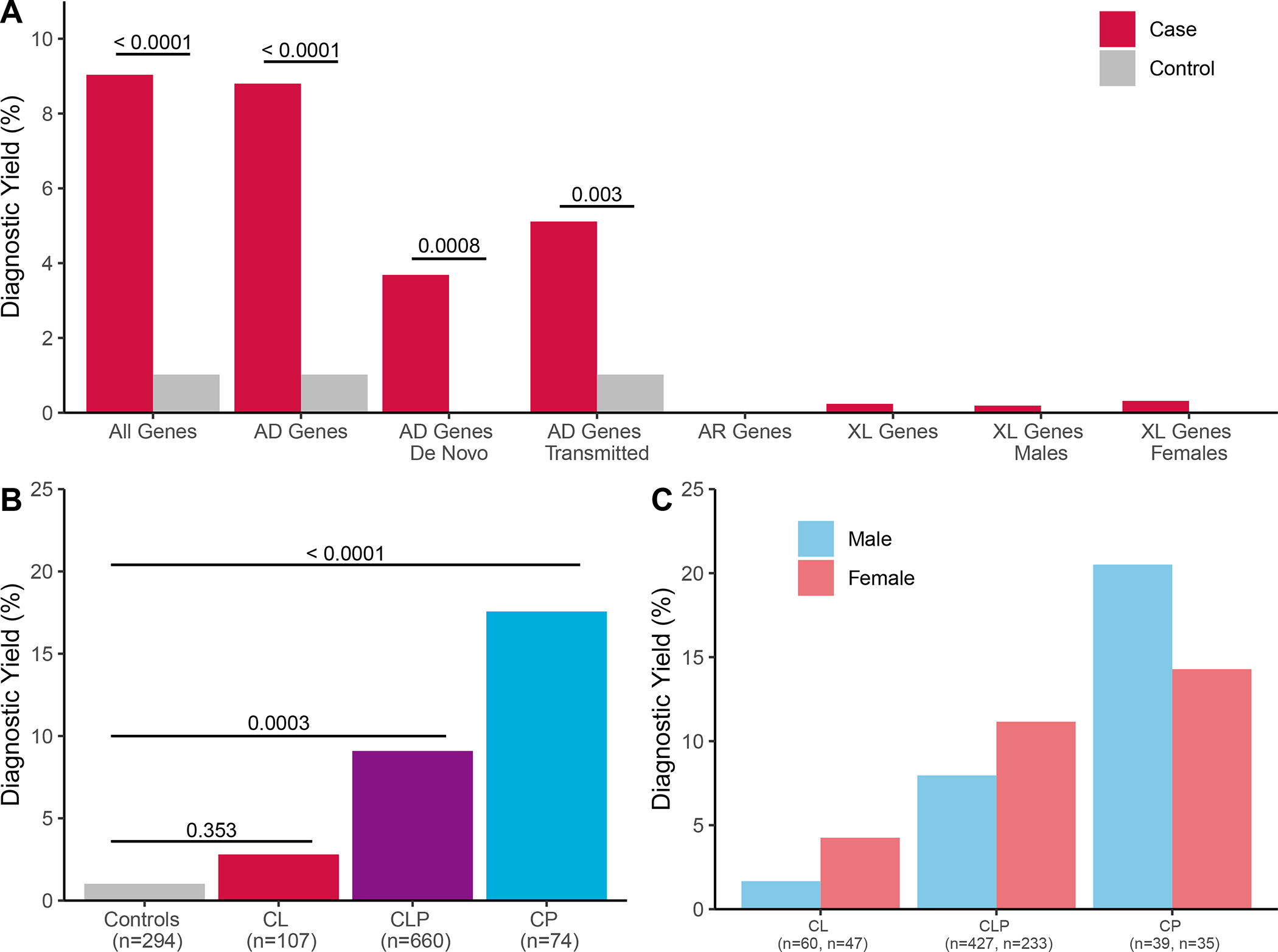
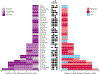
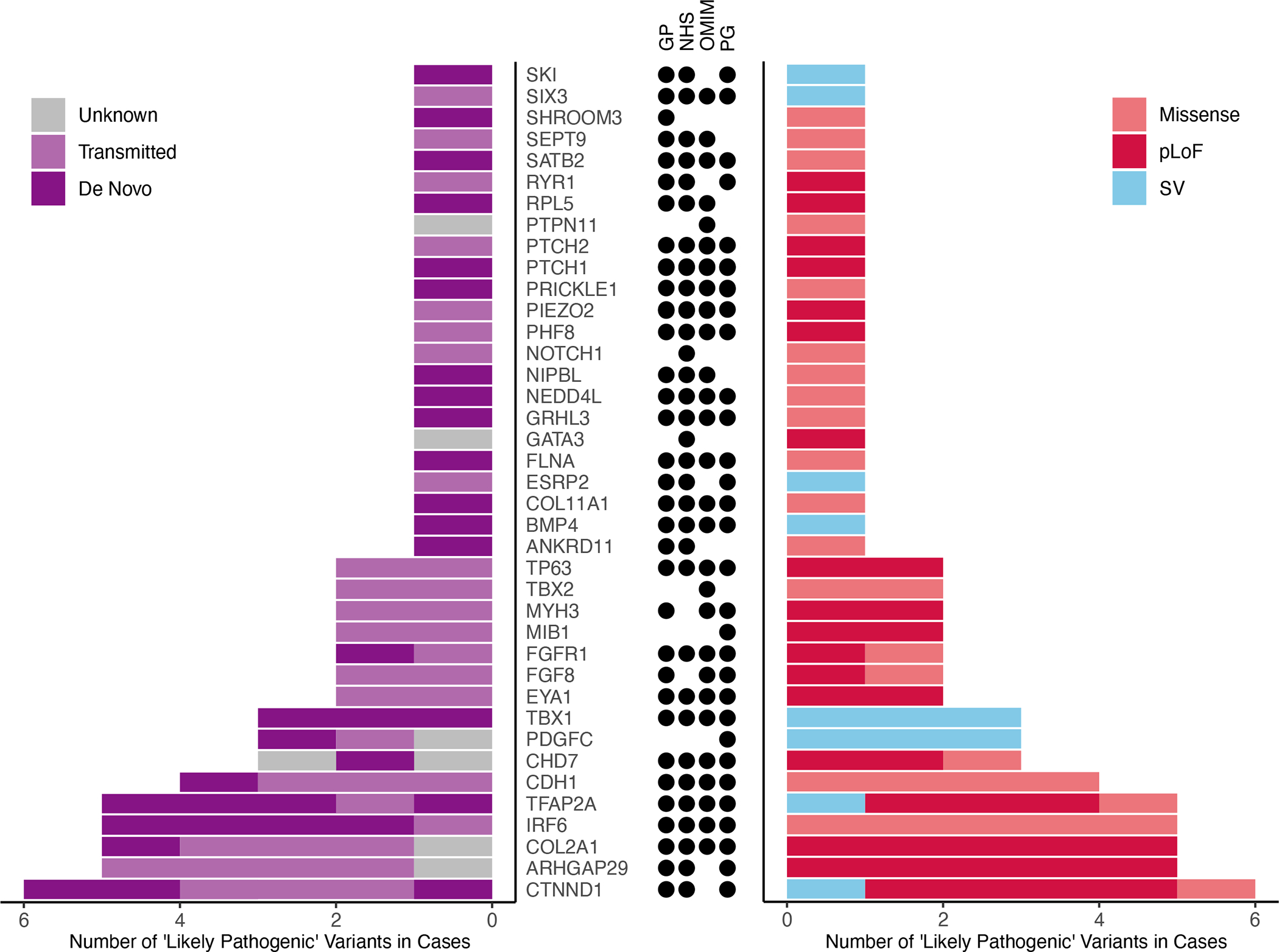
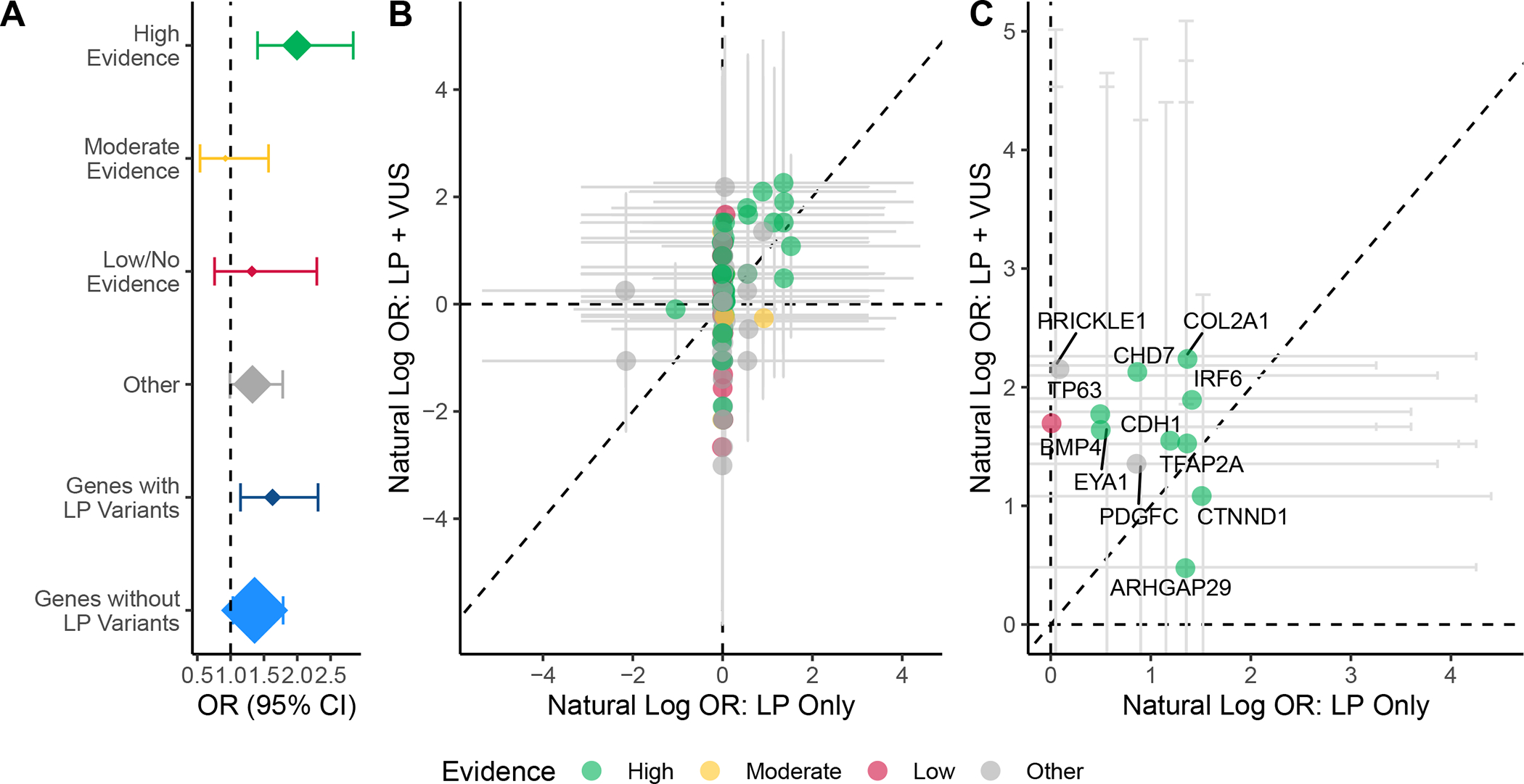
9.04% of cases and 1.02% of controls had ‘likely pathogenic’ (LP) variants (p<0.0001), which was almost exclusively driven by heterozygous variants in autosomal genes. CP (17.6%) and CLP (9.09%) cases had the highest yield while CL cases had a 2.80% yield. Out of 39 genes with LP variants, nine genes, including CTNND1 and IRF6, accounted for more than half of the yield (4.64% of cases). Most variants (61.8%) were ‘variants of uncertain significance’ (VUSs), occurring more frequently in cases (p=0.004), but no individual gene showed a significant excess of VUSs.
Conclusion:
These results underscore the etiological heterogeneity of OFCs and suggest sequencing could reduce the diagnostic gap in OFCs. -
Subjects:
-
Keywords:
-
Source:Genet Med. 25(10):100918
-
Pubmed ID:37330696
-
Pubmed Central ID:PMC10592535
-
Document Type:
-
Funding:R01 DE011931/DE/NIDCR NIH HHSUnited States/ ; U2C HL138346/HL/NHLBI NIH HHSUnited States/ ; R01 DE016148/DE/NIDCR NIH HHSUnited States/ ; R01 DE031261/DE/NIDCR NIH HHSUnited States/ ; U54 HG003079/HG/NHGRI NIH HHSUnited States/ ; U24 HD090743/HD/NICHD NIH HHSUnited States/ ; R01 DE028342/DE/NIDCR NIH HHSUnited States/ ; R01 DD000295/DD/NCBDD CDC HHSUnited States/ ; R03 DE027103/DE/NIDCR NIH HHSUnited States/ ; R03 DE027121/DE/NIDCR NIH HHSUnited States/ ; HHMI/Howard Hughes Medical InstituteUnited States/ ; R00 DE026824/DE/NIDCR NIH HHSUnited States/ ; R01 DE030342/DE/NIDCR NIH HHSUnited States/ ; R03 DE026469/DE/NIDCR NIH HHSUnited States/ ; R01 DE027983/DE/NIDCR NIH HHSUnited States/ ; R00 DE025060/DE/NIDCR NIH HHSUnited States/ ; T32 GM008490/GM/NIGMS NIH HHSUnited States/
-
Volume:25
-
Issue:10
-
Download URL:
-
File Type:
 [PDF - 723.91 KB]
 -
Collection(s):
-
Main Document Checksum:urn:sha-512:f4f6c39c7eeef5efec7d3cd6fd90b07b0c256ff23fe01e1f9a143ba84071141525048c6158e6a42d74a00b8071cccef24dc440086c570e30827f3a07738b02f1
Supporting Files


File Language:
English
 Was this page helpful?
 Found an issue?

CDC STACKS serves as an archival repository of CDC-published products including
scientific findings, journal articles, guidelines, recommendations, or other public health information authored or
co-authored by CDC or funded partners.
As a repository, CDC STACKS retains documents in their original published format to ensure public access to scientific information.
As a repository, CDC STACKS retains documents in their original published format to ensure public access to scientific information.
You May Also Like
COLLECTION
CDC Public Access