


Perceived discrimination in bateyes of the Dominican Republic: results from the Everyday Discrimination Scale and implications for public health programs
Supporting Files

-
November 12 2019
-
File Language:
English
Details
-
Alternative Title:BMC Public Health
-
Personal Author:
-
Description:Background
Discrimination is a major driver of health disparities among minority groups and can impede the reach of public health programs. In the Dominican Republic, residents of bateyes, or agricultural ‘company towns,’ often face barriers to health care. This study examined the extent of perceived discrimination among batey populations and places the findings within the context of disease elimination efforts.
Methods
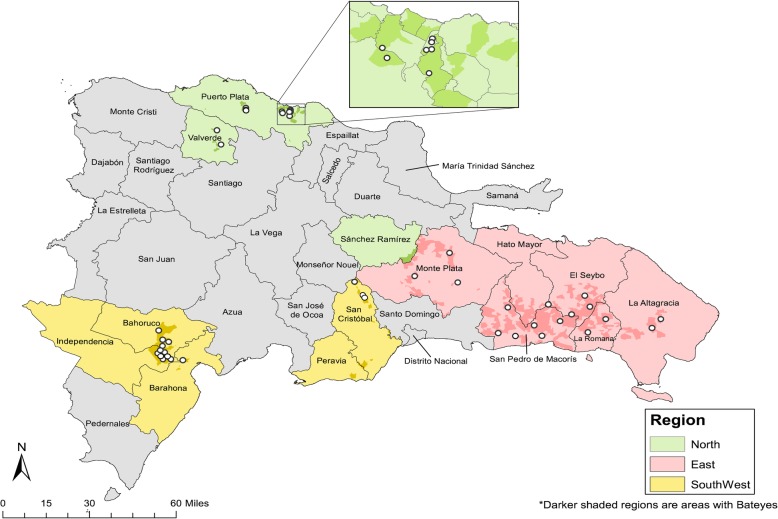
In March—April 2016, a stratified, multi-stage cluster survey that included the 9-item Everyday Discrimination Scale (EDS) was conducted among residents (n = 768) of bateyes across the Dominican Republic. Exploratory factor analysis, differential item functioning, and linear and logistic regression were used to assess associations between EDS scores, ethnic group status, reasons for discrimination, and healthcare-seeking behavior.
Results
Three ethnic groups were identified in the population: Haitian-born persons (42.5%), Dominican-born persons with Haitian descent (25.5%), and Dominican-born persons without Haitian descent (32.0%). Mean EDS scores (range 0–45) were highest among persons born in Haiti (18.2, 95% confidence interval [CI] = 16.4–20.1), followed by persons with Haitian descent (16.5, 95% CI = 14.9–18.0), and those without Haitian descent (13.3, 95% CI = 12.1–14.5). Higher EDS scores were significantly associated with Haitian birth (β = 6.8, 95% CI = 4.2—9.4; p < 0.001) and Haitian descent (β = 6.1, 95% CI = 3.2—9.0; p < 0.001). Most respondents (71.5%) had scores high enough to elicit reasons for their discrimination. Regardless of ethnic group, poverty was a common reason for discrimination, but Haitian-born and Haitian-descended people also attributed discrimination to their origin, documentation status, or skin color. EDS scores were not significantly associated with differences in reported care-seeking for recent fever (β = 1.7, 95% CI = − 1.4—4.9; p = 0.278).
Conclusion
Perceived discrimination is common among batey residents of all backgrounds but highest among Haitian-born people. Discrimination did not appear to be a primary barrier to care-seeking, suggesting other explanations for reduced care-seeking among Haitian populations. Public health community engagement strategies should avoid exacerbating stigma, build active participation in programs, and work towards community ownership of disease control and elimination goals.
-
Subjects:
-
Source:BMC Public Health. 19
-
Pubmed ID:31718594
-
Pubmed Central ID:PMC6852895
-
Document Type:
-
Funding:
-
Place as Subject:
-
Volume:19
-
Collection(s):
-
Main Document Checksum:urn:sha256:7007124f6935cb43e536da1c937e1c6279756ca422d14a8a7d825da63969751c
-
Download URL:
-
File Type:
 [PDF
- 1.10 MB
]
[PDF
- 1.10 MB
]
Supporting Files


File Language:
English
ON THIS PAGE


CDC STACKS serves as an archival repository of CDC-published products including
scientific findings,
journal articles, guidelines, recommendations, or other public health information authored or
co-authored by CDC or funded partners.
As a repository, CDC STACKS retains documents in their original published format to ensure public access to scientific information.
As a repository, CDC STACKS retains documents in their original published format to ensure public access to scientific information.
You May Also Like
COLLECTION
CDC Public Access