



Migration and risk of HIV acquisition in Rakai, Uganda: a population-based cohort study
Supporting Files

-
4 2018
-
Available in CDC Stacks on April 01, 2019, 12:00 AM
File Language:
English
Details
-
Journal Article:Lancet HIV
-
Personal Author:Olawore, Oluwasolape ; Tobian, Aaron A.R. ; Kagaayi, Joseph ; Bazaale, Jeremiah M. ; Nantume, Betty ; Kigozi, Grace ; Nankinga, Justine ; Nalugoda, Fred ; Nakigozi, Gertrude ; Kigozi, Godfrey ; Gray, Ronald H. ; Wawer, Maria J. ; Ssekubugu, Robert ; Santelli, John S. ; Reynolds, Steven J. ; Chang, Larry W. ; Serwadda, David ; Grabowski, Mary K.
-
Description:Background:
In sub-Saharan Africa, migrants typically have higher HIV prevalence than non-migrants; however, whether HIV acquisition precedes or follows migration is generally unknown. Here, we assessed risk of HIV following migration.
Methodology:
We assessed the association between migration and HIV acquisition using prospective data from HIV-negative participants aged 15–49 enrolled in an open population-based cohort in Rakai, Uganda between 1999 and 2015. Individuals were classified as recent in-migrants if they moved into study communities within the prior two years, non-recent migrants (>2 years in community), or permanent residents with no migration history. Poisson regression was used to estimate incidence rate ratios (IRR) of HIV associated with residence status with adjustment for demographics, sexual behaviors, and time.
Results:
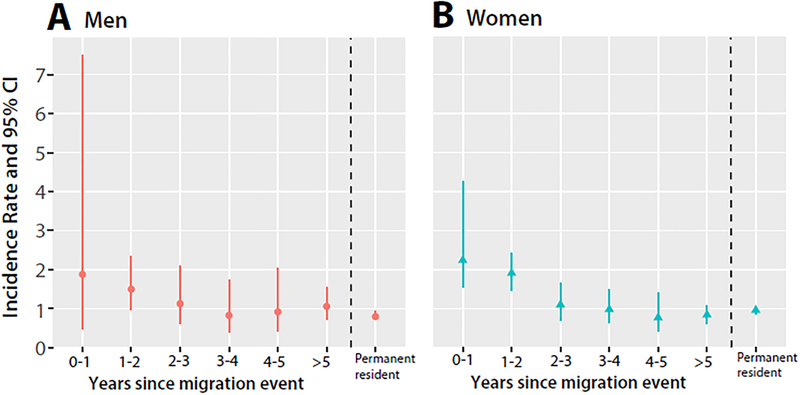
15,187 HIV-negative individuals were followed for 89,292 person-years of whom 29% (n=4451) were ever in-migrants. There were 841 incident HIV events, including 243 (29%) among inmigrants. Relative to permanent residents, HIV incidence was significantly increased among recent inmigrants among women (1.92/100 pys in recent migrants vs. 0.93/100 pys in permanent residents; adjIRR=1.74, 95%CI: 1.12–2.71) and men (1.52/100 pys vs 0.84/100 pys; adjIRR=1.74, 95%CI: 1.12–2.71), but was not among non-recent in-migrants. HIV incidence declined over time with scale-up of combination HIV prevention among permanent residents and non-recent in-migrants, but was unchanged among recent in-migrants.
Conclusion:
The first two years after migration are associated with increased risk of HIV acquisition. Findings highlight the need for prevention programs focused on migrants to reduce HIV incidence in sub-Saharan Africa. -
Keywords:
-
Source:Lancet HIV. 5(4):e181-e189
-
DOI:
-
Pubmed ID:29490875
-
Pubmed Central ID:PMC6195205
-
Document Type:
-
Funding:U01 AI051171/AI/NIAID NIH HHSUnited States/ ; U01 AI100031/AI/NIAID NIH HHSUnited States/ ; U01 AI075115/AI/NIAID NIH HHSUnited States/ ; P30 AI094189/AI/NIAID NIH HHSUnited States/ ; K01 AI125086/AI/NIAID NIH HHSUnited States/ ; R01 HD070769/HD/NICHD NIH HHSUnited States/ ; NU2GGH000817/CC/CDC HHSUnited States/ ; R01 AI102939/AI/NIAID NIH HHSUnited States/ ; R01 HD091003/HD/NICHD NIH HHSUnited States/ ; R01 HD072695/HD/NICHD NIH HHSUnited States/ ; R01 HD050180/HD/NICHD NIH HHSUnited States/ ; R01 MH107275/MH/NIMH NIH HHSUnited States/ ; R01 AI128779/AI/NIAID NIH HHSUnited States/ ; R01 AI110324/AI/NIAID NIH HHSUnited States/
-
Genre:
-
Volume:5
-
Issue:4
-
Download URL:
-
File Type:
 [PDF - 666.20 KB]
 -
Collection(s):
-
Main Document Checksum:urn:sha-512:d485d25fb7735297becf7d263bce8eff4f826cdf26e3b0ffb25a69ba0d15d05075389e53ef0759e0bb81a31bb4383c95317e24c275d5874a74ba9a6b1583e00c
Supporting Files


File Language:
English
 Was this page helpful?
 Found an issue?



CDC STACKS serves as an archival repository of CDC-published products including
scientific findings, journal articles, guidelines, recommendations, or other public health information authored or
co-authored by CDC or funded partners.
As a repository, CDC STACKS retains documents in their original published format to ensure public access to scientific information.
As a repository, CDC STACKS retains documents in their original published format to ensure public access to scientific information.
You May Also Like
COLLECTION
CDC Public Access