


Human-to-Human Transmission of Influenza A(H3N2) Virus with Reduced Susceptibility to Baloxavir, Japan, February 2019
Supporting Files
Public Domain

-
November 17 2019
-
File Language:
English
Details
-
Alternative Title:Emerg Infect Dis
-
Personal Author:Takashita, Emi ; Ichikawa, Masataka ; Morita, Hiroko ; Ogawa, Rie ; Fujisaki, Seiichiro ; Shirakura, Masayuki ; Miura, Hideka ; Nakamura, Kazuya ; Kishida, Noriko ; Kuwahara, Tomoko ; Sugawara, Hiromi ; Sato, Aya ; Akimoto, Miki ; Mitamura, Keiko ; Abe, Takashi ; Yamazaki, Masahiko ; Watanabe, Shinji ; Hasegawa, Hideki ; Odagiri, Takato
-
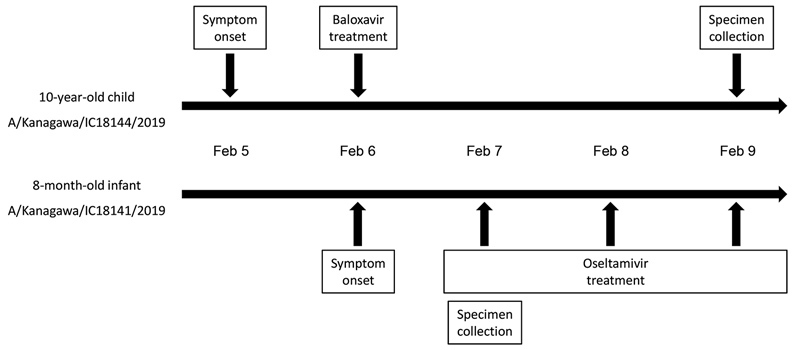
Description:In 2019, influenza A(H3N2) viruses carrying an I38T substitution in the polymerase acidic gene, which confers reduced susceptibility to baloxavir, were detected in Japan in an infant without baloxavir exposure and a baloxavir-treated sibling. These viruses' whole-genome sequences were identical, indicating human-to-human transmission. Influenza virus isolates should be monitored for baloxavir susceptibility.
-
Subjects:
-
Source:Emerg Infect Dis. 25(11):2108-2111
-
Pubmed ID:31436527
-
Pubmed Central ID:PMC6810216
-
Document Type:
-
Place as Subject:
-
Location:
-
Volume:25
-
Issue:11
-
Collection(s):
-
Main Document Checksum:urn:sha256:1ff228287a2d097f9a6f5d1c7bdf3603cdc7c169ec1bd986f4e7aaa3be649fff
-
Download URL:
-
File Type:
 [PDF
- 1000.39 KB
]
[PDF
- 1000.39 KB
]
Supporting Files


File Language:
English
ON THIS PAGE

CDC STACKS serves as an archival repository of CDC-published products including
scientific findings,
journal articles, guidelines, recommendations, or other public health information authored or
co-authored by CDC or funded partners.
As a repository, CDC STACKS retains documents in their original published format to ensure public access to scientific information.
As a repository, CDC STACKS retains documents in their original published format to ensure public access to scientific information.
You May Also Like
COLLECTION
Emerging Infectious Diseases