



Microglia from offspring of dams with allergic asthma exhibit epigenomic alterations in genes dysregulated in autism
Supporting Files

-
November 14 2017
-
Available in CDC Stacks on 2019-03-01T00:00:00Z
File Language:
English
Details
-
Alternative Title:Glia
-
Personal Author:
-
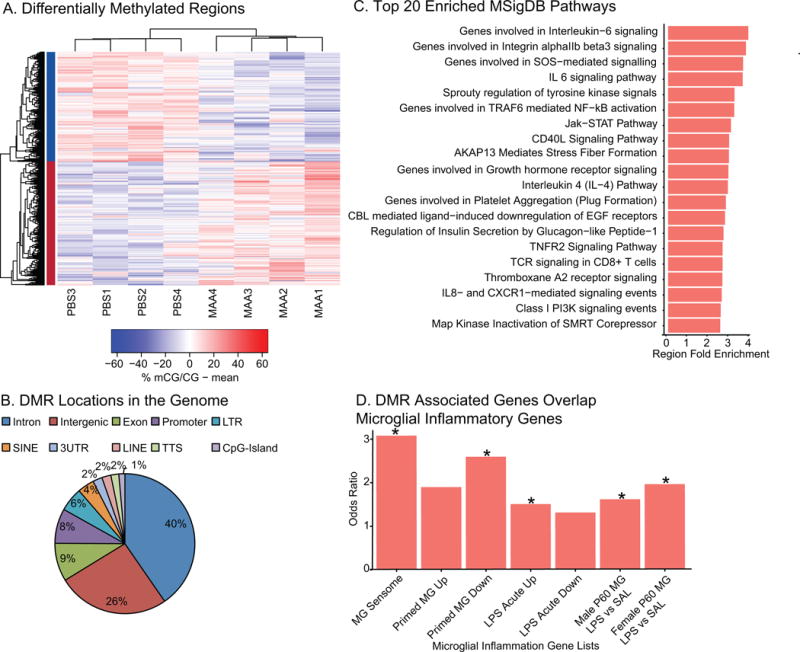
Description:Dysregulation in immune responses during pregnancy increases the risk of a having a child with an autism spectrum disorder (ASD). Asthma is one of the most common chronic diseases among pregnant women, and symptoms often worsen during pregnancy. We recently developed a mouse model of maternal allergic asthma (MAA) that induces changes in sociability, repetitive, and perseverative behaviors in the offspring. Since epigenetic changes help a static genome adapt to the maternal environment, activation of the immune system may epigenetically alter fetal microglia, the brain's resident immune cells. We therefore tested the hypothesis that epigenomic alterations to microglia may be involved in behavioral abnormalities observed in MAA offspring. We used the genome-wide approaches of whole genome bisulfite sequencing to examine DNA methylation and RNA sequencing to examine gene expression in microglia from juvenile MAA offspring. Differentially methylated regions were enriched for immune signaling pathways and important microglial developmental transcription factor binding motifs. Differential expression analysis identified genes involved in controlling microglial sensitivity to the environment and shaping neuronal connections in the developing brain. Differentially expressed genes significantly overlapped genes with altered expression in human ASD cortex, supporting a role for microglia in the pathogenesis of ASD.
-
Subjects:
- Article
- Maternal Immune Activation
- Maternal Allergic Asthma
- Autism Spectrum Disorders
- DNA methylation
- Microglia
- Animals
- Asthma
- Autistic Disorder
- DNA Methylation
- Disease Models, Animal
- Epigenesis, Genetic
- Female
- Gene Expression
- Hypersensitivity
- Mice, Inbred C57BL
- Pregnancy
- Prenatal Exposure Delayed Effects
- Random Allocation
- Sequence Analysis, RNA
- Transcriptome
- Whole Genome Sequencing
-
Source:Glia. 66(3):505-521
-
Pubmed ID:29134693
-
Pubmed Central ID:PMC5767155
-
Document Type:
-
Funding:P30 CA093373/NCI NIH HHS/National Cancer Institute/United States ; T32 MH073124/NIMH NIH HHS/National Institute of Mental Health/United States ; S10 RR026825/NCRR NIH HHS/National Center for Research Resources/United States ; U54 HD079125/NICHD NIH HHS/National Institute of Child Health & Human Development/United States ; R21 HD086669/NICHD NIH HHS/National Institute of Child Health & Human Development/United States ; R01 HD041462/NICHD NIH HHS/National Institute of Child Health & Human Development/United States ; R21 ES025560/NIEHS NIH HHS/National Institute of Environmental Health Sciences/United States ; R21 MH116383/NIMH NIH HHS/National Institute of Mental Health/United States ; S10 OD018174/ODCDC CDC HHS/Office of the Director/United States ; R01 NS081913/NINDS NIH HHS/National Institute of Neurological Disorders and Stroke/United States ; C06 RR012088/NCRR NIH HHS/National Center for Research Resources/United States
-
Volume:66
-
Issue:3
-
Download URL:
-
File Type:
 [PDF - 984.61 KB]
 -
Collection(s):
-
Main Document Checksum:urn:sha256:a3073684d5ad586ab27b3dded6faa06d9a67f690b3999e11e35a39dbad953cc2
Supporting Files


File Language:
English
 Was this page helpful?
 Found an issue?



CDC STACKS serves as an archival repository of CDC-published products including
scientific findings, journal articles, guidelines, recommendations, or other public health information authored or
co-authored by CDC or funded partners.
As a repository, CDC STACKS retains documents in their original published format to ensure public access to scientific information.
As a repository, CDC STACKS retains documents in their original published format to ensure public access to scientific information.
You May Also Like
COLLECTION
CDC Public Access