


Germline polymorphisms in myeloid-associated genes are not associated with survival in glioma patients
Supporting Files

-
Sep 30 2017
-
File Language:
English
Details
-
Alternative Title:J Neurooncol
-
Personal Author:Jacobs, Daniel I. ; Liu, Yanhong ; Gabrusiewicz, Konrad ; Tsavachidis, Spiridon ; Armstrong, Georgina N. ; Zhou, Renke ; Wei, Jun ; Ivan, Cristina ; Calin, George ; Molinaro, Annette M. ; Rice, Terri ; Bracci, Paige M. ; Hansen, Helen M. ; Wiencke, John K. ; Wrensch, Margaret R. ; Heimberger, Amy B. ; Bondy, Melissa L.
-
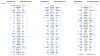
Description:Immune cells of myeloid origin, including microglia, macrophages, and myeloid-derived suppressor cells adopt immunosuppressive phenotypes that support gliomagenesis. Here, we tested an a priori hypothesis that single nucleotide polymorphisms (SNPs) in genes related to glioma-associated myeloid cell regulation and function are also associated with patient survival after glioma diagnosis. Subjects for this study were 992 glioma patients treated at The University of Texas MD Anderson Cancer Center in Houston, Texas between 1992 and 2008. Haplotype-tagging SNPs in 91 myeloid-associated genes were analyzed for association with survival by Cox regression. Individual SNP- and gene-based tests were performed separately in glioblastoma (WHO grade IV, n = 511) and lower-grade glioma (WHO grade II-III, n = 481) groups. After adjustment for multiple testing, no myeloid-associated gene variants were significantly associated with survival in glioblastoma. Two SNPs, rs147960238 in CD163 (p = 2.2 × 10|) and rs17138945 in MET (p = 5.6 × 10|) were significantly associated with survival of patients with lower-grade glioma. However, these associations were not confirmed in an independent analysis of 563 lower-grade glioma cases from the University of California at San Francisco Adult Glioma Study (p = 0.65 and p = 0.41, respectively). The results of this study do not support a role for inherited polymorphisms in myeloid-associated genes in affecting survival of patients diagnosed with glioblastoma or lower-grade glioma.
-
Subjects:
-
Source:J Neurooncol. 136(1):33-39
-
Pubmed ID:28965162
-
Pubmed Central ID:PMC5756111
-
Document Type:
-
Funding:R01 CA139020/CA/NCI NIH HHS/United States ; R01 CA120813/CA/NCI NIH HHS/United States ; P30 CA016672/CA/NCI NIH HHS/United States ; HHSN261201000140C/CA/NCI NIH HHS/United States ; R01CA139020/National Institutes of Health/ ; HHSN261201000035C/CA/NCI NIH HHS/United States ; K07 CA181480/CA/NCI NIH HHS/United States ; UL1 RR024131/RR/NCRR NIH HHS/United States ; R01 CA119215/National Institutes of Health/ ; R01 CA070917/National Institutes of Health/ ; RP160097/CPRIT Post-Graduate Training Program in Integrative Cancer Epidemiology/ ; R01 CA139020/National Institutes of Health/ ; P50 CA127001/National Institutes of Health/ ; P50 CA097257/CA/NCI NIH HHS/United States ; R01 CA070917/CA/NCI NIH HHS/United States ; R01CA52689/National Institutes of Health/ ; HHSN261201000035I/CA/NCI NIH HHS/United States ; R01 CA207360/CA/NCI NIH HHS/United States ; R01 CA120813/National Institutes of Health/ ; HHSN261201000034C/CA/NCI NIH HHS/United States ; R01 CA119215/CA/NCI NIH HHS/United States ; U58 DP003862/DP/NCCDPHP CDC HHS/United States ; P50 CA127001/CA/NCI NIH HHS/United States ; K07 CA181480/National Institutes of Health/ ; P50CA097257/National Institutes of Health/ ; R01 CA052689/CA/NCI NIH HHS/United States
-
Volume:136
-
Issue:1
-
Collection(s):
-
Main Document Checksum:urn:sha256:c7e2ec697b1b87a280f643abe723c6a7297b23e0344884c1c7882b2d5321c3b7
-
Download URL:
-
File Type:
 [PDF
- 551.05 KB
]
[PDF
- 551.05 KB
]
Supporting Files


File Language:
English
ON THIS PAGE

CDC STACKS serves as an archival repository of CDC-published products including
scientific findings,
journal articles, guidelines, recommendations, or other public health information authored or
co-authored by CDC or funded partners.
As a repository, CDC STACKS retains documents in their original published format to ensure public access to scientific information.
As a repository, CDC STACKS retains documents in their original published format to ensure public access to scientific information.
You May Also Like
COLLECTION
CDC Public Access