


Serum Perfluoroalkyl Substances and Cardiometabolic Consequences in Adolescents Exposed to the World Trade Center Disaster and a Matched Comparison Group
Supporting Files

-
Sep 08 2017
-
File Language:
English
Details
-
Alternative Title:Environ Int
-
Personal Author:
-
Description:Background
Large amounts of various chemical contaminants, including perfluoroalkyl substances (PFASs), were released at the time of the World Trade Center (WTC) disaster. Thousands of children who lived and/or attended school near the disaster site were exposed to these substances but few studies have examined the possible consequences related to these exposures.
Objectives
To examine the relationship of PFASs serum levels with cardiometabolic profile in children and adolescents enrolled in the World Trade Center Health Registry (WTCHR) and a matched comparison group.
Methods
We evaluated WTCHR enrollees who resided in New York City and were born between September 11, 1993 and September 10, 2001, and a matched comparison group consisting of individuals who were ineligible for WTCHR participation upon distance of their home, school or work from the WTC and lack of participation in rescue and recovery activities. Matching was based on date of birth, sex, race, ethnicity, and income. We assessed exposure to PFASs, as measured by serum levels and association with cardiometabolic profile as measured by arterial wall stiffness, body mass index, insulin resistance, fasting total cholesterol, HDL, LDL and triglycerides.
Results
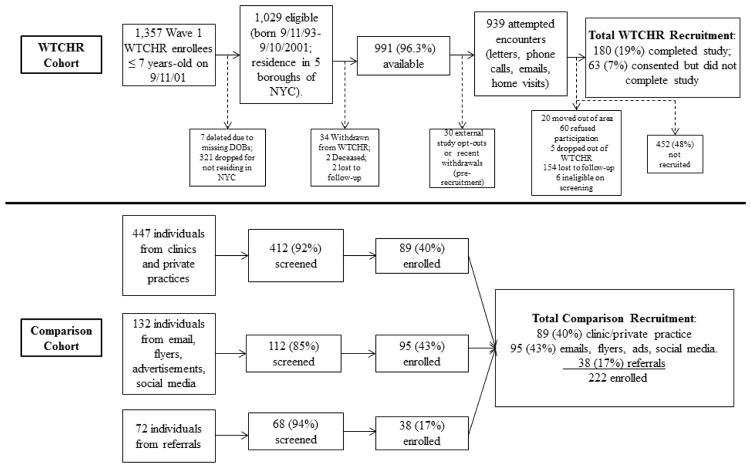
A total of 402 participants completed the study and serum samples were analyzed from 308 participants, 123 in the WTCHR group and 185 in the comparison group. In multivariable regression analysis, after adjusting for relevant confounders, we observed a significant, positive association of perfluorooctanoic acid (PFOA) with triglycerides (beta coefficient = 0.14, 95% CI: 0.02, 0.27, 15.1 percent change), total cholesterol (beta coefficient = 0.09, 95% CI: 0.04, 0.14, 9.2 percent change), and LDL cholesterol (beta coefficient = 0.11, 95% CI: 0.03, 0.19, 11.5 percent change). Perfluorohexanesulfonic acid levels were associated with decreased insulin resistance (beta coefficient = −0.09, 95% CI: −0.18, −0.003, −8.6 percent change); PFOA and perfluorononanoic acid were associated with increased brachial artery distensibility.
Conclusions
This research adds to our knowledge of the physical health impacts in a large group of children exposed to the WTC disaster. Abnormal lipid levels in young adults might be an early marker of atherosclerosis and cardiovascular diseases and our findings highlight the importance of conducting longitudinal studies in this population.
-
Subjects:
-
Source:Environ Int. 109:128-135.
-
Pubmed ID:28890218
-
Pubmed Central ID:PMC5660646
-
Document Type:
-
Funding:
-
Volume:109
-
Collection(s):
-
Main Document Checksum:urn:sha256:30a44fae46f28308ff77d0999c8d43f99e9e7182ba914f83e3a945d3fe394568
-
Download URL:
-
File Type:
 [PDF
- 542.76 KB
]
[PDF
- 542.76 KB
]
Supporting Files


File Language:
English
ON THIS PAGE

CDC STACKS serves as an archival repository of CDC-published products including
scientific findings,
journal articles, guidelines, recommendations, or other public health information authored or
co-authored by CDC or funded partners.
As a repository, CDC STACKS retains documents in their original published format to ensure public access to scientific information.
As a repository, CDC STACKS retains documents in their original published format to ensure public access to scientific information.
You May Also Like
COLLECTION
CDC Public Access