



Paternal and Maternal Urinary Phthalate Metabolite Concentrations and Birth Weight of Singletons Conceived by Subfertile Couples
Supporting Files

-
10 2017
-
Available in CDC Stacks on October 01, 2018, 12:00 AM
File Language:
English
Details
-
Alternative Title:Environ Int
-
Personal Author:
-
Description:Background
Ortho-phthalates are known endocrine disruptors. Prenatal phthalate exposure has been inconsistently associated with fetal growth and infant birth weight; however, the effect of paternal and maternal preconception exposure remains understudied.
Objectives
To investigate associations of paternal and maternal preconception and maternal prenatal urinary phthalate metabolite concentrations with birth weight.
Methods
The study comprised 364 singletons born to 364 mothers and 195 fathers (195 couples) from the EARTH Study, a prospective cohort of couples from Boston, MA. Births were categorized by mode of conception: in-vitro fertilization based (IVF) (n=208) or non-IVF based (n=156, intrauterine insemination or non-medically assisted/natural conception). We measured urinary concentrations of eleven phthalate metabolites in maternal (n=1,425) and paternal (n=489) preconception and maternal prenatal (n=781) samples. Birth weight was abstracted from delivery records. Covariate-adjusted associations between loge-phthalate metabolite concentrations and birth weight were evaluated separately by mode of conception using multivariable linear regression.
Results
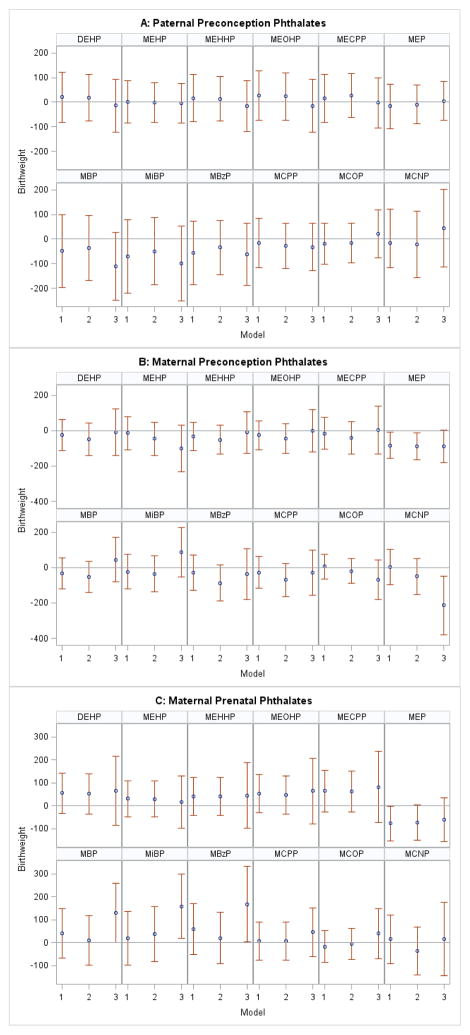
Each loge-unit increase in paternal urinary concentration of the sum of di(2-ethylhexyl) phthalate (ΣDEHP) metabolites was associated with a 90 gram (95% CI: −165, −15) decrease in birth weight among IVF singletons, but not among non-IVF singletons (18 grams; 95% CI: −76, 113). Additional adjustment for maternal prenatal ΣDEHP concentrations modestly strengthened findings among IVF singletons. While few associations were found with maternal preconception phthalate metabolites, we observed an inverse relationship between several maternal prenatal urinary phthalate metabolite concentrations and birth weight among IVF singletons in covariate-adjusted models. However, with further adjustment for specific paternal phthalate metabolite concentrations, these associations were attenuated and no longer significant.
Conclusions
Paternal preconception urinary concentration of ΣDEHP metabolites was associated with a decrease in birth weight among IVF-conceived singletons. These results, if replicated, highlight the importance of preconception health, especially among subfertile couples. -
Keywords:
- preconception
- phthalates
- birth weight
- maternal exposure
- paternal exposure
- Adult
- Birth Weight
- Boston
- Environmental Monitoring
- Environmental Pollutants
- Female
- Fertilization in Vitro
- Humans
- Infant, Newborn
- Infertility
- Linear Models
- Male
- Maternal Exposure
- Paternal Exposure
- Phthalic Acids
- Pregnancy
- Prospective Studies
-
Source:Environ Int. 107:55-64
-
Pubmed ID:28666241
-
Pubmed Central ID:PMC5563279
-
Document Type:
-
Funding:
-
Volume:107
-
Download URL:
-
File Type:
 [PDF - 792.98 KB]
 -
Collection(s):
-
Main Document Checksum:urn:sha-512:26f28031ee132225736189a9eaed4473a4d2d971015f857fff7d050e54d81ffbf96f74c7ac0e96d6e18a36470d2023b4e77007feb3de403bc52e94aa5454d8d2
Supporting Files


File Language:
English
 Was this page helpful?
 Found an issue?


CDC STACKS serves as an archival repository of CDC-published products including
scientific findings, journal articles, guidelines, recommendations, or other public health information authored or
co-authored by CDC or funded partners.
As a repository, CDC STACKS retains documents in their original published format to ensure public access to scientific information.
As a repository, CDC STACKS retains documents in their original published format to ensure public access to scientific information.
You May Also Like
COLLECTION
CDC Public Access