


Mortality from motorcycle crashes: the baby-boomer cohort effect
Supporting Files

-
Aug 09 2016
Details
-
Alternative Title:Inj Epidemiol
-
Personal Author:
-
Description:Background
Motorcyclists are known to be at substantially higher risk per mile traveled of dying from crashes than car occupants. In 2014, motorcycling made up less than 1 % of person-miles traveled but 13 % of the total mortality from motor-vehicle crashes in the United States. We assessed the cohort effect of the baby-boomers (i.e., those born between 1946 and 1964) in motorcycle crash mortality from 1975 to 2014 in the United States.
Methods
Using mortality data for motorcycle occupants from the Fatality Analysis Reporting System, we performed an age-period-cohort analysis using the multiphase method and the intrinsic estimator method.
Results
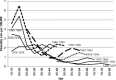
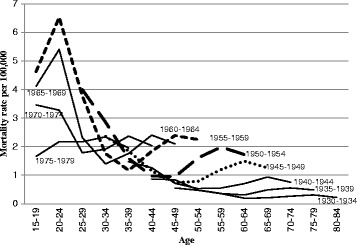
Baby-boomers experienced the highest mortality rates from motorcycle crashes at age 20-24 years and continued to experience excess mortality after age 40 years. After removing the effects of age and period, the estimated mortality risk from motorcycle crashes for baby-boomers was 48 % higher than that of the referent cohort (those born between 1930 and 1934, rate ratio 1.48; 95 % CI: 1.01, 2.18). Results from the multiphase method and the intrinsic estimator method were consistent.
Conclusions
The baby-boomers have experienced significantly higher mortality from motorcycle crashes than other birth cohorts. To reduce motorcycle crash mortality, intervention programs specifically tailored for the baby-boomer generation are warranted.
Electronic supplementary material
The online version of this article (doi:10.1186/s40621-016-0083-6) contains supplementary material, which is available to authorized users.
-
Subjects:
-
Source:Inj Epidemiol. 3.
-
Pubmed ID:27547704
-
Pubmed Central ID:PMC4978754
-
Document Type:
-
Funding:
-
Volume:3
-
Collection(s):
-
Main Document Checksum:urn:sha256:23fbb59f7ab1879f562a515e2601d8de39528cbb0d0d24dcfc3e6b0443477cb2
-
Download URL:
-
File Type:
 [PDF
- 524.61 KB
]
[PDF
- 524.61 KB
]
Supporting Files


ON THIS PAGE

CDC STACKS serves as an archival repository of CDC-published products including
scientific findings,
journal articles, guidelines, recommendations, or other public health information authored or
co-authored by CDC or funded partners.
As a repository, CDC STACKS retains documents in their original published format to ensure public access to scientific information.
As a repository, CDC STACKS retains documents in their original published format to ensure public access to scientific information.
You May Also Like
COLLECTION
CDC Public Access