



Vertebrate Host Susceptibility to Heartland Virus
Supporting Files
Public Domain

-
Dec 2016
File Language:
English
Details
-
Alternative Title:Emerg Infect Dis
-
Personal Author:
-
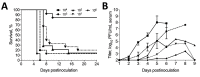
Description:Heartland virus (HRTV) is a recently described phlebovirus initially isolated in 2009 from 2 humans who had leukopenia and thrombocytopenia. Serologic assessment of domestic and wild animal populations near the residence of 1 of these persons showed high exposure rates to raccoons, white-tailed deer, and horses. To our knowledge, no laboratory-based assessments of viremic potential of animals infected with HRTV have been performed. We experimentally inoculated several vertebrates (raccoons, goats, chickens, rabbits, hamsters, C57BL/6 mice, and interferon-α/β/γ receptor-deficient Ag129) mice with this virus. All animals showed immune responses against HRTV after primary or secondary exposure. However, neutralizing antibody responses were limited. Only Ag129 mice showed detectable viremia and associated illness and death, which were dose dependent. Ag129 mice also showed development of mean peak viral antibody titers >8 log10 PFU/mL, hemorrhagic hepatic lesions, splenomegaly, and large amounts of HRTV antigen in mononuclear cells and hematopoietic cells in the spleen.
-
Subjects:
- Research
- Animal Diseases
- Animals
- Antibodies, Neutralizing
- Antibodies, Viral
- Biopsy
- Bunyaviridae Infections
- Cricetinae
- Disease Models, Animal
- Disease Susceptibility
- Female
- Host-Pathogen Interactions
- Male
- Mice
- Mice, Knockout
- Mortality
- Phlebovirus
- Rabbits
- Raccoons
- Receptors, Interferon
- Serologic Tests
- Vertebrates
- Viremia
-
Source:Emerg Infect Dis. 22(12):2070-2077.
-
Pubmed ID:27869591
-
Pubmed Central ID:PMC5189141
-
Document Type:
-
Volume:22
-
Issue:12
-
Download URL:
-
File Type:
 [PDF - 1.50 MB]
 -
Collection(s):
-
Main Document Checksum:urn:sha256:573dc9ec708d15f932033edb20bf86ce264ca3c7037b325caddf6731f21ae48e
Supporting Files


File Language:
English
 Was this page helpful?
 Found an issue?




CDC STACKS serves as an archival repository of CDC-published products including
scientific findings, journal articles, guidelines, recommendations, or other public health information authored or
co-authored by CDC or funded partners.
As a repository, CDC STACKS retains documents in their original published format to ensure public access to scientific information.
As a repository, CDC STACKS retains documents in their original published format to ensure public access to scientific information.
You May Also Like
COLLECTION
Emerging Infectious Diseases