


Prenatal DDT and DDE Exposure and Child IQ in the CHAMACOS Cohort
Supporting Files

-
12 2015
-
File Language:
English
Details
-
Alternative Title:Environ Int
-
Personal Author:
-
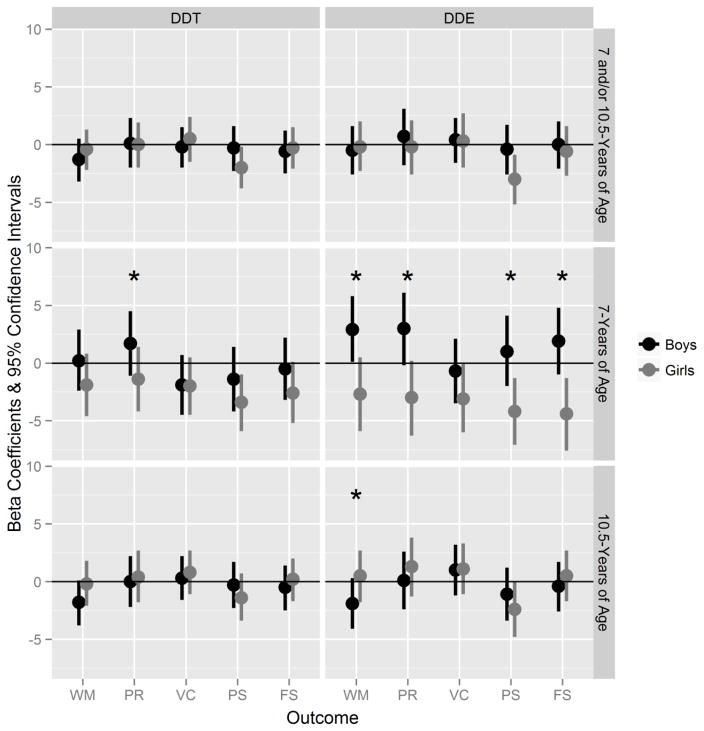
Description:Although banned in most countries, dichlorodiphenyl-trichloroethane (DDT) continues to be used for vector control in some malaria endemic areas. Previous findings from the Center for the Health Assessment of Mothers and Children of Salinas (CHAMACOS) cohort study found increased prenatal levels of DDT and its breakdown product dichlorodiphenyl-dichloroethylene (DDE) to be associated with altered neurodevelopment in children at 1 and 2years of age. In this study, we combined the measured maternal DDT/E concentrations during pregnancy obtained for the prospective birth cohort with predicted prenatal DDT and DDE levels estimated for a retrospective birth cohort. Using generalized estimating equation (GEE) and linear regression models, we evaluated the relationship of prenatal maternal DDT and DDE serum concentrations with children's cognition at ages 7 and 10.5years as assessed using the Full Scale Intelligence Quotient (IQ) and 4 subtest scores (Working Memory, Perceptual Reasoning, Verbal Comprehension, and Processing Speed) of the Wechsler Intelligence Scale for Children (WISC). In GEE analyses incorporating both age 7 and 10.5 scores (n=619), we found prenatal DDT and DDE levels were not associated with Full Scale IQ or any of the WISC subscales (p-value>0.05). In linear regression analyses assessing each time point separately, prenatal DDT levels were inversely associated with Processing Speed at age 7years (n=316), but prenatal DDT and DDE levels were not associated with Full Scale IQ or any of the WISC subscales at age 10.5years (n=595). We found evidence for effect modification by sex. In girls, but not boys, prenatal DDE levels were inversely associated with Full Scale IQ and Processing Speed at age 7years. We conclude that prenatal DDT levels may be associated with delayed Processing Speed in children at age 7years and the relationship between prenatal DDE levels and children's cognitive development may be modified by sex, with girls being more adversely affected.
-
Subjects:
-
Source:Environ Int. 85:206-212
-
Pubmed ID:26414943
-
Pubmed Central ID:PMC5152618
-
Document Type:
-
Funding:P01 ES0009605/ES/NIEHS NIH HHSUnited States/ ; R01 ES015572/ES/NIEHS NIH HHSUnited States/ ; R01ES017054/ES/NIEHS NIH HHSUnited States/ ; CC999999/Intramural CDC HHSUnited States/ ; R01 ES017054/ES/NIEHS NIH HHSUnited States/ ; R01ES015572/ES/NIEHS NIH HHSUnited States/ ; P01 ES009605/ES/NIEHS NIH HHSUnited States/
-
Volume:85
-
Collection(s):
-
Main Document Checksum:urn:sha256:404d52b27685617bdf82fc6a747435de31a719bff0d5335ead21b1866ade66a8
-
Download URL:
-
File Type:
 [PDF
- 517.74 KB
]
[PDF
- 517.74 KB
]
Supporting Files


File Language:
English
ON THIS PAGE

CDC STACKS serves as an archival repository of CDC-published products including
scientific findings,
journal articles, guidelines, recommendations, or other public health information authored or
co-authored by CDC or funded partners.
As a repository, CDC STACKS retains documents in their original published format to ensure public access to scientific information.
As a repository, CDC STACKS retains documents in their original published format to ensure public access to scientific information.
You May Also Like
COLLECTION
CDC Public Access