


The effect of patient and contextual characteristics on racial/ethnic disparity in breast cancer mortality
Supporting Files

-
Apr 26 2016
-
File Language:
English
Details
-
Alternative Title:Cancer Epidemiol Biomarkers Prev
-
Personal Author:
-
Description:Background
Racial/ethnic disparity in breast cancer-specific mortality in the U.S. is well documented. We examined whether accounting for racial/ethnic differences in the prevalence of clinical, patient, and lifestyle and contextual factors that are associated with breast cancer-specific mortality can explain this disparity.
Methods
The California Breast Cancer Survivorship Consortium combined interview data from six California-based breast cancer studies with cancer registry data to create a large racially diverse cohort of women with primary invasive breast cancer. We examined the contribution of variables in a previously reported Cox regression baseline model plus additional contextual, physical activity, body size, and comorbidity variables to the racial/ethnic disparity in breast cancer-specific mortality.
Results
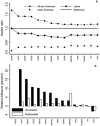
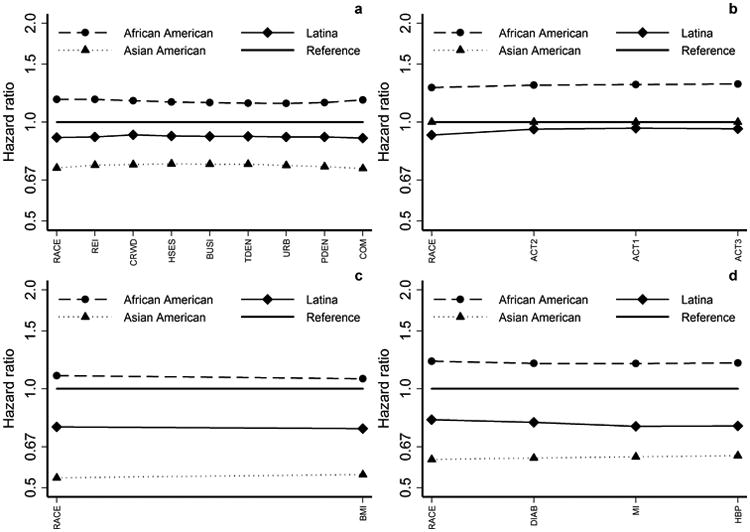
The cohort comprised 12,098 women. Fifty-four percent were non-Latina Whites, 17% African Americans, 17% Latinas, and 12% Asian Americans. In a model adjusting only for age and study, breast cancer-specific hazard ratios relative to Whites were 1.69 (95% CI 1.46 -1.96), 1.00 (0.84 - 1.19), and 0.52 (0.33 - 0.85) for African Americans, Latinas, and Asian Americans respectively. Adjusting for baseline-model variables decreased disparity primarily by reducing the hazard ratio for African Americans to 1.13 (0.96 - 1.33). The most influential variables were related to disease characteristics, neighborhood socioeconomic status, and smoking status at diagnosis. Other variables had negligible impact on disparity.
Conclusions
While contextual, physical activity, body size, and comorbidity variables may influence breast cancer-specific mortality, they do not explain racial/ethnic mortality disparity.
Impact
Other factors besides those investigated here may explain the existing racial/ethnic disparity in mortality.
-
Subjects:
-
Source:Cancer Epidemiol Biomarkers Prev. 25(7):1064-1072.
-
Pubmed ID:27197297
-
Pubmed Central ID:PMC4930680
-
Document Type:
-
Funding:UM1 CA164973/CA/NCI NIH HHS/United States ; N01 HD033175/HD/NICHD NIH HHS/United States ; HHSN261201000035C/PC,CA/None/None ; HHSN261201000140C/CA/NCI NIH HHS/United States ; R01 CA129059/CA/NCI NIH HHS/United States ; U58 DP000807/DP/NCCDPHP CDC HHS/United States ; K05 CA136967/CA/NCI NIH HHS/United States ; HHSN261201000035I/CA/NCI NIH HHS/United States ; R01 CA063446/CA/NCI NIH HHS/United States ; R01 CA077398/CA/NCI NIH HHS/United States ; R01 CA054281/CA/NCI NIH HHS/United States ; HHSN261201000034C/CA/NCI NIH HHS/United States ; U58 DP003862/DP/NCCDPHP CDC HHS/United States ; R37 CA054281/CA/NCI NIH HHS/United States
-
Place as Subject:
-
Volume:25
-
Issue:7
-
Collection(s):
-
Main Document Checksum:urn:sha256:ba678984ebb2e6f052e67ac8cb487facea462aa05dddacfa6fc797dfc5f7d5c6
-
Download URL:
-
File Type:
 [PDF
- 234.96 KB
]
[PDF
- 234.96 KB
]
Supporting Files


File Language:
English
ON THIS PAGE


CDC STACKS serves as an archival repository of CDC-published products including
scientific findings,
journal articles, guidelines, recommendations, or other public health information authored or
co-authored by CDC or funded partners.
As a repository, CDC STACKS retains documents in their original published format to ensure public access to scientific information.
As a repository, CDC STACKS retains documents in their original published format to ensure public access to scientific information.
You May Also Like
COLLECTION
CDC Public Access