



Structural insights into the mechanism defining substrate affinity in Arabidopsis thaliana dUTPase: the role of tryptophan 93 in ligand orientation
Supporting Files
Public Domain

-
Dec 15 2015
-
Available in CDC Stacks on 2015-12-15T00:00:00Z
File Language:
English
Details
-
Alternative Title:BMC Res Notes
-
Personal Author:
-
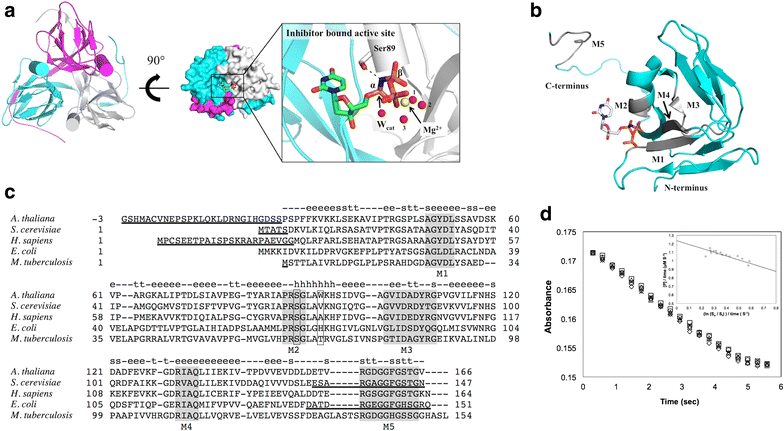
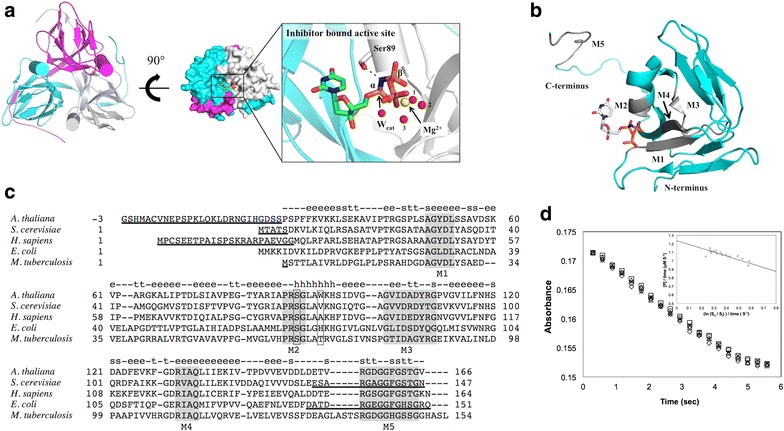
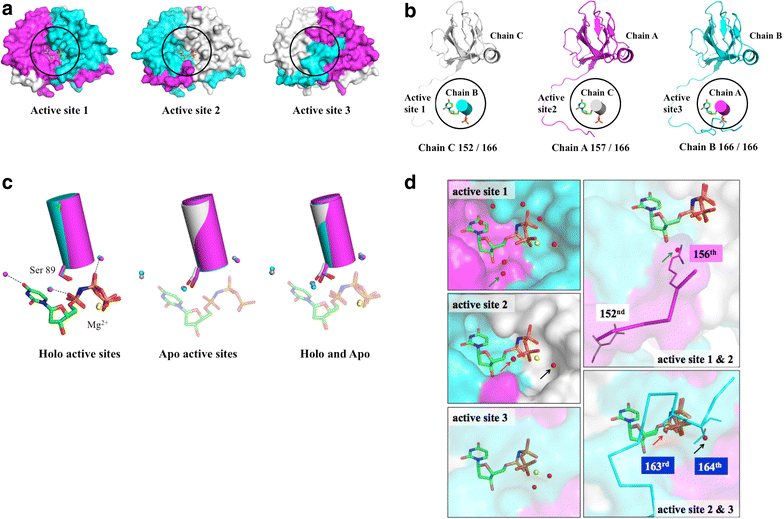
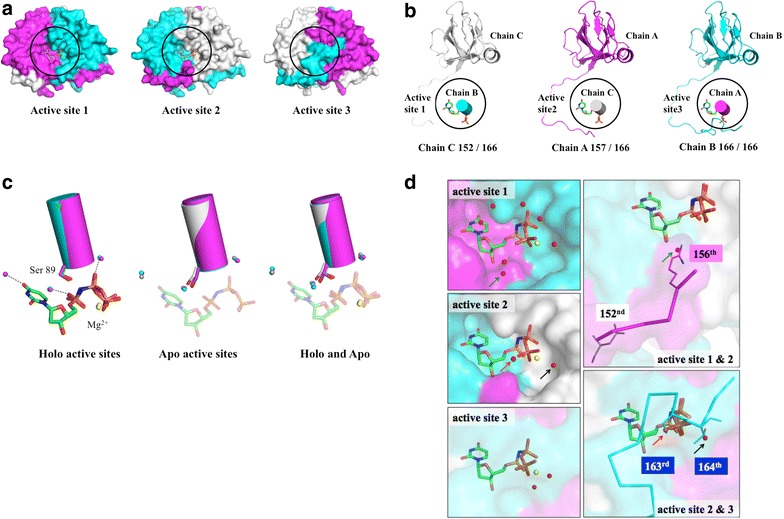
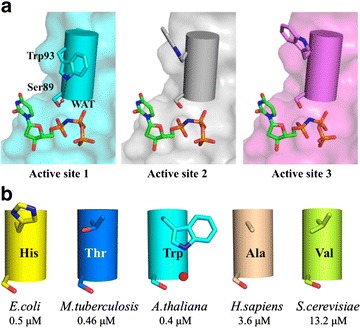
Description:Background ; Deoxyuridine triphosphate nucleotidohydrolase (dUTPase) hydrolyzes dUTP to dUMP and pyrophosphate to maintain the cellular thymine-uracil ratio. dUTPase is also a target for cancer chemotherapy. However, the mechanism defining its substrate affinity remains unclear. Sequence comparisons of various dUTPases revealed that Arabidopsis thaliana dUTPase has a unique tryptophan at position 93, which potentially contributes to its degree of substrate affinity. To better understand the roles of tryptophan 93, A. thaliana dUTPase was studied. ; Results ; Enzyme assays showed that A. thaliana dUTPase belongs to a high-affinity group of isozymes, which also includes the enzymes from Escherichia coli and Mycobacterium tuberculosis. Enzymes from Homo sapiens and Saccharomyces cerevisiae are grouped as low-affinity dUTPases. The structure of the homo-trimeric A. thaliana dUTPase showed three active sites, each with a different set of ligand interactions between the amino acids and water molecules. On an α-helix, tryptophan 93 appears to keep serine 89 in place via a water molecule and to specifically direct the ligand. Upon being oriented in the active site, the C-terminal residues close the active site to promote the reaction. ; Conclusions ; In the high-affinity group, the prefixed direction of the serine residues was oriented by a positively charged residue located four amino acids away, while low-affinity enzymes possess small hydrophobic residues at the corresponding sites. ; Electronic supplementary material ; The online version of this article (doi:10.1186/s13104-015-1760-1) contains supplementary material, which is available to authorized users.
-
Subjects:
- Amino Acid Sequence
- Arabidopsis
- Arabidopsis Proteins
- Binding Sites
- Binding, Competitive
- Catalytic Domain
- Crystallography, X-Ray
- Hydrophobic and Hydrophilic Interactions
- Ligands
- Models, Molecular
- Molecular Sequence Data
- Protein Binding
- Protein Structure, Secondary
- Protein Structure, Tertiary
- Pyrophosphatases
- Sequence Homology, Amino Acid
- Substrate Specificity
- Tryptophan
-
Source:BMC Res Notes. 8.
-
Pubmed ID:26666293
-
Pubmed Central ID:PMC4678481
-
Document Type:
-
Volume:8
-
Download URL:
-
File Type:
 [PDF - 1.64 MB]
 -
Collection(s):
-
Main Document Checksum:urn:sha256:00dbda34c940988600cd814cc81f25522022661958bebf428f6dd87beafee738
Supporting Files


File Language:
English
 Was this page helpful?
 Found an issue?


CDC STACKS serves as an archival repository of CDC-published products including
scientific findings, journal articles, guidelines, recommendations, or other public health information authored or
co-authored by CDC or funded partners.
As a repository, CDC STACKS retains documents in their original published format to ensure public access to scientific information.
As a repository, CDC STACKS retains documents in their original published format to ensure public access to scientific information.
You May Also Like
COLLECTION
CDC Public Access