



Impact of Repeated Vaccination on Vaccine Effectiveness Against Influenza A(H3N2) and B During 8 Seasons
Supporting Files

-
Sep 29 2014
-
Available in CDC Stacks on September 29, 2014, 12:00 AM
File Language:
English
Details
-
Alternative Title:Clin Infect Dis
-
Personal Author:
-
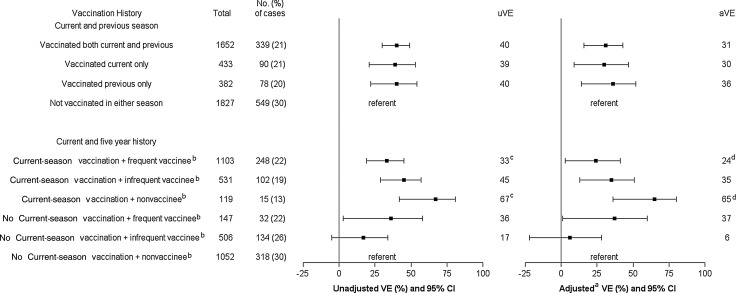
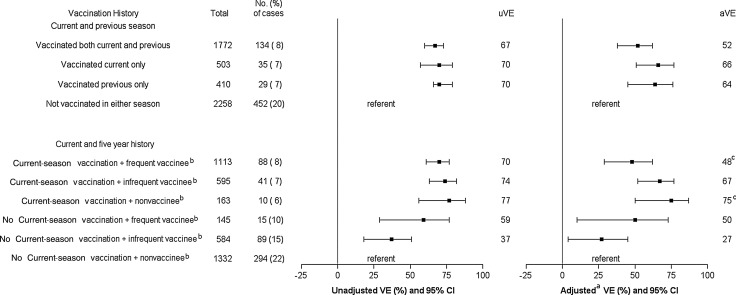
Description:Recent studies suggest that influenza vaccination in the previous season may influence the effectiveness of current-season vaccination, but this has not been assessed in a single population over multiple years.|Patients presenting with acute respiratory illness were prospectively enrolled during the 2004-2005 through 2012-2013 influenza seasons. Respiratory swabs were tested for influenza and vaccination dates obtained from a validated registry. Vaccination status was determined for the current, previous, and prior 5 seasons. Vaccine effectiveness (VE) was calculated for participants aged ≥9 years using logistic regression models with an interaction term for vaccination history.|There were 7315 enrollments during 8 seasons; 1056 (14%) and 650 (9%) were positive for influenza A(H3N2) and B, respectively. Vaccination during current only, previous only, or both seasons yielded similar protection against H3N2 (adjusted VE range, 31%-36%) and B (52%-66%). In the analysis using 5 years of historical vaccination data, current season VE against H3N2 was significantly higher among vaccinated individuals with no prior vaccination history (65%; 95% confidence interval CI, 36%-80%) compared with vaccinated individuals with a frequent vaccination history (24%; 95% CI, 3%-41%; P = .01). VE against B was 75% (95% CI, 50%-87%) and 48% (95% CI, 29%-62%), respectively (P = .05). Similar findings were observed when analysis was restricted to adults 18-49 years.|Current- and previous-season vaccination generated similar levels of protection, and vaccine-induced protection was greatest for individuals not vaccinated during the prior 5 years. Additional studies are needed to understand the long-term effects of annual vaccination.
-
Subjects:
-
Source:Clin Infect Dis. 2014; 59(10):1375-1385.
-
Pubmed ID:25270645
-
Pubmed Central ID:PMC4207422
-
Document Type:
-
Funding:
-
Volume:59
-
Issue:10
-
Download URL:
-
File Type:
 [PDF - 282.08 KB]
 -
Collection(s):
-
Main Document Checksum:urn:sha256:5b86aba92eb9082db0810eece053902c47582844fde019d01f11a7a1a75314be
Supporting Files
-
html


File Language:
English
 Was this page helpful?
 Found an issue?


CDC STACKS serves as an archival repository of CDC-published products including
scientific findings, journal articles, guidelines, recommendations, or other public health information authored or
co-authored by CDC or funded partners.
As a repository, CDC STACKS retains documents in their original published format to ensure public access to scientific information.
As a repository, CDC STACKS retains documents in their original published format to ensure public access to scientific information.
You May Also Like
COLLECTION
CDC Public Access