



Outbreak of Variant Influenza A(H3N2) Virus in the United States
Supporting Files

-
12-2013
-
Available in CDC Stacks on December 18, 2017, 12:00 AM
File Language:
English
Details
-
Alternative Title:Clin Infect Dis
-
Personal Author:Jhung, Michael A. ; Epperson, Scott ; Biggerstaff, Matthew ; Allen, Donna ; Balish, Amanda ; Barnes, Nathelia ; Beaudoin, Amanda ; Berman, LaShondra ; Bidol, Sally ; Blanton, Lenee ; Blythe, David ; Brammer, Lynnette ; D’Mello, Tiffany ; Danila, Richard ; Davis, William ; de Fijter, Sietske ; DiOrio, Mary ; Durand, Lizette O. ; Emery, Shannon ; Fowler, Brian ; Garten, Rebecca ; Grant, Yoran ; Greenbaum, Adena ; Gubareva, Larisa ; Havers, Fiona ; Haupt, Thomas ; House, Jennifer ; Ibrahim, Sherif ; Jiang, Victoria ; Jain, Seema ; Jernigan, Daniel ; Kazmierczak, James ; Klimov, Alexander ; Lindstrom, Stephen ; Longenberger, Allison ; Lucas, Paul ; Lynfield, Ruth ; McMorrow, Meredith ; Moll, Maria ; Morin, Craig ; Ostroff, Stephen ; Page, Shannon L. ; Park, Sarah Y. ; Peters, Susan ; Quinn, Celia ; Reed, Carrie ; Richards, Shawn ; Scheftel, Joni ; Simwale, Owen ; Shu, Bo ; Soyemi, Kenneth ; Stauffer, Jill ; Steffens, Craig ; Su, Su ; Torso, Lauren ; Uyeki, Timothy M. ; Vetter, Sara ; Villanueva, Julie ; Wong, Karen K. ; Shaw, Michael ; Bresee, Joseph S. ; Cox, Nancy ; Finelli, Lyn
-
Description:Background
Variant influenza virus infections are rare but may have pandemic potential if person-to-person transmission is efficient. We describe the epidemiology of a multistate outbreak of an influenza A(H3N2) variant virus (H3N2v) first identified in 2011.
Methods
We identified laboratory-confirmed cases of H3N2v and used a standard case report form to characterize illness and exposures. We considered illness to result from person-to-person H3N2v transmission if swine contact was not identified within 4 days prior to illness onset.
Results
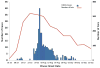
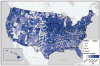
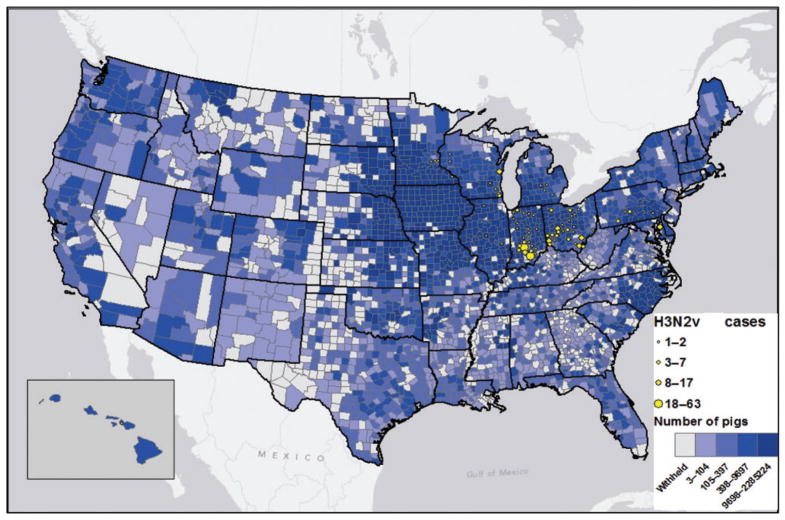
From 9 July to 7 September 2012, we identified 306 cases of H3N2v in 10 states. The median age of all patients was 7 years. Commonly reported signs and symptoms included fever (98%), cough (85%), and fatigue (83%). Sixteen patients (5.2%) were hospitalized, and 1 fatal case was identified. The majority of those infected reported agricultural fair attendance (93%) and/or contact with swine (95%) prior to illness. We identified 15 cases of possible person-to-person transmission of H3N2v. Viruses recovered from patients were 93%–100% identical and similar to viruses recovered from previous cases of H3N2v. All H3N2v viruses examined were susceptible to oseltamivir and zanamivir and resistant to adamantane antiviral medications.
Conclusions
In a large outbreak of variant influenza, the majority of infected persons reported exposures, suggesting that swine contact at an agricultural fair was a risk for H3N2v infection. We identified limited person-to-person H3N2v virus transmission, but found no evidence of efficient or sustained person-to-person transmission. Fair managers and attendees should be aware of the risk of swine-to-human transmission of influenza viruses in these settings. -
Keywords:
-
Source:Clin Infect Dis. 57(12):1703-1712
-
Pubmed ID:24065322
-
Pubmed Central ID:PMC5733625
-
Document Type:
-
Funding:
-
Volume:57
-
Issue:12
-
Download URL:
-
File Type:
 [PDF - 740.53 KB]
 -
Collection(s):
-
Main Document Checksum:urn:sha256:a01408f00a4efab8fd0262451f5ec59e93338ec4a3a24df9a6087cb9609d6617
Supporting Files


File Language:
English
 Was this page helpful?
 Found an issue?


CDC STACKS serves as an archival repository of CDC-published products including
scientific findings, journal articles, guidelines, recommendations, or other public health information authored or
co-authored by CDC or funded partners.
As a repository, CDC STACKS retains documents in their original published format to ensure public access to scientific information.
As a repository, CDC STACKS retains documents in their original published format to ensure public access to scientific information.
You May Also Like
COLLECTION
CDC Public Access