


Genitourinary health in a population-based cohort of males with Duchenne and Becker muscular dystrophies
Supporting Files

-
Jun 03 2015
-
File Language:
English
Details
-
Alternative Title:Muscle Nerve
-
Personal Author:
-
Corporate Authors:
-
Description:Introduction
Genitourinary (GU) health among patients with Duchenne and Becker muscular dystrophies (DBMD) has not been explored using population-based data.
Methods
Medical records of 918 males ascertained by the Muscular Dystrophy Surveillance, Tracking, and Research Network were reviewed for documentation of GU-related hospitalizations and prescribed medications. Percentages of males who received these medical interventions were calculated, hazard ratios (HR) and 95% confidence intervals (CI) were estimated for associations with sociodemographics (study site, race/ethnicity), symptoms (early-versus late-onset, ambulation status, scoliosis), and treatments (respiratory support, steroids).
Results
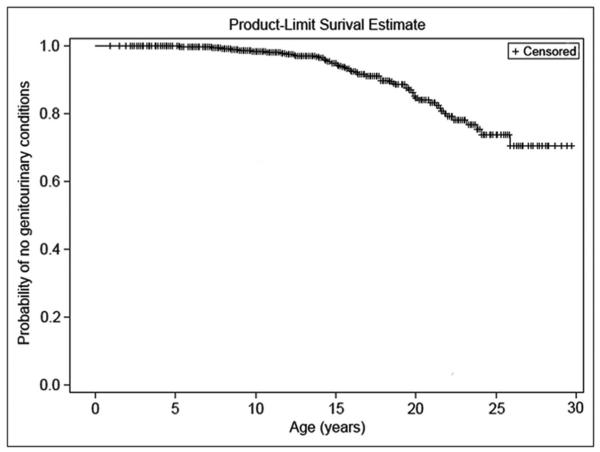
Among the 918 males, 81 (9%) had a GU condition; voiding dysfunction (n=40), GU tract infection (n=19), and kidney/ureter calculus (n=9) were most common. A Kaplan-Meier curve produced a cumulative probability of 27%. Cox regression showed GU conditions were more common when males were non-ambulatory (HR=2.7, 95% CI=1.3-5.6).
Discussion
These findings highlight increased awareness of GU health and multidisciplinary care of DBMD patients.
-
Subjects:
-
Source:Muscle Nerve. 52(1):22-27.
-
Pubmed ID:25297835
-
Pubmed Central ID:PMC4412791
-
Document Type:
-
Funding:
-
Volume:52
-
Issue:1
-
Collection(s):
-
Main Document Checksum:urn:sha256:767b7259c16167c4e138341cc464e788ac10cdad1dfa59bc543aac1e9a7e2bc4
-
Download URL:
-
File Type:
 [PDF
- 227.87 KB
]
[PDF
- 227.87 KB
]
Supporting Files


File Language:
English
ON THIS PAGE

CDC STACKS serves as an archival repository of CDC-published products including
scientific findings,
journal articles, guidelines, recommendations, or other public health information authored or
co-authored by CDC or funded partners.
As a repository, CDC STACKS retains documents in their original published format to ensure public access to scientific information.
As a repository, CDC STACKS retains documents in their original published format to ensure public access to scientific information.
You May Also Like
COLLECTION
CDC Public Access