



Protocolized fluid therapy in brain-dead donors: The multi-center randomized MOnIToR trial
Supporting Files

-
2015/03/01
-
Available in CDC Stacks on 2016-03-01T00:00:00Z
File Language:
English
Details
-
Alternative Title:Intensive Care Med
-
Personal Author:Al-Khafaji, Ali ; Elder, Michele ; Lebovitz, Daniel J ; Murugan, Raghavan ; Souter, Michael ; Stuart, Susan ; Wahed, Abdus S. ; Keebler, Ben ; Dils, Dorrie ; Mitchell, Stephanie ; Shutterly, Kurt ; Wilkerson, Dawn ; Pearse, Rupert ; Kellum, John A
-
Corporate Authors:
-
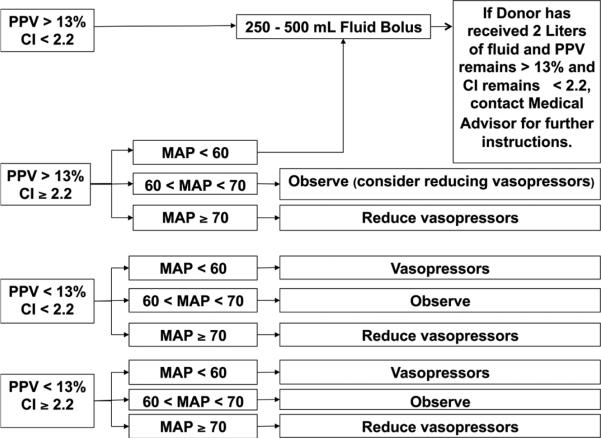
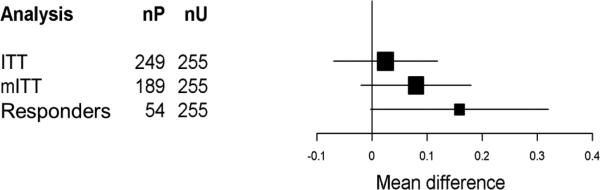
Description:BACKGROUND ; Critical shortages of organs for transplantation jeopardize many lives. Observational data suggest that better fluid management for deceased organ donors could increase organ recovery. We conducted the first large multi-center randomized trial in brain-dead donors to determine whether protocolized fluid therapy increases organs transplanted. ; METHODS ; We randomly assigned donors to either protocolized or usual care in eight organ procurement organizations. A "protocol-guided fluid therapy" algorithm targeting cardiac index, mean arterial pressure and pulse pressure variation was used. Our primary outcome was the number of organs transplanted per donor and our primary analysis was intention-to-treat. Secondary analyses included: 1) modified intention-to-treat where only subjects able to receive the intervention were included, and 2) twelve-month survival in transplant recipients. The study was stopped early. ; RESULTS ; We enrolled 556 donors; 279 protocolized care, 277 usual care. Groups had similar characteristics at baseline. The study protocol could be implemented in 76% of subjects randomized to the intervention. There was no significant difference in mean number of organs transplanted per donor: 3.39 organs per donor, (95%CI: 3.14-3.63) with protocolized care, compared to usual care 3.29 (95%CI: 3.04-3.54) (mean difference, 0.1, 95%CI: -0.25 to 0.45; p=0.56). In modified intention-to-treat analysis the mean number of organs increased (3.52 organs per donor, 95%CI: 3.23-3.8) but was not statistically significant (mean difference, 0.23, 95%CI: -0.15-0.61; p=0.23). Among the 1430 recipients of organs from study subjects, with data available, 56 deaths (7.8%) occurred in the protocolized care arm and 56 (7.9%) in the usual care arm in the first year (Hazard Ratio: 0.97, p=0.86). ; CONCLUSIONS ; In brain-dead organ donors, protocol-guided fluid therapy compared to usual care may not increase the number of organs transplanted per donor.
-
Keywords:
-
Source:Intensive Care Med. 41(3):418-426
-
Pubmed ID:25583616
-
Pubmed Central ID:PMC4351113
-
Document Type:
-
Funding:UL1 TR000005/TR/NCATS NIH HHSUnited States/ ; UL1 RR024153/RR/NCRR NIH HHSUnited States/ ; R01DK083961/DK/NIDDK NIH HHSUnited States/ ; R01 DK083961/DK/NIDDK NIH HHSUnited States/ ; CS/08/08/17/DH_/Department of HealthUnited Kingdom/ ; R38OT1058/OT/OSTLTS CDC HHSUnited States/ ; RP_2014-04-022/DH_/Department of HealthUnited Kingdom/ ; UL1TR000005/TR/NCATS NIH HHSUnited States/
-
Genre:
-
Volume:41
-
Issue:3
-
Download URL:
-
File Type:
 [PDF - 670.25 KB]
 -
Collection(s):
-
Main Document Checksum:urn:sha-512:1e44ba12836234708ab927928434348238fd35220c5b24a0bd8bcba3601a446b829f03dea6eea20ba220d110435ac9118ad7b93c617ab5b05c21c8d6fb55fdec
Supporting Files


File Language:
English
 Was this page helpful?
 Found an issue?



CDC STACKS serves as an archival repository of CDC-published products including
scientific findings, journal articles, guidelines, recommendations, or other public health information authored or
co-authored by CDC or funded partners.
As a repository, CDC STACKS retains documents in their original published format to ensure public access to scientific information.
As a repository, CDC STACKS retains documents in their original published format to ensure public access to scientific information.
You May Also Like
COLLECTION
CDC Public Access