



Attitudes and acceptance of First Person Authorization: A national comparison of donor and nondonor families
Supporting Files

-
Jan 2013
-
Available in CDC Stacks on 2013-01-09T00:00:00Z
File Language:
English
Details
-
Alternative Title:J Trauma Acute Care Surg
-
Personal Author:
-
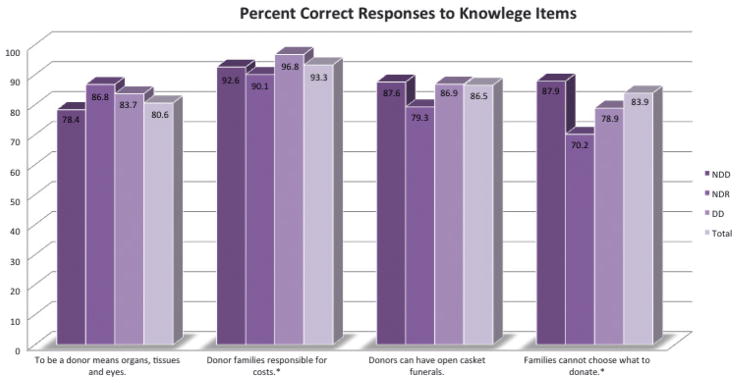
Description:BACKGROUND ; First Person Authorization (i.e., donor designation) legislation makes indicating one’s intent to be a posthumous organ donor legally binding, much like a living will or advance directive. Such legislation is the most recent in a long history of organ donation policies in the United States and has received little attention in the literature. ; METHODS ; This retrospective cohort study recruited nine US organ procurement organizations (OPOs) and their staff who make requests for organ donation as well as family decision makers approached by OPO staff about organ donation. Telephone interviews (N = 1,087) with family decision makers assessed the attitudes, perceptions, and behaviors regarding the request for organ donation of families of designated donors as compared with those of patients who did not formally designate themselves as donors. ; RESULTS ; Almost two thirds (65.7%) of the families of registered donors were aware of the decedent’s decision to register as a posthumous donor. Family decision makers who authorized donation and those of designated donors exhibited greater knowledge of organ donation and more positive attitudes than decision makers who refused to donate. Families of designated donors had more favorable perceptions of the request for organ donation and were more satisfied with both the time spent discussing donation and the request process; fewer donor designation families were surprised at the request for donation. ; CONCLUSION ; The enactment of First Person Authorization legislation increases the likelihood of familial authorization and satisfaction with the final donation outcome. As compared with other families approached about the option of organ donation, families of designated donors report having a more positive experience with the organ donation request process overall and greater comfort and satisfaction with the donation decision. ; LEVEL OF EVIDENCE ; Retrospective cohort study, level II.
-
Subjects:
-
Source:J Trauma Acute Care Surg. 2012; 74(1):294-300.
-
Document Type:
-
Funding:
-
Place as Subject:
-
Volume:74
-
Issue:1
-
Download URL:
-
File Type:
 [PDF - 328.54 KB]
 -
Collection(s):
-
Main Document Checksum:urn:sha256:135ea7dda013bc48bb0372713984c0238b69d77bcb24a96f800a09e118cbbfe3
Supporting Files


File Language:
English
 Was this page helpful?
 Found an issue?

CDC STACKS serves as an archival repository of CDC-published products including
scientific findings, journal articles, guidelines, recommendations, or other public health information authored or
co-authored by CDC or funded partners.
As a repository, CDC STACKS retains documents in their original published format to ensure public access to scientific information.
As a repository, CDC STACKS retains documents in their original published format to ensure public access to scientific information.
You May Also Like
COLLECTION
CDC Public Access