


Manganese Accumulation in Bone Following Chronic Exposure in Rats: Steady-State Concentration and Half-life in Bone
Supporting Files

-
8 17 2014
-
File Language:
English
Details
-
Alternative Title:Toxicol Lett
-
Personal Author:
-
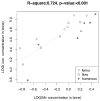
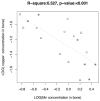
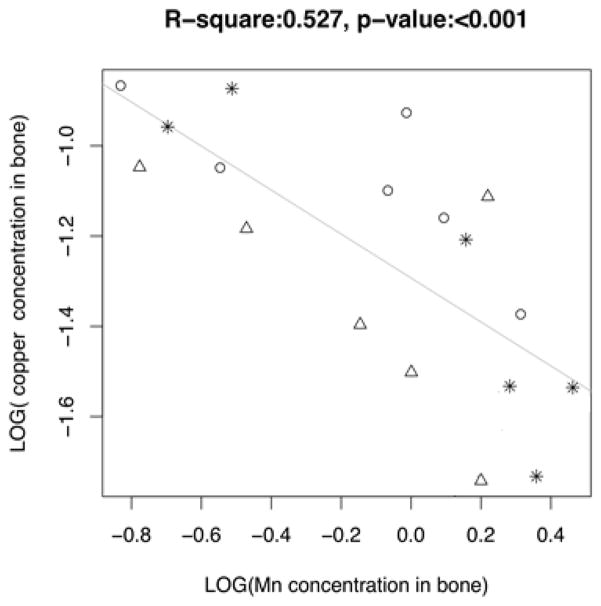
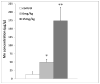
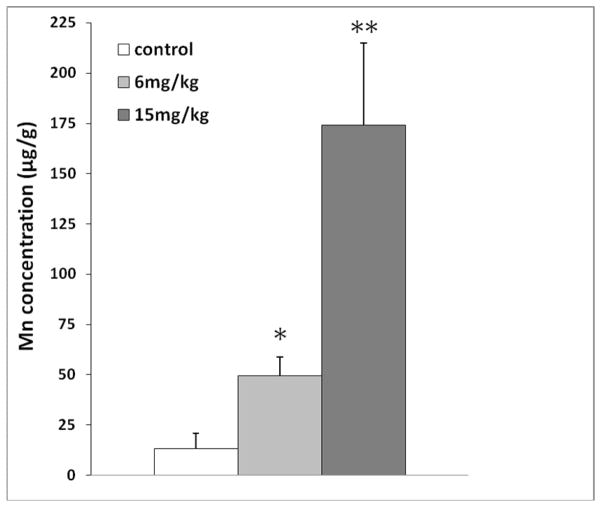
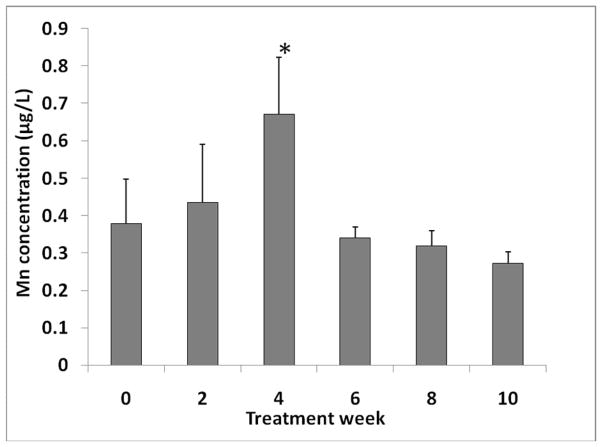
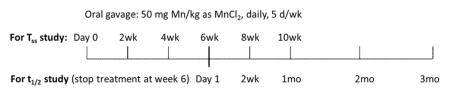
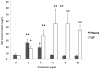
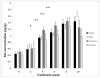
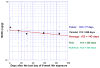
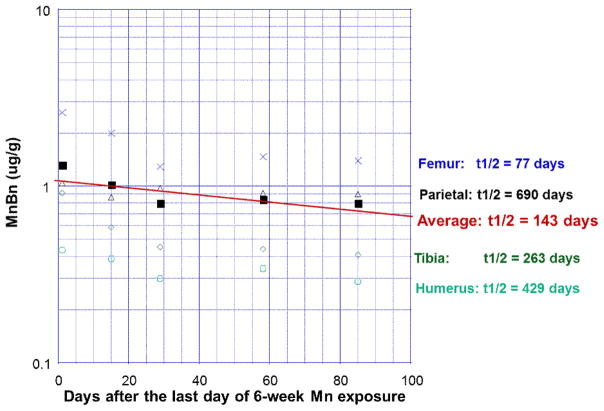
Description:Literature data indicate that bone is a major storage organ for manganese (Mn), accounting for 43% of total body Mn. However, the kinetic nature of Mn in bone, especially the half-life (t(1/2)), remained unknown. This study was designed to understand the time-dependence of Mn distribution in rat bone after chronic oral exposure. Adult male rats received 50 mg Mn/kg (as MnCl2) by oral gavage, 5 days per week, for up to 10 weeks. Animals were sacrificed every 2 weeks during Mn administration for the uptake study, and on day 1, week 2, 4, 8, or 12 after the cessation at 6-week Mn exposure for the t(1/2) study. Mn concentrations in bone (MnBn) were determined by AAS analysis. By the end of 6-week's treatment, MnBn appeared to reach the steady state (T(ss)) level, about 2-3.2 fold higher than MnBn at day 0. Kinetic calculation revealed t(1/2)s of Mn in femur, tibia, and humerus bone of 77 (r=0.978), 263 (r=0.988), and 429 (r=0.994) days, respectively; the average t(1/2) in rat skeleton was about 143 days, equivalent to 8.5 years in human bone. Moreover, MnBn were correlated with Mn levels in striatum, hippocampus, and CSF. These data support MnBn to be a useful biomarker of Mn exposure.
-
Subjects:
-
Keywords:
-
Source:Toxicol Lett. 2014; 229(1):93-100
-
Pubmed ID:24930841
-
Pubmed Central ID:PMC4126163
-
Document Type:
-
Funding:
-
Volume:229
-
Issue:1
-
Collection(s):
-
Main Document Checksum:urn:sha256:04a3de5a8e2033491279099d1771c7d8dbd07e45269a539ef164a9536020dd36
-
Download URL:
-
File Type:
 [PDF
- 877.43 KB
]
[PDF
- 877.43 KB
]
Supporting Files


File Language:
English
ON THIS PAGE





CDC STACKS serves as an archival repository of CDC-published products including
scientific findings,
journal articles, guidelines, recommendations, or other public health information authored or
co-authored by CDC or funded partners.
As a repository, CDC STACKS retains documents in their original published format to ensure public access to scientific information.
As a repository, CDC STACKS retains documents in their original published format to ensure public access to scientific information.
You May Also Like
COLLECTION
CDC Public Access