


MHC associations with clinical and autoantibody manifestations in European SLE
Supporting Files

-
Mar 06 2014
-
Details
-
Alternative Title:Genes Immun
-
Personal Author:Morris, DL ; Fernando, MMA ; Taylor, KE ; Chung, SA ; Nititham, J ; Alarcón-Riquelme, ME ; Barcellos, LF ; Behrens, TW ; Cotsapas, C ; Gaffney, PM ; Graham, RR ; Pons-Estel, BA ; Gregersen, PK ; Harley, JB ; Hauser, SL ; Hom, G ; Langefeld, CD ; Noble, JA ; Rioux, JD ; Seldin, MF ; Vyse, TJ ; Criswell, LA
-
Corporate Authors:
-
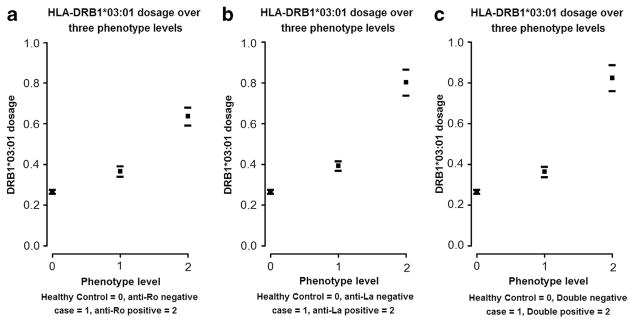
Description:Systemic lupus erythematosus (SLE) is a clinically heterogeneous disease affecting multiple organ systems and characterized by autoantibody formation to nuclear components. Although genetic variation within the major histocompatibility complex (MHC) is associated with SLE, its role in the development of clinical manifestations and autoantibody production is not well defined. We conducted a meta-analysis of four independent European SLE case collections for associations between SLE sub-phenotypes and MHC single-nucleotide polymorphism genotypes, human leukocyte antigen (HLA) alleles and variant HLA amino acids. Of the 11 American College of Rheumatology criteria and 7 autoantibody sub-phenotypes examined, anti-Ro/SSA and anti-La/SSB antibody subsets exhibited the highest number and most statistically significant associations. HLA-DRB1*03:01 was significantly associated with both sub-phenotypes. We found evidence of associations independent of MHC class II variants in the anti-Ro subset alone. Conditional analyses showed that anti-Ro and anti-La subsets are independently associated with HLA-DRB1*0301, and that the HLA-DRB1*03:01 association with SLE is largely but not completely driven by the association of this allele with these sub-phenotypes. Our results provide strong evidence for a multilevel risk model for HLA-DRB1*03:01 in SLE, where the association with anti-Ro and anti-La antibody-positive SLE is much stronger than SLE without these autoantibodies.
-
Subjects:
-
Source:Genes Immun. 2014; 15(4):210-217.
-
Pubmed ID:24598797
-
Pubmed Central ID:PMC4102853
-
Document Type:
-
Funding:076113/Wellcome Trust/United Kingdom ; 085475/Wellcome Trust/United Kingdom ; 17761/PI/Arthritis Research UK/United Kingdom ; 18239/Arthritis Research UK/United Kingdom ; 5 M01 RR-00079/RR/NCRR NIH HHS/United States ; AI024717/AI/NIAID NIH HHS/United States ; AI063274/AI/NIAID NIH HHS/United States ; AI067152/AI/NIAID NIH HHS/United States ; AI082714/AI/NIAID NIH HHS/United States ; AI083194/AI/NIAID NIH HHS/United States ; AI31584/AI/NIAID NIH HHS/United States ; AI40076/AI/NIAID NIH HHS/United States ; AI53747/AI/NIAID NIH HHS/United States ; AI62629/AI/NIAID NIH HHS/United States ; AR02175/AR/NIAMS NIH HHS/United States ; AR043274/AR/NIAMS NIH HHS/United States ; AR048929/AR/NIAMS NIH HHS/United States ; AR049084/AR/NIAMS NIH HHS/United States ; AR052125/AR/NIAMS NIH HHS/United States ; AR052300/AR/NIAMS NIH HHS/United States ; AR19084/AR/NIAMS NIH HHS/United States ; AR22804/AR/NIAMS NIH HHS/United States ; AR42460/AR/NIAMS NIH HHS/United States ; AR48940/AR/NIAMS NIH HHS/United States ; AR62277/AR/NIAMS NIH HHS/United States ; DE15223/DE/NIDCR NIH HHS/United States ; HG006828/HG/NHGRI NIH HHS/United States ; K24 AR002175/AR/NIAMS NIH HHS/United States ; KL2 TR000143/TR/NCATS NIH HHS/United States ; KL2TR000143/TR/NCATS NIH HHS/United States ; M01 RR000079/RR/NCRR NIH HHS/United States ; M01 RR001271/RR/NCRR NIH HHS/United States ; N01 AR062277/AR/NIAMS NIH HHS/United States ; N01AI40076/AI/NIAID NIH HHS/United States ; P01 AI083194/AI/NIAID NIH HHS/United States ; P01 AR048929/AR/NIAMS NIH HHS/United States ; P01 AR049084/AR/NIAMS NIH HHS/United States ; P20 RR020143/RR/NCRR NIH HHS/United States ; P30 GM110766/GM/NIGMS NIH HHS/United States ; P50 AR048940/AR/NIAMS NIH HHS/United States ; P60 AR053308/AR/NIAMS NIH HHS/United States ; PR094002/PR/OCPHP CDC HHS/United States ; R01 AI024717/AI/NIAID NIH HHS/United States ; R01 AI031584/AI/NIAID NIH HHS/United States ; R01 AI063274/AI/NIAID NIH HHS/United States ; R01 AI065841/AI/NIAID NIH HHS/United States ; R01 AR042460/AR/NIAMS NIH HHS/United States ; R01 AR043274/AR/NIAMS NIH HHS/United States ; R01 AR044804/AR/NIAMS NIH HHS/United States ; R01 AR052125/AR/NIAMS NIH HHS/United States ; R01 AR052300/AR/NIAMS NIH HHS/United States ; R01 DE015223/DE/NIDCR NIH HHS/United States ; R21 AI053747/AI/NIAID NIH HHS/United States ; RR20143/RR/NCRR NIH HHS/United States ; U01 HG006828/HG/NHGRI NIH HHS/United States ; U19 AI062629/AI/NIAID NIH HHS/United States ; U19 AI082714/AI/NIAID NIH HHS/United States
-
Volume:15
-
Issue:4
-
Collection(s):
-
Main Document Checksum:urn:sha256:a5a8b7e61d15f4a92f1ba123f16e27becc87dfbc95516fccaf2e38d8f1cc1f3e
-
Download URL:
-
File Type:
 [PDF
- 324.50 KB
]
[PDF
- 324.50 KB
]
Supporting Files


ON THIS PAGE

CDC STACKS serves as an archival repository of CDC-published products including
scientific findings,
journal articles, guidelines, recommendations, or other public health information authored or
co-authored by CDC or funded partners.
As a repository, CDC STACKS retains documents in their original published format to ensure public access to scientific information.
As a repository, CDC STACKS retains documents in their original published format to ensure public access to scientific information.
You May Also Like
COLLECTION
CDC Public Access