



Long-term opioid therapy among patients with systemic lupus erythematosus in the community. A Lupus Midwest Network study
Supporting Files

-
4 2023 ; 4-2023
-
Available in CDC Stacks on 2024-04-01T00:00:00Z
File Language:
English
Details
-
Alternative Title:J Rheumatol
-
Personal Author:Figueroa-Parra, Gabriel
 ;
Jeffery, Molly M.
;
Dabit, Jesse Y.
;
Chevet, Baptiste
;
Valenzuela-Almada, Maria O.
;
Hocaoglu, Mehmet
;
Osei-Onomah, Shirley-Ann
;
Kurani, Shaheen
;
Vallejo, Sebastian
;
Achenbach, Sara J.
;
Hooten, W. Michael
;
Barbour, Kamil E.
;
Crowson, Cynthia S.
;
Duarte-García, Alí
;
Jeffery, Molly M.
;
Dabit, Jesse Y.
;
Chevet, Baptiste
;
Valenzuela-Almada, Maria O.
;
Hocaoglu, Mehmet
;
Osei-Onomah, Shirley-Ann
;
Kurani, Shaheen
;
Vallejo, Sebastian
;
Achenbach, Sara J.
;
Hooten, W. Michael
;
Barbour, Kamil E.
;
Crowson, Cynthia S.
;
Duarte-García, Alí
-
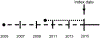
Description:Objective ; There is little information about the epidemiology and factors associated with opioid therapy in systemic lupus erythematosus (SLE). We aimed to assess the prevalence of opioid therapy and explore factors associated with long-term opioid therapy (LTOT) in patients with SLE. ; Methods ; Patients with SLE were matched with non-SLE controls in a population-based cohort on January 1, 2015. We captured demographics, manifestations of lupus, comorbidities (fibromyalgia, mood disorders, osteoarthritis, chronic low back pain CLBP, chronic kidney disease, avascular necrosis, osteoporosis, fragility fractures, and cancer), and the area deprivation index (ADI). Opioid prescription data were used to assess prevalence of LTOT, defined as contiguous prescriptions (gaps of <30 days between prescriptions) and receiving opioid therapy ≥90 days or ≥10 prescriptions before index date. ; Results ; 465 SLE patients and 465 non-SLE controls were included; 13% of SLE patients and 3% of non-SLE controls were receiving opioid therapy (P<0.001), and 11% of SLE patients were on LTOT versus 1% of non-SLE controls. Among SLE patients, acute pericarditis (OR: 3.92; 95% CI: 1.78–8.66), fibromyalgia (OR: 7.78; 95% CI: 3.89–15.55), fragility fractures (OR: 3.72; 95% CI: 1.25–11.07), CLBP (OR: 4.00; 95% CI: 2.13–7.51), and mood disorders (OR: 2.76; 95% CI: 1.47–5.16) were associated with LTOT. We did not find an association between opioid therapy and ADI. ; Conclusion ; Patients with SLE have higher LTOT than controls. Among patients with SLE, LTOT was associated with pericarditis and several comorbidities. However, LTOT was not associated with kidney disease despite the limited pain control options in these patients.
-
Subjects:
-
Keywords:
-
Source:J Rheumatol. 50(4):504-511
-
Pubmed ID:36379579
-
Pubmed Central ID:PMC10066823
-
Document Type:
-
Funding:
-
Volume:50
-
Issue:4
-
Download URL:
-
File Type:
 [PDF - 342.12 KB]
 -
Collection(s):
-
Main Document Checksum:urn:sha256:a4d4dd54293d29bcbf950a957ef32d312286da6c29a26d596d9899acf4f10819
Supporting Files


File Language:
English
 Was this page helpful?
 Found an issue?



CDC STACKS serves as an archival repository of CDC-published products including
scientific findings, journal articles, guidelines, recommendations, or other public health information authored or
co-authored by CDC or funded partners.
As a repository, CDC STACKS retains documents in their original published format to ensure public access to scientific information.
As a repository, CDC STACKS retains documents in their original published format to ensure public access to scientific information.
You May Also Like
COLLECTION
CDC Public Access