



Frequency and Evolution of Azole Resistance in Aspergillus fumigatus Associated with Treatment Failure1
Supporting Files
Public Domain

-
Jul 2009
Details
-
Alternative Title:Emerg Infect Dis
-
Personal Author:
-
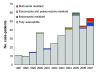
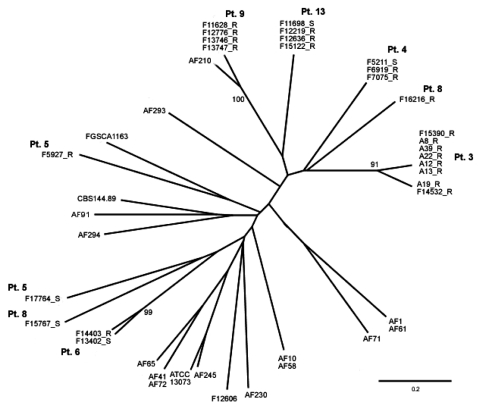
Description:Azoles are the mainstay of oral therapy for aspergillosis. Azole resistance in Aspergillus has been reported infrequently. The first resistant isolate was detected in 1999 in Manchester, UK. In a clinical collection of 519 A. fumigatus isolates, the frequency of itraconazole resistance was 5%, a significant increase since 2004 (p<0.001). Of the 34 itraconazole-resistant isolates we studied, 65% (22) were cross-resistant to voriconazole and 74% (25) were cross-resistant to posaconazole. Thirteen of 14 evaluable patients in our study had prior azole exposure; 8 infections failed therapy (progressed), and 5 failed to improve (remained stable). Eighteen amino acid alterations were found in the target enzyme, Cyp51A, 4 of which were novel. A population genetic analysis of microsatellites showed the existence of resistant mutants that evolved from originally susceptible strains, different cyp51A mutations in the same strain, and microalterations in microsatellite repeat number. Azole resistance in A. fumigatus is an emerging problem and may develop during azole therapy.
-
Subjects:
- Research
- Aspergillus fumigatus
- azoles
- antifungal drug resistance
- sterol 14-alpha demethylase CYP51A
- Aspergillus
- population genetics
- microsatellites
- research
- Amino Acid Substitution
- Antifungal Agents
- Aspergillosis
- Azoles
- Cytochrome P-450 Enzyme System
- Disease Progression
- Drug Resistance, Fungal
- Evolution, Molecular
- Fungal Proteins
- Humans
- Itraconazole
- Pyrimidines
- Treatment Failure
- Triazoles
-
Source:Emerg Infect Dis. 15(7):1068-1076.
-
Document Type:
-
Volume:15
-
Issue:7
-
Download URL:
-
File Type:
 [PDF - 655.31 KB]
 -
Collection(s):
-
Main Document Checksum:urn:sha256:2e377978c9e653933307113d365ce99e94f0c8873ae7d19e67ffa7217e72a627
Supporting Files


 Was this page helpful?
 Found an issue?



CDC STACKS serves as an archival repository of CDC-published products including
scientific findings, journal articles, guidelines, recommendations, or other public health information authored or
co-authored by CDC or funded partners.
As a repository, CDC STACKS retains documents in their original published format to ensure public access to scientific information.
As a repository, CDC STACKS retains documents in their original published format to ensure public access to scientific information.
You May Also Like
COLLECTION
Emerging Infectious Diseases