



In Vitro Cell Culture Infectivity Assay for Human Noroviruses
Supporting Files
Public Domain

-
Mar 2007
-
Series: Emerging Infectious Diseases
File Language:
English
Details
-
Journal Article:Emerging Infectious Diseases
-
Personal Author:Straub, Timothy M. ; Höner zu Bentrup, Kerstin ; Coghlan, Patricia Orosz ; Dohnalkova, Alice ; Mayer, Brooke K. ; Bartholomew, Rachel A. ; Valdez, Catherine O. ; Bruckner-Lea, Cynthia J. ; Gerba, Charles P. ; Abbaszadegan, Morteza A. ; Nickerson, Cheryl A.
-
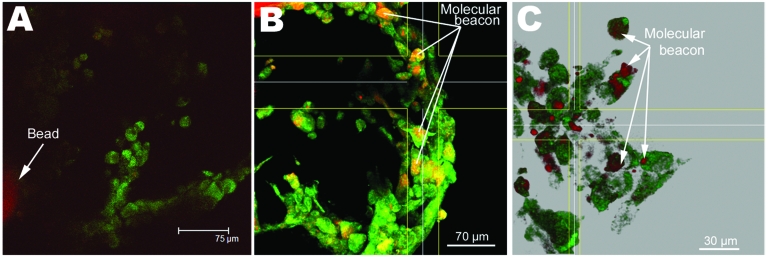
Description:Human noroviruses cause severe, self-limiting gastroenteritis that typically lasts 24-48 hours. Because of the lack of suitable tissue culture or animal models, the true nature of norovirus pathogenesis remains unknown. We show, for the first time, that noroviruses can infect and replicate in a physiologically relevant 3-dimensional (3-D), organoid model of human small intestinal epithelium. This level of cellular differentiation was achieved by growing the cells on porous collagen-I coated microcarrier beads under conditions of physiological fluid shear in rotating wall vessel bioreactors. Microscopy, PCR, and fluorescent in situ hybridization provided evidence of norovirus infection. Cytopathic effect and norovirus RNA were detected at each of the 5 cell passages for genogroup I and II viruses. Our results demonstrate that the highly differentiated 3-D cell culture model can support the natural growth of human noroviruses, whereas previous attempts that used differentiated monolayer cultures failed.
-
Subjects:
-
Series:
-
Pubmed ID:17552092
-
Document Type:
-
Genre:
-
Rights:Public Domain
-
Volume:13
-
Issue:3
-
Citation:Emerg Infect Dis. 13(3):396-403.
-
Download URL:
-
File Type:
 [PDF - 388.74 KB]
 -
Collection(s):
-
Main Document Checksum:urn:sha-512:b930efe733f0c7b8f23c4bf397225ba6233041dea6f23c462faf3d4cb0bb061d67e6d0aa4e7f0a2e415f692f0c7bb0cf6ab8e95921eb0b2864b693483c44a36c
Supporting Files


File Language:
English
 Was this page helpful?
 Found an issue?









CDC STACKS serves as an archival repository of CDC-published products including
scientific findings, journal articles, guidelines, recommendations, or other public health information authored or
co-authored by CDC or funded partners.
As a repository, CDC STACKS retains documents in their original published format to ensure public access to scientific information.
As a repository, CDC STACKS retains documents in their original published format to ensure public access to scientific information.
You May Also Like
COLLECTION
Emerging Infectious Diseases