



Human Rotavirus Serotype G9, São Paulo, Brazil, 1996–2003
Supporting Files
Public Domain

-
Jun 2006
File Language:
English
Details
-
Alternative Title:Emerg Infect Dis
-
Personal Author:
-
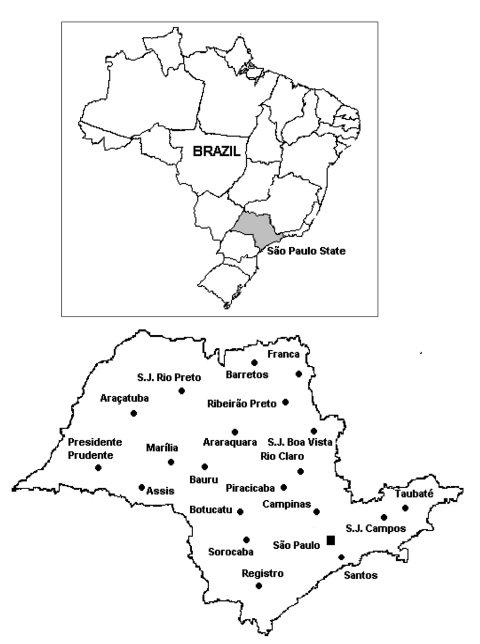
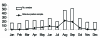
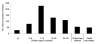
Description:A total of 3,101 fecal specimens were collected during an 8-year survey for rotavirus infection in São Paulo, Brazil. Group A rotavirus was detected in 774 (25.0%) specimens. Of these, 431 strains (55.7%) were analyzed for G and P types by reverse transcription-polymerase chain reaction; G1 was the predominant serotype (68.2%), followed by G9 (17.2%), G4 (6.3%), G2 (1.2%), G3 (0.7%), mixed infection (1.8%), and untypeable (4.6%). Both rotavirus G and P types could be established in 332 strains (77.0%). We identified the 4 most common strains worldwide: P8G1 (66.6%), P4G2 (1.0%), P8G3 (0.6%), and P8G4 (7.2%). Among the single G9 strains detected, VP4 genotyping showed that P8G9 was the most prevalent, followed by P4G9 and P6G9. The emergence and high frequency of rotavirus G9 in São Paulo, Brazil, and other parts of the world will affect the development and evaluation of future vaccines.
-
Subjects:
-
Source:Emerg Infect Dis. 12(6):963-968.
-
Document Type:
-
Place as Subject:
-
Volume:12
-
Issue:6
-
Download URL:
-
File Type:
 [PDF - 215.72 KB]
 -
Collection(s):
-
Main Document Checksum:urn:sha256:fc801dc46f07f8f8377c2f7f1c2384f3d0ad726ca3f59381e3e0ac4af792a126
Supporting Files


File Language:
English
 Was this page helpful?
 Found an issue?



CDC STACKS serves as an archival repository of CDC-published products including
scientific findings, journal articles, guidelines, recommendations, or other public health information authored or
co-authored by CDC or funded partners.
As a repository, CDC STACKS retains documents in their original published format to ensure public access to scientific information.
As a repository, CDC STACKS retains documents in their original published format to ensure public access to scientific information.
You May Also Like
COLLECTION
Emerging Infectious Diseases