



Antibodies to Malondialdehyde-Acetaldehyde Adduct Are Associated with Prevalent and Incident Rheumatoid Arthritis-Associated Interstitial Lung Disease in U.S. Veterans
Supporting Files

-
9 2024 ; 9-2024
-
Available in CDC Stacks on 2025-09-01T00:00:00Z
File Language:
English
Details
-
Alternative Title:Arthritis Rheumatol
-
Personal Author:Aripova, Nozima ; Thiele, Geoffrey M. ; Duryee, Michael J. ; Hunter, Carlos D. ; Yang, Yangyuna ; Roul, Punyasha ; Ascherman, Dana P. ; Matson, Scott M. ; Kunkel, Gary ; Cannon, Grant W. ; Wysham, Katherine D. ; Kerr, Gail S. ; Monach, Paul A. ; Baker, Joshua F. ; Poole, Jill A. ; Mikuls, Ted R. ; England, Bryant R.

-
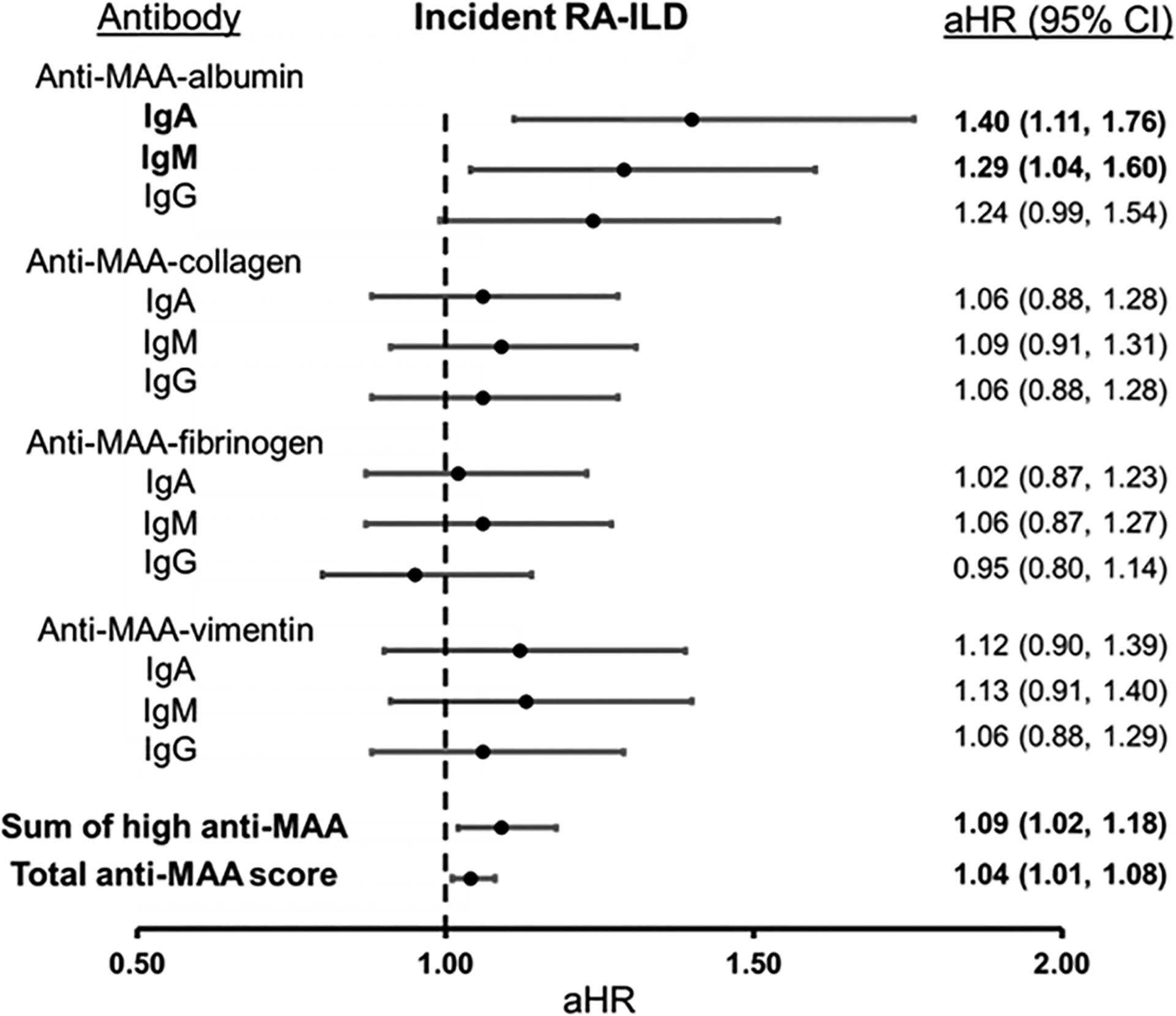
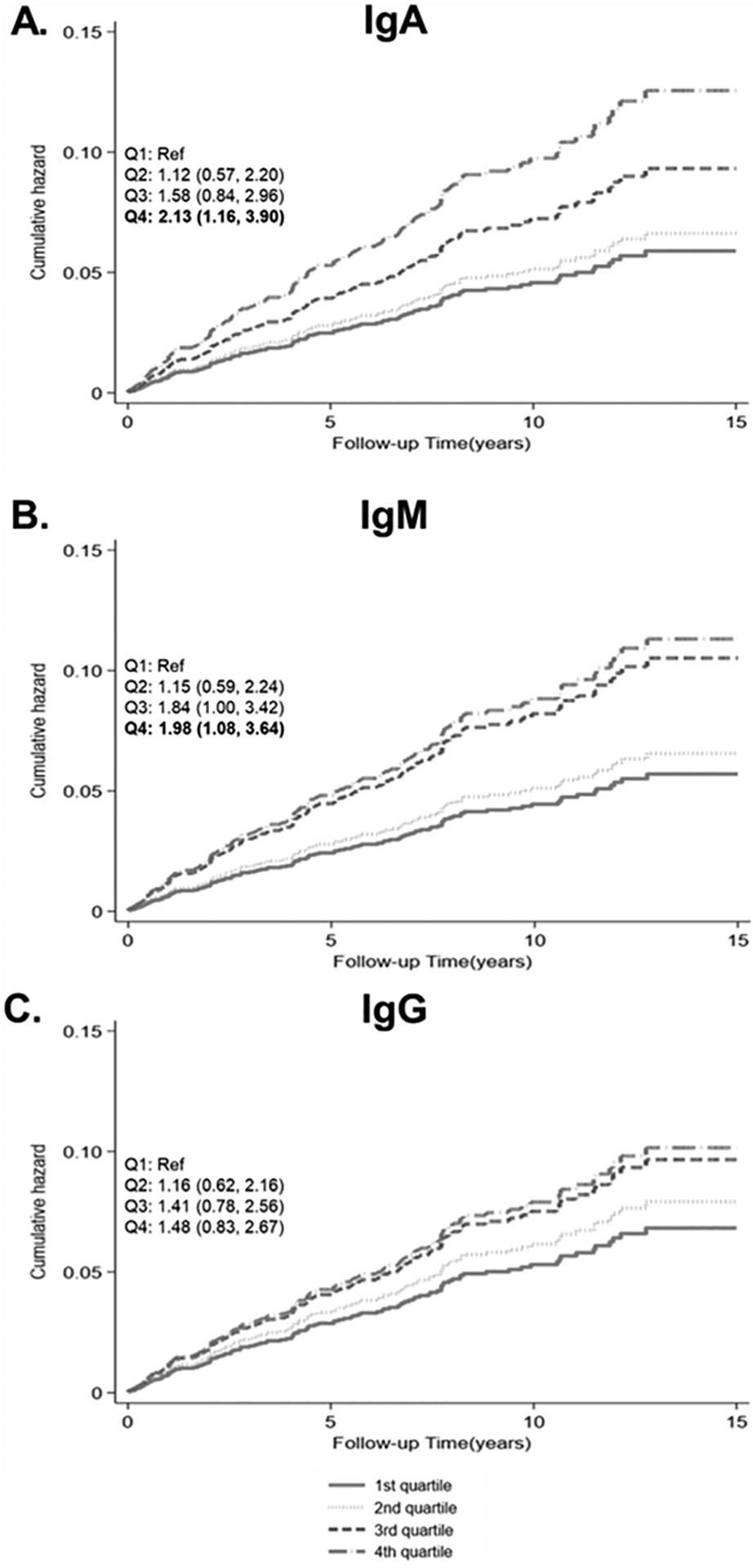
Description:Objective: ; To determine the associations of protein-specific anti-malondialdehyde acetaldehyde (MAA) antibodies with prevalent and incident rheumatoid arthritis-interstitial lung disease (RA-ILD). ; Methods: ; Within a multicenter, prospective cohort of U.S. Veterans with RA, RA-ILD was validated by medical record review of clinical diagnoses, chest imaging, and pathology. Serum antibodies to MAA-albumin, MAA-collagen, MAA-fibrinogen, and MAA-vimentin (IgA, IgM, and IgG) were measured by a standardized ELISA. Associations of anti-MAA antibodies with prevalent and incident RA-ILD were assessed using multivariable regression models adjusting for established RA-ILD risk factors. ; Results: ; Among 2,739 RA participants (88% male, mean age 64 years), there were 114 prevalent and 136 incident RA-ILD cases (average time to diagnosis: 6.6 years). Higher IgM anti-MAA-collagen (per 1 SD: aOR 1.28 1.02–1.61), IgA anti-MAA-fibrinogen (aOR 1.48 1.14–1.92), and IgA (aOR 1.78 1.34–2.37) and IgG (aOR 1.48 1.14–1.92) anti-MAA-vimentin antibodies were associated with prevalent RA-ILD. In incident analyses, higher IgA (per 1 SD: aHR 1.40 1.11–1.76) and IgM (aHR 1.29 1.04–1.60) anti-MAA-albumin antibody concentrations were associated with increased ILD risk. Participants with IgA (aHR 2.13 1.16–3.90) or IgM (aHR 1.98 1.08–3.64) anti-MAA-albumin antibody concentrations in the highest quartile had an approximate 2-fold increased risk of incident RA-ILD. Across all isotypes, anti-MAA-fibrinogen, -collagen, and -vimentin antibodies were not significantly associated with incident RA-ILD. ; Conclusions: ; Protein-specific anti-MAA antibodies to collagen, fibrinogen, and vimentin were associated with prevalent RA-ILD. IgA and IgM anti-MAA-albumin antibodies were associated with a higher risk of incident RA-ILD. These findings suggest that MAA-modifications and resultant immune responses may contribute to RA-ILD pathogenesis.
-
Subjects:
-
Keywords:
-
Source:Arthritis Rheumatol. 76(9):1353-1363
-
Pubmed ID:38766737
-
Pubmed Central ID:PMC11349468
-
Document Type:
-
Funding:PR200793/U.S. Department of Defense/ ; P20GM130423/GM/NIGMS NIH HHSUnited States/ ; BX004600/Veterans Affairs Biomedical Laboratory Research and Development/ ; IK CX002351/Veterans Affairs Clinical Science Research and Development/ ; I01 RX003644/RX/RRD VAUnited States/ ; P20 GM130423/GM/NIGMS NIH HHSUnited States/ ; I01 BX003635/BX/BLRD VAUnited States/ ; IK2 CX002351/CX/CSRD VAUnited States/ ; U54 GM115458/GM/NIGMS NIH HHSUnited States/ ; Rheumatology Research Foundation/ ; I01 BX004660/BX/BLRD VAUnited States/ ; IK2 CX002203/CX/CSRD VAUnited States/ ; R01 OH012045/OH/NIOSH CDC HHSUnited States/ ; U54GM115458/GM/NIGMS NIH HHSUnited States/ ; I01 CX001703/CX/CSRD VAUnited States/
-
Volume:76
-
Issue:9
-
Download URL:
-
File Type:
 [PDF - 649.85 KB]
 -
Collection(s):
-
Main Document Checksum:urn:sha-512:26c59db16b3f7f59422d4f44634c1f707bc37833cf73f1949badd74bb782b9f35f81cd02fa0cde080a6b7608e0ba836bbbf67f3a2744c7e29b9f07fd10a0abf5
Supporting Files


File Language:
English
 Was this page helpful?
 Found an issue?



CDC STACKS serves as an archival repository of CDC-published products including
scientific findings, journal articles, guidelines, recommendations, or other public health information authored or
co-authored by CDC or funded partners.
As a repository, CDC STACKS retains documents in their original published format to ensure public access to scientific information.
As a repository, CDC STACKS retains documents in their original published format to ensure public access to scientific information.
You May Also Like
COLLECTION
CDC Public Access