



Combined Collagen-Induced Arthritis and Organic Dust-Induced Airway Inflammation to Model Inflammatory Lung Disease in Rheumatoid Arthritis
Supporting Files

-
9 2019 ; 9-2019
-
Available in CDC Stacks on 2020-09-01T00:00:00Z
File Language:
English
Details
-
Alternative Title:J Bone Miner Res
-
Personal Author:Poole, Jill A. ; Thiele, Geoffrey M. ; Janike, Katherine ; Nelson, Amy J. ; Duryee, Michael J. ; Rentfro, Kathryn ; England, Bryant R. ; Romberger, Debra J. ; Carrington, Joseph M. ; Wang, Dong ; Swanson, Benjamin J. ; Klassen, Lynell W. ; Mikuls, Ted R.
-
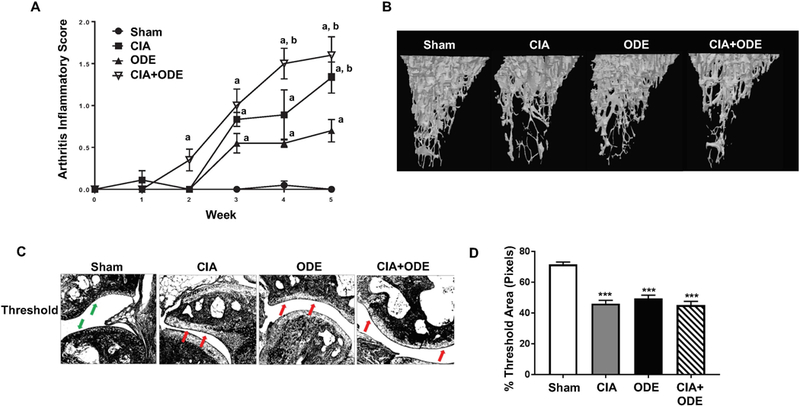
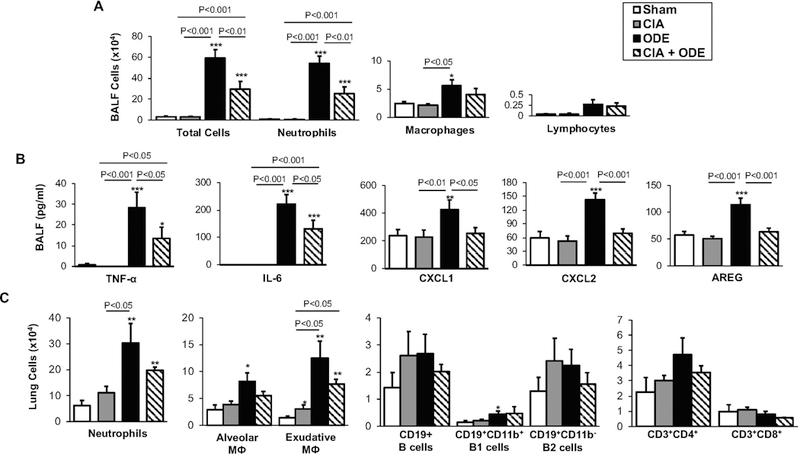
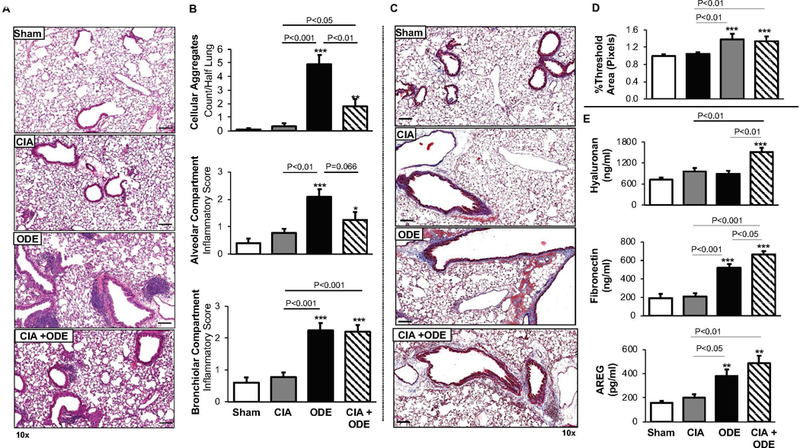
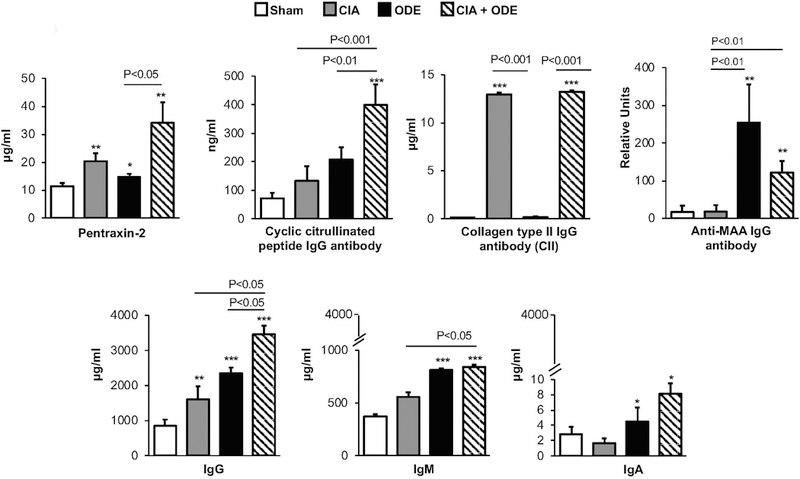
Description:Objectives: ; Rheumatoid Arthritis (RA) is characterized by extra-articular involvement including lung disease, yet the mechanisms linking the two conditions are poorly understood. The collagen–induced arthritis (CIA) model was combined with the organic dust extract (ODE) airway inflammatory model to assess bone/joint-lung inflammatory outcomes. ; Methods: ; DBA/1J mice were intranasally treated with saline or ODE daily for 5 weeks. CIA was induced on Days 1 and 21. Treatment groups included Sham (saline injection/saline inhalation); CIA (CIA/saline); ODE (saline/ODE); CIA+ODE (CIA/ODE). Arthritis inflammatory scores, bones, bronchoalveolar lavage fluid, lung tissues, and serum were assessed. ; Results: ; In DBA/1J male mice, arthritis was increased in CIA+ODE>CIA>ODE vs. Sham. Micro-CT demonstrated loss of bone mineral density and volume and deterioration of bone micro-architecture to be greatest in CIA+ODE. However, ODE-induced airway neutrophil influx and inflammatory cytokine/chemokine levels in lavage fluids were increased in ODE>CIA+ODE vs. sham. Activated lung CD11c+CD11b+ macrophages were increased in ODE>CIA+ODE>CIA pattern while lung hyaluronan, fibronectin, and amphiregulin levels were greatest in CIA+ODE. Serum autoantibody and inflammatory marker concentrations varied among experimental groups. Compared to male mice, female mice showed less articular and pulmonary disease. ; Conclusion: ; The interaction of inhalation induced airway inflammation and arthritis induction resulted in compartmentalized responses with the greatest degree of arthritis and bone loss in male mice with combined exposures. Data also support suppression of the lung inflammatory response but increases in extracellular matrix protein deposition/interstitial disease in the setting of arthritis. This co-exposure model could be exploited to better understand and treat RA-lung disease.
-
Subjects:
-
Keywords:
-
Source:J Bone Miner Res. 34(9):1733-1743
-
Pubmed ID:30995344
-
Pubmed Central ID:PMC6744331
-
Document Type:
-
Funding:R01ES019325/ES/NIEHS NIH HHSUnited States/ ; U54 GM115458/GM/NIGMS NIH HHSUnited States/ ; U54OH010162/ACL/ACL HHSUnited States/ ; I01 CX000896/CX/CSRD VAUnited States/ ; U54GM115458/GM/NIGMS NIH HHSUnited States/ ; I01 CX001714/CX/CSRD VAUnited States/ ; R01 ES019325/ES/NIEHS NIH HHSUnited States/ ; P30CA036727/CA/NCI NIH HHSUnited States/ ; R25AA020818/AA/NIAAA NIH HHSUnited States/ ; P30 CA036727/CA/NCI NIH HHSUnited States/ ; U54 OH010162/OH/NIOSH CDC HHSUnited States/ ; R25 AA020818/AA/NIAAA NIH HHSUnited States/
-
Volume:34
-
Issue:9
-
Download URL:
-
File Type:
 [PDF - 821.36 KB]
 -
Collection(s):
-
Main Document Checksum:urn:sha-512:378d0932105d6a89949839919cc5018aa1fd927a5681fa32c6cc18e37b099204e258dd9e8b163fcaf1f4ffc77b46cd50d4868ce9498389a79d2973f599cb1555
Supporting Files


File Language:
English
 Was this page helpful?
 Found an issue?




CDC STACKS serves as an archival repository of CDC-published products including
scientific findings, journal articles, guidelines, recommendations, or other public health information authored or
co-authored by CDC or funded partners.
As a repository, CDC STACKS retains documents in their original published format to ensure public access to scientific information.
As a repository, CDC STACKS retains documents in their original published format to ensure public access to scientific information.
You May Also Like
COLLECTION
CDC Public Access