



A one health approach for monitoring antimicrobial resistance: developing a national freshwater pilot effort
Supporting Files

-
5 17 2024
-
File Language:
English
Details
-
Alternative Title:Front Water
-
Personal Author:Franklin, Alison M. ; Weller, Daniel L. ; Durso, Lisa M. ; Bagley, Mark ; Davis, Benjamin C. ; Frye, Jonathan G. ; Grim, Christopher J. ; Ibekwe, Abasiofiok M. ; Jahne, Michael A. ; Keely, Scott P. ; Kraft, Autumn L. ; McConn, Betty R. ; Mitchell, Richard M. ; Ottesen, Andrea R. ; Sharma, Manan ; Strain, Errol A. ; Tadesse, Daniel A. ; Tate, Heather ; Wells, Jim E. ; Williams, Clinton F. ; Cook, Kim L. ; Kabera, Claudine ; McDermott, Patrick F. ; Garland, Jay L.
-
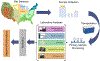
Description:Antimicrobial resistance (AMR) is a world-wide public health threat that is projected to lead to 10 million annual deaths globally by 2050. The AMR public health issue has led to the development of action plans to combat AMR, including improved antimicrobial stewardship, development of new antimicrobials, and advanced monitoring. The National Antimicrobial Resistance Monitoring System (NARMS) led by the United States (U.S) Food and Drug Administration along with the U.S. Centers for Disease Control and U.S. Department of Agriculture has monitored antimicrobial resistant bacteria in retail meats, humans, and food animals since the mid 1990's. NARMS is currently exploring an integrated One Health monitoring model recognizing that human, animal, plant, and environmental systems are linked to public health. Since 2020, the U.S. Environmental Protection Agency has led an interagency NARMS environmental working group (EWG) to implement a surface water AMR monitoring program (SWAM) at watershed and national scales. The NARMS EWG divided the development of the environmental monitoring effort into five areas: (i) defining objectives and questions, (ii) designing study/sampling design, (iii) selecting AMR indicators, (iv) establishing analytical methods, and (v) developing data management/analytics/metadata plans. For each of these areas, the consensus among the scientific community and literature was reviewed and carefully considered prior to the development of this environmental monitoring program. The data produced from the SWAM effort will help develop robust surface water monitoring programs with the goal of assessing public health risks associated with AMR pathogens in surface water (e.g., recreational water exposures), provide a comprehensive picture of how resistant strains are related spatially and temporally within a watershed, and help assess how anthropogenic drivers and intervention strategies impact the transmission of AMR within human, animal, and environmental systems.
-
Keywords:
-
Source:Front Water. 6
-
Pubmed ID:38855419
-
Pubmed Central ID:PMC11157689
-
Document Type:
-
Funding:
-
Volume:6
-
Collection(s):
-
Main Document Checksum:urn:sha256:a01e629b70559172040f7711d32c3bfdabbb664298d58b5a17ca160eeedec574
-
Download URL:
-
File Type:
 [PDF
- 838.29 KB
]
[PDF
- 838.29 KB
]
Supporting Files


File Language:
English
 Was this page helpful?
 Found an issue?


CDC STACKS serves as an archival repository of CDC-published products including
scientific findings,
journal articles, guidelines, recommendations, or other public health information authored or
co-authored by CDC or funded partners.
As a repository, CDC STACKS retains documents in their original published format to ensure public access to scientific information.
As a repository, CDC STACKS retains documents in their original published format to ensure public access to scientific information.
You May Also Like
COLLECTION
CDC Public Access