



Sulfa Use, Dihydropteroate Synthase Mutations, and Pneumocystis jirovecii Pneumonia
Supporting Files
Public Domain

-
Oct 2004
File Language:
English
Details
-
Alternative Title:Emerg Infect Dis
-
Personal Author:
-
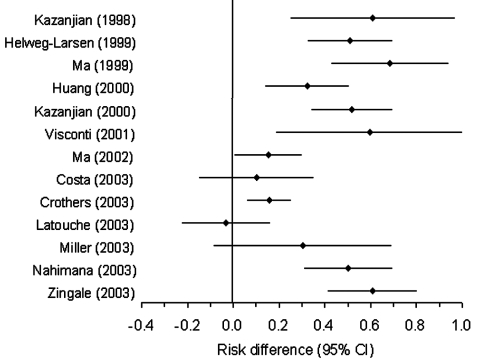
Description:A systematic review was conducted to examine the associations in Pneumocystis jirovecii pneumonia (PCP) patients between dihydropteroate synthase (DHPS) mutations and sulfa or sulfone (sulfa) prophylaxis and between DHPS mutations and sulfa treatment outcome. Selection criteria included study populations composed entirely of PCP patients and mutation or treatment outcome results for all patients, regardless of exposure status. Based on 13 studies, the risk of developing DHPS mutations is higher for PCP patients receiving sulfa prophylaxis than for PCP patients not receiving sulfa prophylaxis (p < 0.001). Results are too heterogeneous (p < 0.001) to warrant a single summary effect estimate. Estimated effects are weaker after 1996 and stronger in studies that included multiple isolates per patient. Five studies examined treatment outcome. The effect of DHPS mutations on treatment outcome has not been well studied, and the few studies that have been conducted are inconsistent even as to the presence or absence of an association.
-
Subjects:
-
Source:Emerg Infect Dis. 10(10):1760-1765.
-
Document Type:
-
Volume:10
-
Issue:10
-
Download URL:
-
File Type:
 [PDF - 141.41 KB]
 -
Collection(s):
-
Main Document Checksum:urn:sha256:cd3d92b8679592eb4093ac0fdfd9d2f0dbf61b6bdd97c2268a2fa08587172389
Supporting Files


File Language:
English
 Was this page helpful?
 Found an issue?


CDC STACKS serves as an archival repository of CDC-published products including
scientific findings, journal articles, guidelines, recommendations, or other public health information authored or
co-authored by CDC or funded partners.
As a repository, CDC STACKS retains documents in their original published format to ensure public access to scientific information.
As a repository, CDC STACKS retains documents in their original published format to ensure public access to scientific information.
You May Also Like
COLLECTION
Emerging Infectious Diseases