



Silent Nucleotide Polymorphisms and a Phylogeny for Mycobacterium tuberculosis
Supporting Files
Public Domain

-
Sep 2004
Details
-
Alternative Title:Emerg Infect Dis
-
Personal Author:
-
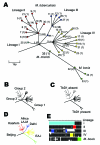
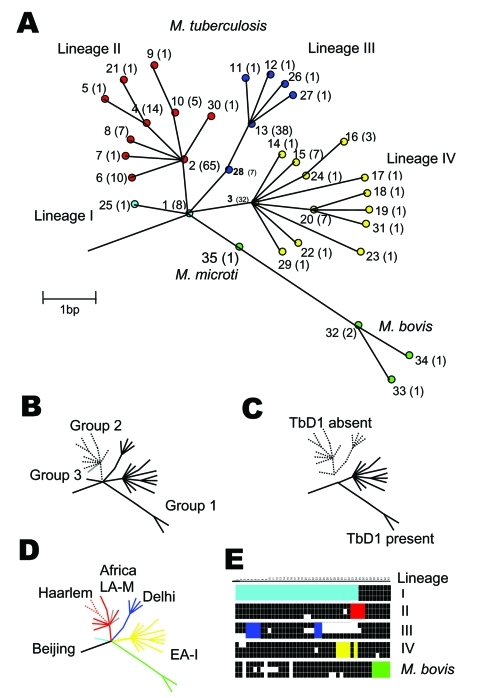
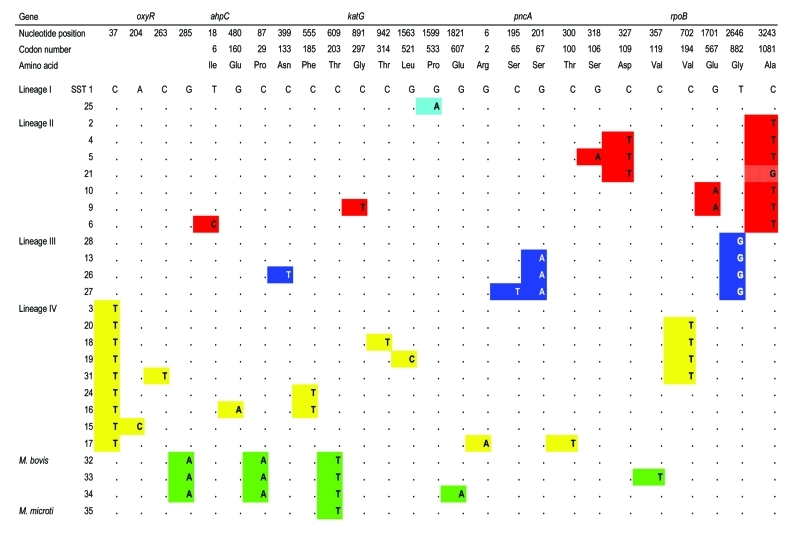
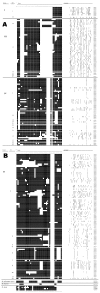
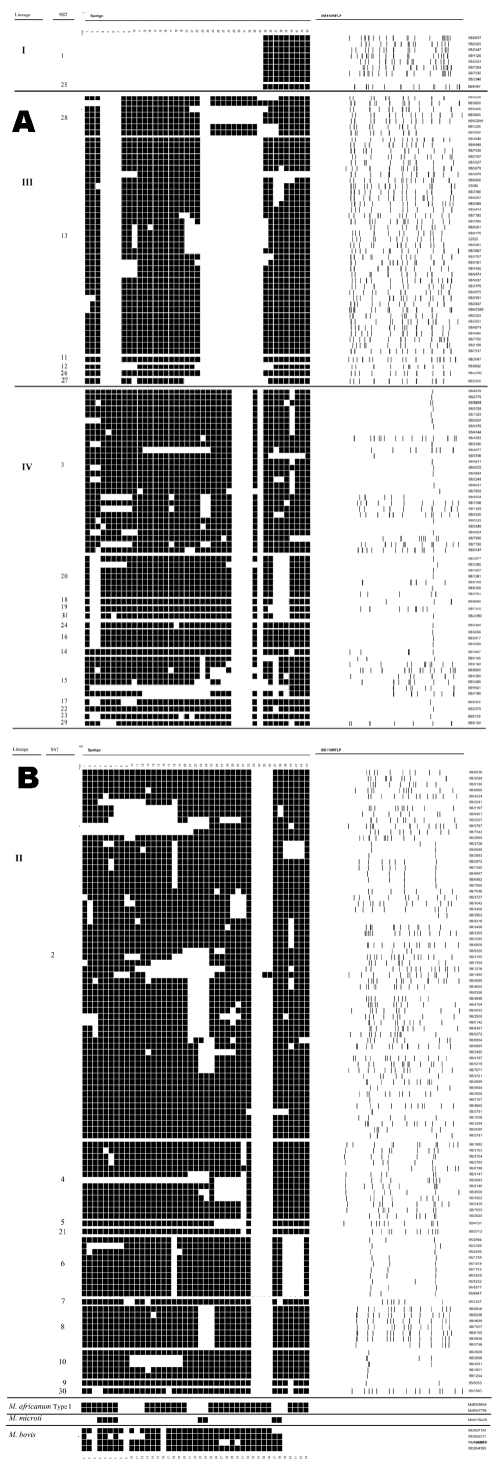
Description:Much remains unknown of the phylogeny and evolution of Mycobacterium tuberculosis, an organism that kills 2 million people annually. Using a population-based approach that analyzes multiple loci around the chromosome, we demonstrate that neutral genetic variation in genes associated with antimicrobial drug resistance has sufficient variation to construct a robust phylogenetic tree for M. tuberculosis. The data describe a clonal population with a minimum of four distinct M. tuberculosis lineages, closely related to M. bovis. The lineages are strongly geographically associated. Nucleotide substitutions proven to cause drug resistance are distributed throughout the tree, whereas nonsynonymous base substitutions unrelated to drug resistance have a restricted distribution. The phylogenetic structure is concordant with all the previously described genotypic and phenotypic groupings of M. tuberculosis strains and provides a unifying framework for both epidemiologic and evolutionary analysis of M. tuberculosis populations.
-
Subjects:
- Research
- Molecular evolution
- bacterial genetics
- Mycobacterium tuberculosis
- Mycobacterium bovis
- phylogeny
- polymorphism
- tuberculosis
- Amidohydrolases
- Antitubercular Agents
- Bacterial Proteins
- Base Sequence
- Catalase
- DNA Fingerprinting
- DNA Gyrase
- DNA-Directed RNA Polymerases
- Drug Resistance, Multiple, Bacterial
- Evolution, Molecular
- Genetic Variation
- Molecular Sequence Data
- Phylogeny
- Polymorphism, Single Nucleotide
- Ribosomal Proteins
- Sequence Alignment
- Sequence Analysis, DNA
-
Source:Emerg Infect Dis. 10(9):1568-1577.
-
Document Type:
-
Volume:10
-
Issue:9
-
Download URL:
-
File Type:
 [PDF - 309.04 KB]
 -
Collection(s):
-
Main Document Checksum:urn:sha256:2b519ef3726c48f5936094ac74c41b369d7c7e7d48e7998c5b048e40845a1b47
Supporting Files


 Was this page helpful?
 Found an issue?

CDC STACKS serves as an archival repository of CDC-published products including
scientific findings, journal articles, guidelines, recommendations, or other public health information authored or
co-authored by CDC or funded partners.
As a repository, CDC STACKS retains documents in their original published format to ensure public access to scientific information.
As a repository, CDC STACKS retains documents in their original published format to ensure public access to scientific information.
You May Also Like
COLLECTION
Emerging Infectious Diseases