



Molecular Characterization of a Non–Babesia divergens Organism Causing Zoonotic Babesiosis in Europe
Supporting Files
Public Domain

-
Aug 2003
File Language:
English
Details
-
Alternative Title:Emerg Infect Dis
-
Personal Author:
-
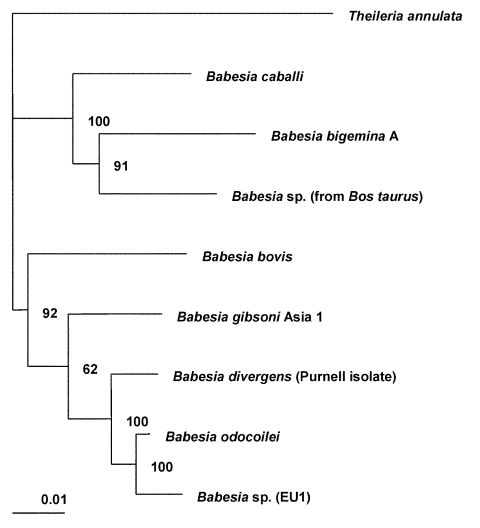
Description:In Europe, most reported human cases of babesiosis have been attributed, without strong molecular evidence, to infection with the bovine parasite Babesia divergens. We investigated the first known human cases of babesiosis in Italy and Austria, which occurred in two asplenic men. The complete 18S ribosomal RNA (18S rRNA) gene was amplified from specimens of their whole blood by polymerase chain reaction (PCR). With phylogenetic analysis, we compared the DNA sequences of the PCR products with those for other Babesia spp. The DNA sequences were identical for the organism from the two patients. In phylogenetic analysis, the organism clusters with B. odocoilei, a parasite of white-tailed deer; these two organisms form a sister group with B. divergens. This evidence indicates the patients were not infected with B. divergens but with an organism with previously unreported molecular characteristics for the 18S rRNA gene.
-
Subjects:
-
Source:Emerg Infect Dis. 9(8):943-948
-
Pubmed ID:12967491
-
Pubmed Central ID:PMC3020600
-
Document Type:
-
Place as Subject:
-
Volume:9
-
Issue:8
-
Download URL:
-
File Type:
 [PDF - 285.59 KB]
 -
Collection(s):
-
Main Document Checksum:urn:sha256:01d38762d64055563f413f999b52652a678af04389b58edf220e7b301dfcbbb2
Supporting Files


File Language:
English
 Was this page helpful?
 Found an issue?




CDC STACKS serves as an archival repository of CDC-published products including
scientific findings, journal articles, guidelines, recommendations, or other public health information authored or
co-authored by CDC or funded partners.
As a repository, CDC STACKS retains documents in their original published format to ensure public access to scientific information.
As a repository, CDC STACKS retains documents in their original published format to ensure public access to scientific information.
You May Also Like
COLLECTION
Emerging Infectious Diseases