



Prenatal ultrasound use and risk of autism spectrum disorder: Findings from the case-control Study to Explore Early Development
Supporting Files

-
2023/08/01
-
Available in CDC Stacks on August 01, 2024, 12:00 AM

File Language:
English
Details
-
Alternative Title:Paediatr Perinat Epidemiol
-
Personal Author:
-
Description:Background:
Studies evaluating the association between prenatal ultrasounds and autism spectrum disorder (ASD) have largely produced negative results. Concern remains due to the rising identification of children with ASD and ultrasound use.
Objective:
To evaluate the association between prenatal ultrasound use and ASD.
Methods:
We used data from the Study to Explore Early Development, a multisite case-control study of preschool-aged children with ASD implemented during 2007-2012. We recruited cases from children receiving developmental disability services and randomly selected population controls from birth records. ASD case status was based on in-person standardised assessments. We stratified analyses by pre-existing maternal medical conditions and pregnancy complications associated with increased ultrasound use (ultrasound indications) and used logistic regression to model case status by increasing ultrasound counts. For pregnancies with medical record data on ultrasound timing, we conducted supplementary tests to model associations by trimester of exposure.
Results:
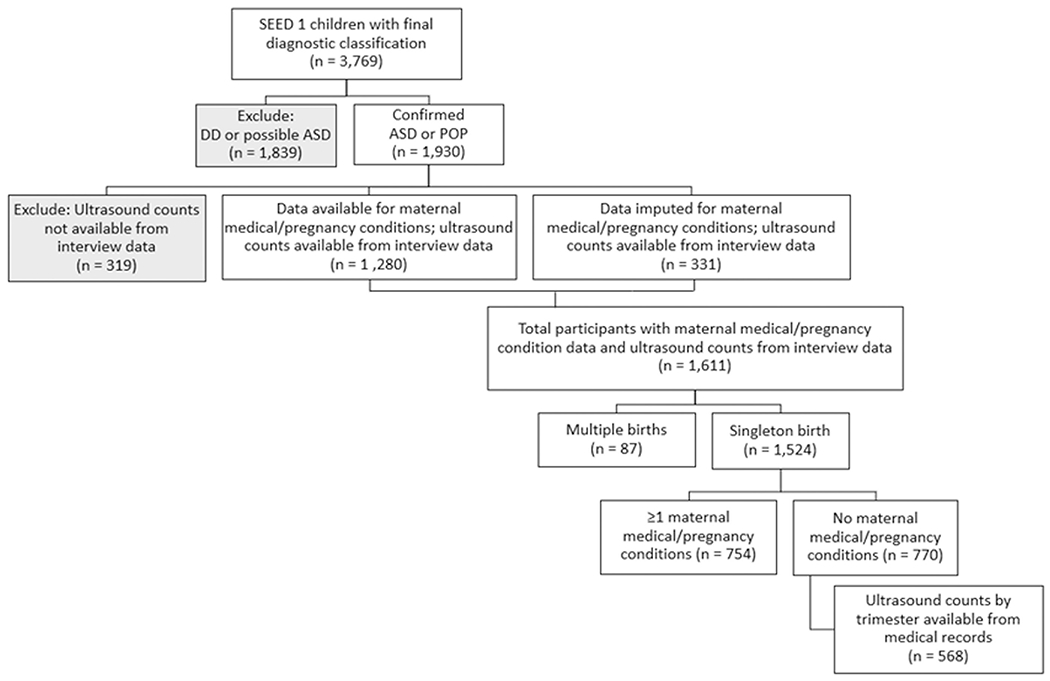
Among 1524 singleton pregnancies, ultrasound indications were more common for ASD cases than controls; respectively, for each group, no indications were reported for 45.1% and 54.2% of pregnancies, while ≥2 indications were reported for 26.1% and 18.4% of pregnancies. The percentage of pregnancies with multiple ultrasounds varied by case status and the presence of ultrasound indications. However, stratified regression models showed no association between increasing ultrasound counts and case status, either for pregnancies without (aOR 1.01, 95% CI 0.92, 1.11) or with ultrasound indications (aOR 1.01, 95% CI 0.95, 1.08). Trimester-specific analyses using medical record data showed no association in any individual trimester.
Conclusions:
We found no evidence that prenatal ultrasound use increases ASD risk. Study strengths included gold-standard assessments for ASD case classification, comparison of cases with controls, and a stratified sample to account for conditions associated both with increased prenatal ultrasound use and ASD. -
Subjects:
-
Keywords:
-
Source:Paediatr Perinat Epidemiol. 37(6):527-535
-
Pubmed ID:37483151
-
Pubmed Central ID:PMC10527947
-
Document Type:
-
Funding:U10 DD000180/DD/NCBDD CDC HHSUnited States/ ; U10 DD000181/DD/NCBDD CDC HHSUnited States/ ; U10 DD000184/DD/NCBDD CDC HHSUnited States/ ; U01 DD000498/DD/NCBDD CDC HHSUnited States/ ; CC999999/ImCDC/Intramural CDC HHSUnited States/ ; U01 DD000750/DD/NCBDD CDC HHSUnited States/ ; U10 DD000182/DD/NCBDD CDC HHSUnited States/ ; U10 DD000183/DD/NCBDD CDC HHSUnited States/
-
Genre:
-
Volume:37
-
Issue:6
-
Download URL:
-
File Type:
 [PDF - 180.51 KB]
 -
Collection(s):
-
Main Document Checksum:urn:sha-512:6bf2ec09351988f64c3773281a5a7be26303c7aaa3f90aefdd74df26e3f83533233af58cc54de80f9865e813a9ba40153c2c76947843d29d541b58bd45211b79
Supporting Files


File Language:
English
 Was this page helpful?
 Found an issue?

CDC STACKS serves as an archival repository of CDC-published products including
scientific findings, journal articles, guidelines, recommendations, or other public health information authored or
co-authored by CDC or funded partners.
As a repository, CDC STACKS retains documents in their original published format to ensure public access to scientific information.
As a repository, CDC STACKS retains documents in their original published format to ensure public access to scientific information.
You May Also Like
COLLECTION
CDC Public Access