



Pregnancy Planning and its Association with Autism Spectrum Disorder: Findings from the Study to Explore Early Development
Supporting Files

-
2024/05/01
-
Available in CDC Stacks on May 01, 2024, 12:00 AM

File Language:
English
Details
-
Alternative Title:Matern Child Health J
-
Personal Author:
-
Description:Objectives
To examine associations between pregnancy planning and autism spectrum disorder (ASD) in offspring.
Methods
The Study to Explore Early Development (SEED), a multi-site case-control study, enrolled preschool-aged children with ASD, other DDs, and from the general population (POP). Some children with DDs had ASD symptoms but did not meet the ASD case definition. We examined associations between mother's report of trying to get pregnant (pregnancy planning) and (1) ASD and (2) ASD symptomatology (ASD group, plus DD with ASD symptoms group combined) (each vs. POP group). We computed odds ratios adjusted for demographic, maternal, health, and perinatal health factors (aORs) via logistic regression. Due to differential associations by race-ethnicity, final analyses were stratified by race-ethnicity.
Results
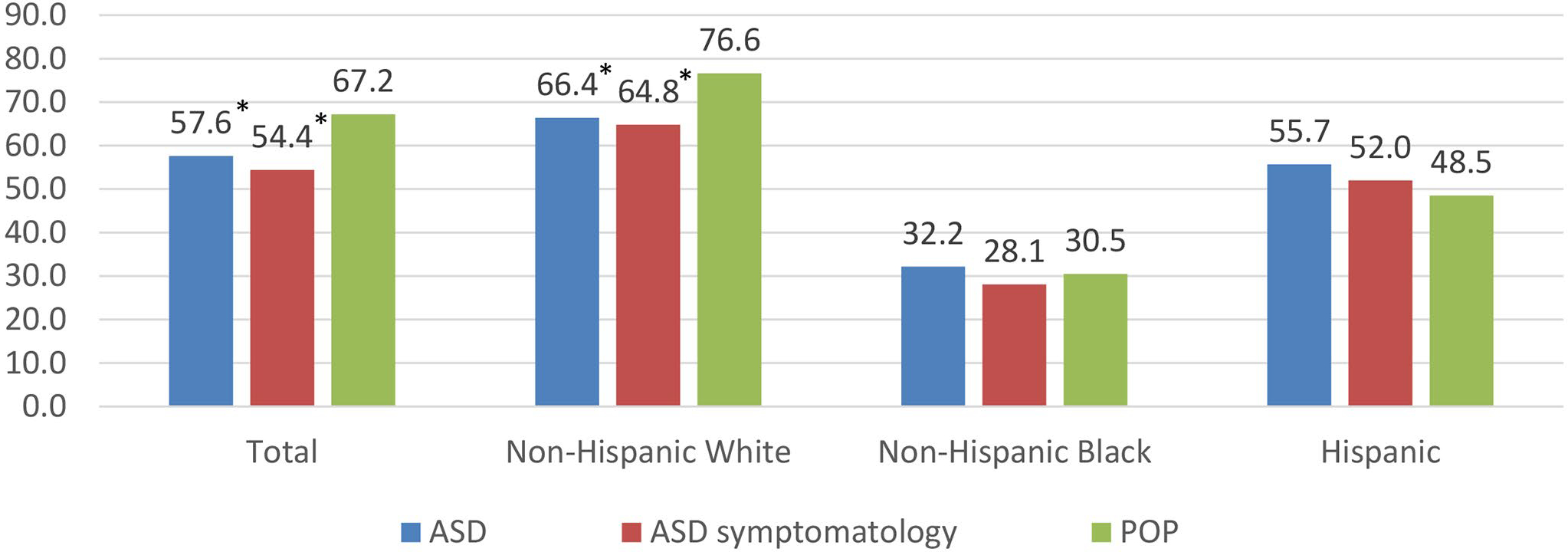
Pregnancy planning was reported by 66.4%, 64.8%, and 76.6% of non-Hispanic White (NHW) mothers in the ASD, ASD symptomatology, and POP groups, respectively. Among NHW mother-child pairs, pregnancy planning was inversely associated with ASD (aOR = 0.71 95% confidence interval 0.56-0.91) and ASD symptomatology (aOR = 0.67 0.54-0.84). Pregnancy planning was much less common among non-Hispanic Black mothers (28-32% depending on study group) and Hispanic mothers (49-56%) and was not associated with ASD or ASD symptomatology in these two race-ethnicity groups.
Conclusion
Pregnancy planning was inversely associated with ASD and ASD symptomatology in NHW mother-child pairs. The findings were not explained by several adverse maternal or perinatal health factors. The associations observed in NHW mother-child pairs did not extend to other race-ethnicity groups, for whom pregnancy planning was lower overall. -
Subjects:
-
Keywords:
-
Source:Matern Child Health J. 28(5):949-958
-
Pubmed ID:38198102
-
Pubmed Central ID:PMC11001519
-
Document Type:
-
Funding:U10 DD000180/DD/NCBDD CDC HHSUnited States/ ; National Center on Birth Defects and Developmental Disabilities/DD/NCBDD CDC HHSUnited States/ ; U10 DD000901/DD/NCBDD CDC HHSUnited States/ ; U10 DD000181/DD/NCBDD CDC HHSUnited States/ ; U10 DD000184/DD/NCBDD CDC HHSUnited States/ ; U01 DD000498/DD/NCBDD CDC HHSUnited States/ ; CC999999/ImCDC/Intramural CDC HHSUnited States/ ; U10 DD000182/DD/NCBDD CDC HHSUnited States/ ; U10 DD000183/DD/NCBDD CDC HHSUnited States/
-
Genre:
-
Volume:28
-
Issue:5
-
Download URL:
-
File Type:
 [PDF - 493.44 KB]
 -
Collection(s):
-
Main Document Checksum:urn:sha-512:9f11235307e4aa682ca49bc04127539df58302201d486a79fd5deeb8efafbff16afd859c65629aec7d99d8b949d399c13aab6c708d8b702fbe882c5ab94eea74
Supporting Files


File Language:
English
 Was this page helpful?
 Found an issue?


CDC STACKS serves as an archival repository of CDC-published products including
scientific findings, journal articles, guidelines, recommendations, or other public health information authored or
co-authored by CDC or funded partners.
As a repository, CDC STACKS retains documents in their original published format to ensure public access to scientific information.
As a repository, CDC STACKS retains documents in their original published format to ensure public access to scientific information.
You May Also Like
COLLECTION
CDC Public Access