



Flexible, high-resolution cortical arrays with large coverage capture microscale high-frequency oscillations in patients with epilepsy
Supporting Files

-
7 2023 ; 7-2023
-
Available in CDC Stacks on July 01, 2024, 12:00 AM
File Language:
English
Details
-
Alternative Title:Epilepsia
-
Personal Author:Barth, Katrina J.
 ;
Sun, James
;
Chiang, Chia-Han
;
Qiao, Shaoyu
;
Wang, Charles
;
Rahimpour, Shervin
;
Trumpis, Michael
;
Duraivel, Suseendrakumar
;
Dubey, Agrita
;
Wingel, Katie E.
;
Voinas, Alex E.
;
Ferrentino, Breonna
;
Doyle, Werner
;
Southwell, Derek G.
;
Haglund, Michael M.
;
Vestal, Matthew
;
Harward, Stephen C.
;
Solzbacher, Florian
;
Devore, Sasha
;
Devinsky, Orrin
;
Friedman, Daniel
;
Pesaran, Bijan
;
Sinha, Saurabh R.
;
Cogan, Gregory B.
;
Blanco, Justin
;
Viventi, Jonathan
;
Sun, James
;
Chiang, Chia-Han
;
Qiao, Shaoyu
;
Wang, Charles
;
Rahimpour, Shervin
;
Trumpis, Michael
;
Duraivel, Suseendrakumar
;
Dubey, Agrita
;
Wingel, Katie E.
;
Voinas, Alex E.
;
Ferrentino, Breonna
;
Doyle, Werner
;
Southwell, Derek G.
;
Haglund, Michael M.
;
Vestal, Matthew
;
Harward, Stephen C.
;
Solzbacher, Florian
;
Devore, Sasha
;
Devinsky, Orrin
;
Friedman, Daniel
;
Pesaran, Bijan
;
Sinha, Saurabh R.
;
Cogan, Gregory B.
;
Blanco, Justin
;
Viventi, Jonathan
-
Description:Summary
Objective:
Effective surgical treatment of drug resistant epilepsy depends on accurate localization of the epileptogenic zone (EZ). High frequency oscillations (HFOs) are potential biomarkers of the EZ. Previous research has shown that HFOs often occur within submillimeter areas of brain tissue and that the coarse spatial sampling of clinical intracranial electrode arrays may limit the accurate capture of HFO activity. In this study, we sought to characterize microscale HFO activity captured on thin, flexible micro-electrocorticographic (μECoG) arrays, which provide high spatial resolution over large cortical surface areas.
Methods:
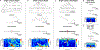
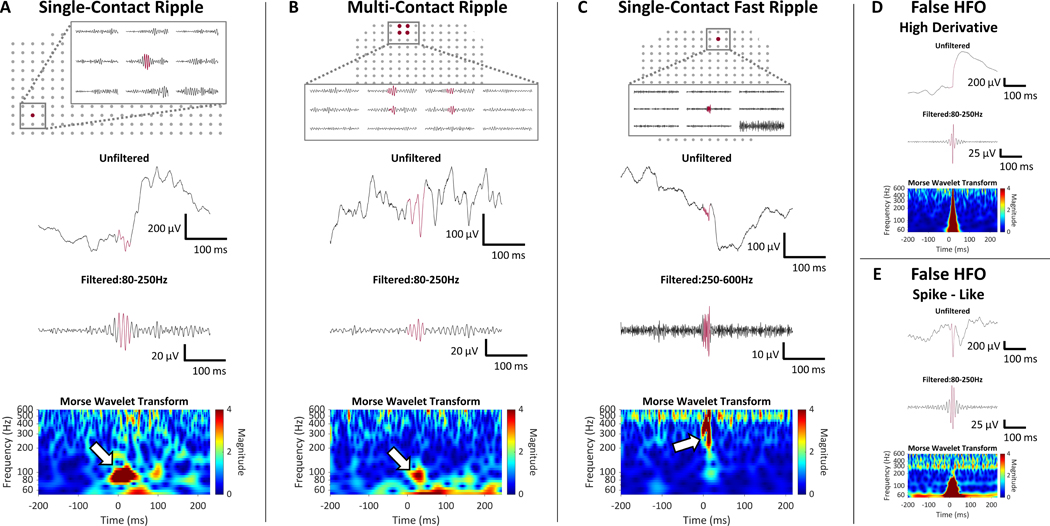
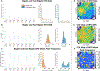
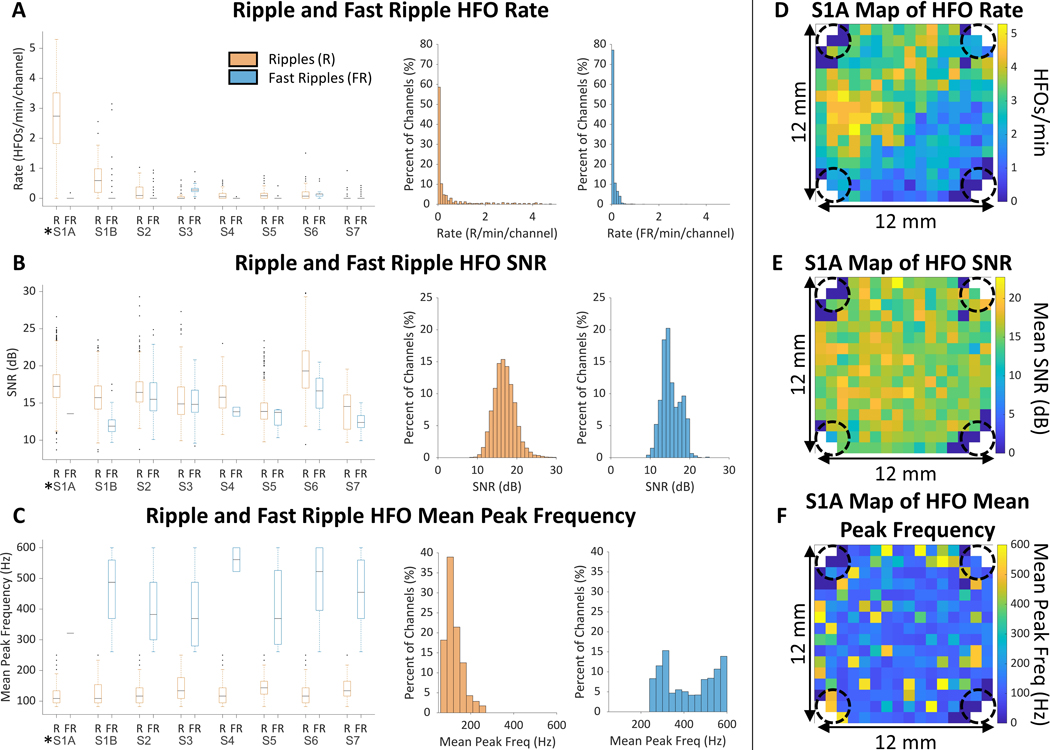
We used novel liquid crystal polymer thin-film (LCP-TF) μECoG arrays (0.76–1.72 mm inter-contact spacing) to capture HFOs in eight intraoperative recordings from seven patients with epilepsy. We identified ripple (80 – 250 Hz) and fast ripple (250 – 600 Hz) HFOs using a common energy thresholding detection algorithm along with two stages of artifact rejection. We visualized microscale subregions of HFO activity using spatial maps of HFO rate, signal-to-noise ratio, and mean peak frequency. We quantified the spatial extent of HFO events by measuring covariance between detected HFOs and surrounding activity. We also compared HFO detection rates on microcontacts to simulated macrocontacts by spatially averaging data.
Results:
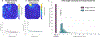
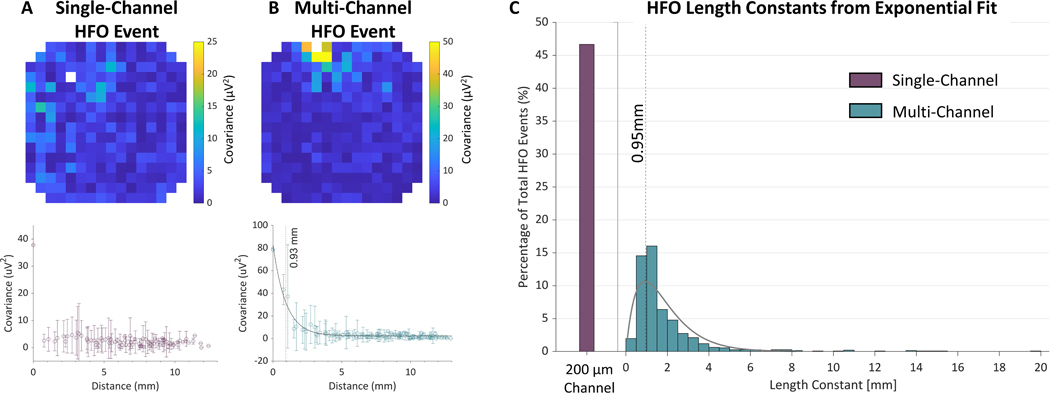
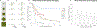
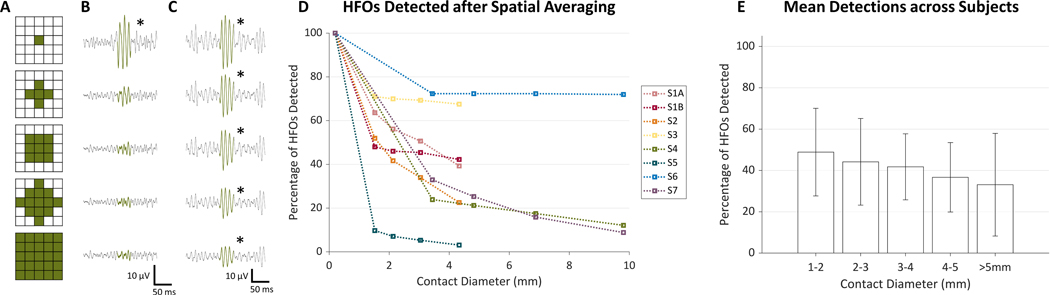
We found visually delineable subregions of elevated HFO activity within each μECoG recording. 47% of HFOs occurred on single 200 μm diameter recording contacts with minimal high frequency activity on surrounding contacts. Other HFO events occurred across multiple contacts simultaneously, with covarying activity most often limited to a 0.95 mm radius. Through spatial averaging, we estimated that macrocontacts with 2–3 mm diameter would only capture 44% of the HFOs detected in our μECoG recordings.
Significance:
These results demonstrate that thin-film microcontact surface arrays with both high resolution and large coverage accurately capture microscale HFO activity and may improve the utility of HFOs to localize the EZ for treatment of drug resistant epilepsy. -
Subjects:
-
Keywords:
-
Source:Epilepsia. 64(7):1910-1924
-
Pubmed ID:37150937
-
Pubmed Central ID:PMC10524535
-
Document Type:
-
Funding:UL 1TR002553/NH/NIH HHSUnited States/ ; R01 DC019498/DC/NIDCD NIH HHSUnited States/ ; R01 HL151490/NH/NIH HHSUnited States/ ; U01 NS122123/NH/NIH HHSUnited States/ ; UF1 NS122123/NS/NINDS NIH HHSUnited States/ ; U01 NS090415/NS/NINDS NIH HHSUnited States/ ; RF1 MH116978/NH/NIH HHSUnited States/ ; R01 MH116978/NH/NIH HHSUnited States/ ; UG3 NS120172/NS/NINDS NIH HHSUnited States/ ; U01 NS099697/NH/NIH HHSUnited States/ ; R01 NS062092/NH/NIH HHSUnited States/ ; U01 NS099697/NS/NINDS NIH HHSUnited States/ ; R01 NS109367/NS/NINDS NIH HHSUnited States/ ; R01 NS104923/NH/NIH HHSUnited States/ ; R01 NS06209207/NH/NIH HHSUnited States/ ; T32 GM136573/GM/NIGMS NIH HHSUnited States/ ; T32 GM136573/NH/NIH HHSUnited States/ ; K12 NS080223/NH/NIH HHSUnited States/ ; U01 NS099705/NS/NINDS NIH HHSUnited States/ ; R25 NS065731/NS/NINDS NIH HHSUnited States/ ; U01 NS103518/NS/NINDS NIH HHSUnited States/ ; U48DP006396-01SIP 19-003/CC/CDC HHSUnited States/ ; RF1 MH116978/MH/NIMH NIH HHSUnited States/ ; R01 NS062092/NS/NINDS NIH HHSUnited States/ ; 1R01-DC019498-01A1/NH/NIH HHSUnited States/ ; R01 MH111417/NH/NIH HHSUnited States/ ; UL1 TR002553/TR/NCATS NIH HHSUnited States/ ; R01 MH107396/MH/NIMH NIH HHSUnited States/ ; R01 MH111417/MH/NIMH NIH HHSUnited States/ ; U01 NS090415/NH/NIH HHSUnited States/ ; R01 NS104923/NS/NINDS NIH HHSUnited States/ ; U01 NS123668/NS/NINDS NIH HHSUnited States/ ; UG3 NS120172/NH/NIH HHSUnited States/ ; U01 NS103518/NH/NIH HHSUnited States/ ; R01 DC019498/NH/NIH HHSUnited States/ ; R01 NS109367/NH/NIH HHSUnited States/ ; U01 NS099705/NH/NIH HHSUnited States/ ; K12 NS080223/NS/NINDS NIH HHSUnited States/ ; U01 NS123668/NH/NIH HHSUnited States/ ; U01 NS099577/NS/NINDS NIH HHSUnited States/ ; R01 MH107396/NH/NIH HHSUnited States/ ; U01 NS099577/NH/NIH HHSUnited States/
-
Volume:64
-
Issue:7
-
Download URL:
-
File Type:
 [PDF - 1.28 MB]
 -
Collection(s):
-
Main Document Checksum:urn:sha256:8cfd211c31c0889c43b33b30136781683c5dc7a78ab2b4c2de67699854e8d25a
Supporting Files


File Language:
English
 Was this page helpful?
 Found an issue?


CDC STACKS serves as an archival repository of CDC-published products including
scientific findings, journal articles, guidelines, recommendations, or other public health information authored or
co-authored by CDC or funded partners.
As a repository, CDC STACKS retains documents in their original published format to ensure public access to scientific information.
As a repository, CDC STACKS retains documents in their original published format to ensure public access to scientific information.
You May Also Like
COLLECTION
CDC Public Access