



Neighborhood Deprivation and Privilege: an Examination of Racialized-Economic Segregation and Preterm Birth, Florida 2019
Supporting Files

-
2 2024 ; 2-2024
-
Available in CDC Stacks on February 01, 2025, 12:00 AM

File Language:
English
Details
-
Alternative Title:J Racial Ethn Health Disparities
-
Personal Author:
-
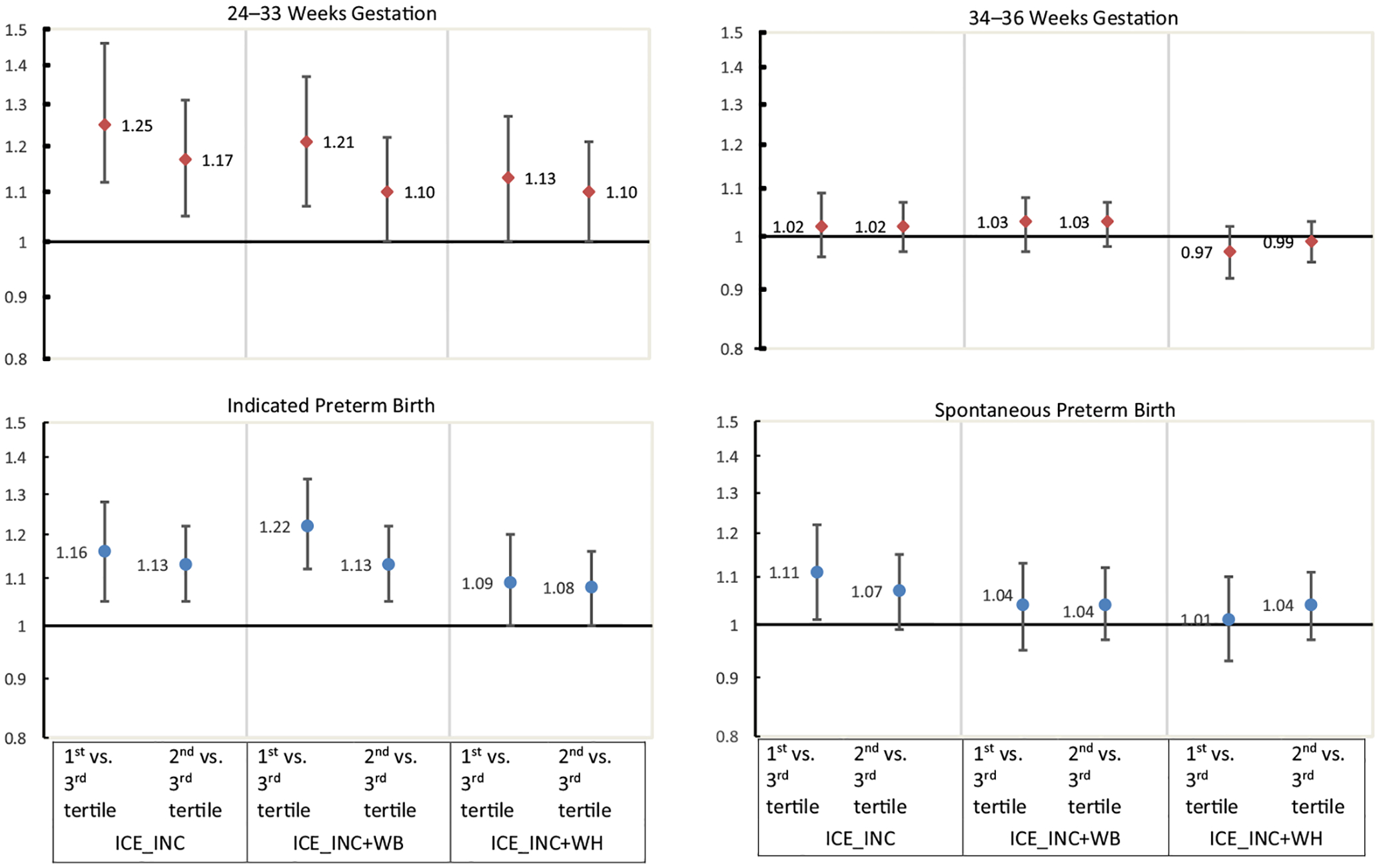
Description:The Black-White disparity in preterm birth persists and is not fully explained by individual-level social, behavioral, or clinical risk factors. Consequently, there is increasing emphasis on understanding the role of structural and area-level factors. Racialized-economic segregation measured as the index of concentration at the extremes (ICE) simultaneously captures extremes of deprivation and privilege. Our objective was to examine associations between preterm birth (PTB) and the index of concentration at the extremes (ICE). In this cross-sectional study, we analyzed 193,957 Florida birth records from 2019 linked to 2015-2019 census tract data from the American Community Survey. We assessed PTB (< 37 weeks gestation) by subtypes: (1) early (< 34 weeks) and late (34-36 weeks) and (2) spontaneous and indicated (i.e., provider-initiated) deliveries. We calculated adjusted odds ratios (aOR) and 95% confidence intervals (CI) for three ICE measures: (1) ICE_INC: income, (2) INC_INC + WB: income + race/ethnicity (non-Hispanic White vs. Black), and (3) INC_INC + WH: income + race/ethnicity (non-Hispanic White vs. Hispanic). Results. For ICE_INC and INC_INC + WB, aORs for residing in the worst-off vs. best-off areas were 1.25 (95% CI: 1.12, 1.46) and 1.21 (95% CI: 1.07, 1.37) for early PTB, respectively, and 1.16 (95% CI: 1.05, 1.28) to 1.22 (95% CI: 1.12, 1.34) for indicated PTB. In conclusion, deprivation captured by ICE was associated with increased odds of early or indicated PTB. Eliminating PTB disparities may require a multifaceted approach that includes addressing the interplay between income and race/ethnicity in residential areas.
-
Subjects:
-
Keywords:
-
Source:J Racial Ethn Health Disparities. 11(1):72-80
-
Pubmed ID:36652162
-
Pubmed Central ID:PMC10352457
-
Document Type:
-
Funding:
-
Volume:11
-
Issue:1
-
Download URL:
-
File Type:
 [PDF - 551.38 KB]
 -
Collection(s):
-
Main Document Checksum:urn:sha-512:cb83938711f66d34bf0b5245dfac4947b08554c2c60f9904bb106cd3c8150f38c34f1475a047d6d920bc7713475df3a8dfda7f868e1d2f31cb05720ff3a499d0
Supporting Files


File Language:
English
 Was this page helpful?
 Found an issue?

CDC STACKS serves as an archival repository of CDC-published products including
scientific findings, journal articles, guidelines, recommendations, or other public health information authored or
co-authored by CDC or funded partners.
As a repository, CDC STACKS retains documents in their original published format to ensure public access to scientific information.
As a repository, CDC STACKS retains documents in their original published format to ensure public access to scientific information.
You May Also Like
COLLECTION
CDC Public Access