


Thyroid Medication Use and Birth Defects in the National Birth Defects Prevention Study
Supporting Files

-
11 01 2017
-

File Language:
English
Details
-
Alternative Title:Birth Defects Res
-
Personal Author:
-
Corporate Authors:
-
Description:Background:
Thyroid disorders are common among reproductive-aged women, with hypothyroidism affecting 2 to 3% of pregnancies, and hyperthyroidism affecting an additional 0.1 to 1%. We examined associations between thyroid medications and individual birth defects using data from the National Birth Defects Prevention Study (NBDPS).
Methods:
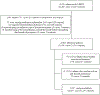
The NBDPS is a multisite, population-based, case–control study that included pregnancies with estimated delivery dates from 1997 to 2011. We analyzed self-reported thyroid medication use from mothers of 31,409 birth defect cases and 11,536 unaffected controls. Adjusted odds ratios (ORs) and 95% confidence intervals (CIs) were estimated using logistic regression for birth defects with five or more exposed cases, controlling for maternal age, race/ethnicity, and study center. Crude ORs and exact 95% CIs were estimated for defects with 3 to 4 exposed cases.
Results:
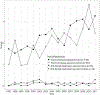
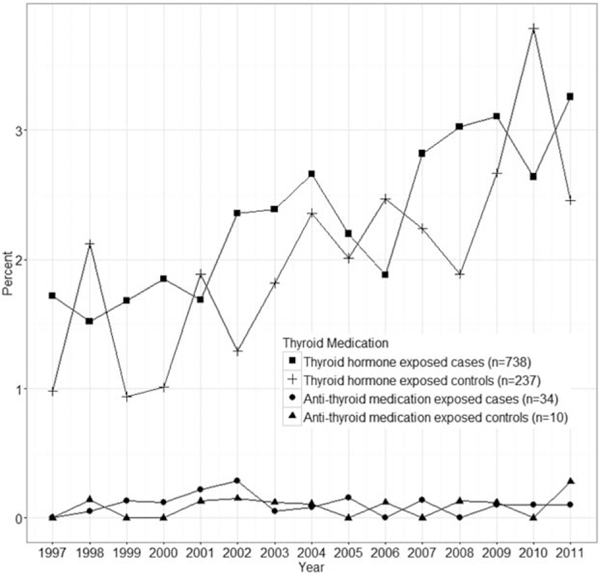
Thyroid hormone was used by 738 (2.3%) case and 237 (2.1%) control mothers, and was associated with anencephaly (OR = 1.68; 95% CI, 1.03–2.73), holoprosencephaly (OR = 2.48; 95% CI, 1.13–5.44), hydrocephaly (1.77; 95% CI, 1.07–2.95) and small intestinal atresia (OR = 1.81; 95% CI, 1.04–3.15). Anti-thyroid medication was used by 34 (0.1%) case and 10 (<0.1%) control mothers, and was associated with aortic valve stenosis (OR = 6.91; 95% CI, 1.21–27.0).
Conclusion:
While new associations were identified, our findings are relatively consistent with previous NBDPS analyses. Our findings suggest thyroid medication use is not associated with most birth defects studied in the NBDPS, but may be associated with some specific birth defects. These results should not be interpreted to suggest that medications used to treat thyroid disease are teratogens, as the observed associations may reflect effects of the underlying thyroid disease.
-
Subjects:
-
Source:Birth Defects Res. 109(18):1471-1481
-
Pubmed ID:28758357
-
Pubmed Central ID:PMC10246666
-
Document Type:
-
Funding:
-
Volume:109
-
Issue:18
-
Collection(s):
-
Main Document Checksum:urn:sha256:45a8bf7ef9f876d21e31ecbe3b9cd7dedfcb1d2501bb20a14818b0ba34bbec52
-
Download URL:
-
File Type:
 [PDF
- 953.31 KB
]
[PDF
- 953.31 KB
]

Supporting Files


File Language:
English
ON THIS PAGE


CDC STACKS serves as an archival repository of CDC-published products including
scientific findings,
journal articles, guidelines, recommendations, or other public health information authored or
co-authored by CDC or funded partners.
As a repository, CDC STACKS retains documents in their original published format to ensure public access to scientific information.
As a repository, CDC STACKS retains documents in their original published format to ensure public access to scientific information.
You May Also Like
COLLECTION
CDC Public Access