



Race-specific associations of urinary phenols and parabens with adipokines in midlife women: The Study of Women’s Health Across the Nation (SWAN)
Supporting Files

-
6 15 2022 ; 6-15-
-
Available in CDC Stacks on 2023-06-15T00:00:00Z
File Language:
English
Details
-
Alternative Title:Environ Pollut
-
Personal Author:
-
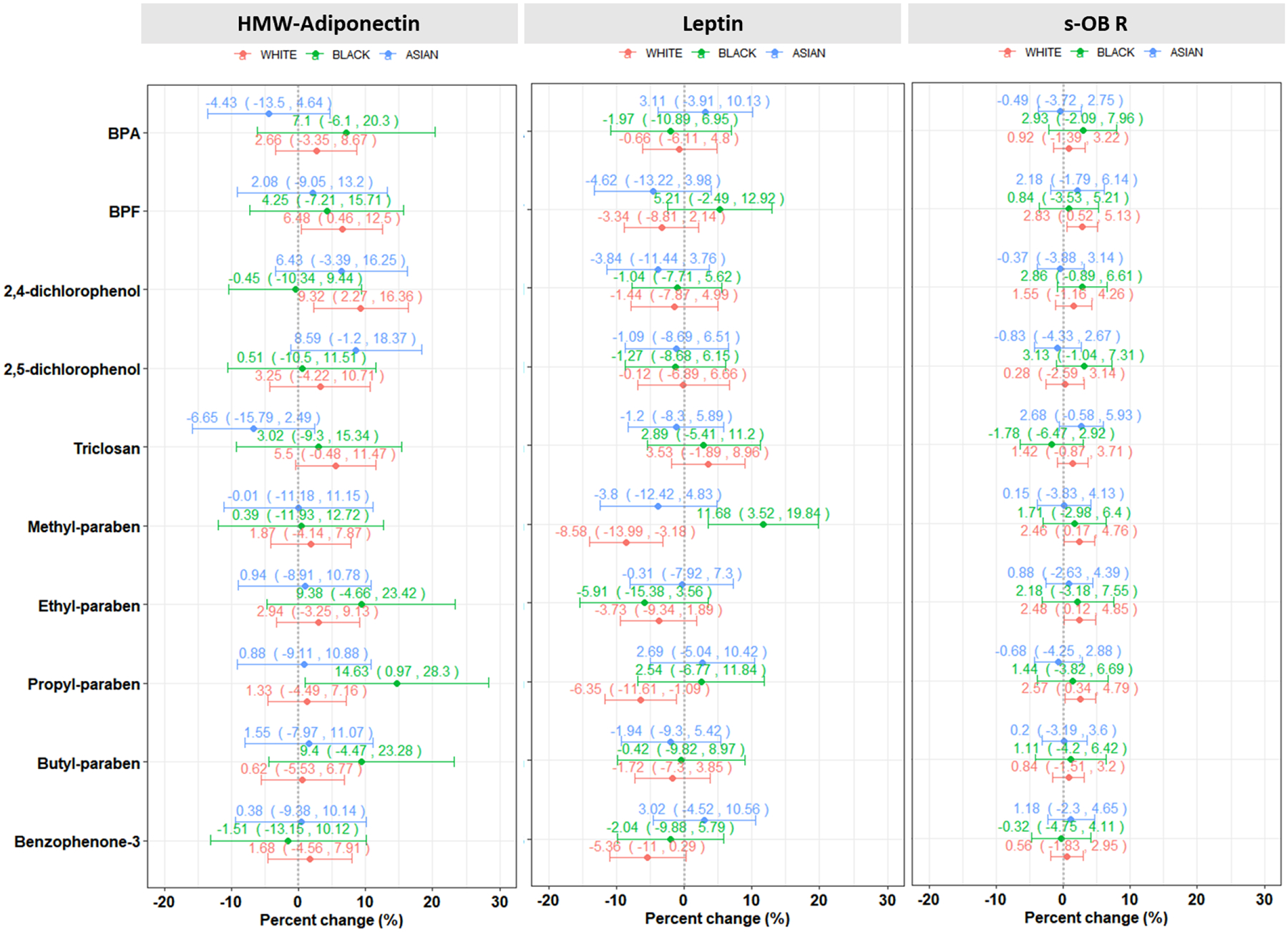
Description:Adipokines, cytokines secreted by adipose tissue, may contribute to obesity-related metabolic disease. The role of environmental phenols and parabens in racial difference in metabolic disease burden has been suggested, but there is limited evidence. We examined the cross-sectional associations of urinary phenols and parabens with adipokines and effect modification by race. Urinary concentrations of 6 phenols (bisphenol-A, bisphenol-F, 2,4-diclorophenol, 2,5-diclorophenol, triclosan, benzophenone-3) and 4 parabens (methyl-paraben, ethyl-paraben, propyl-paraben, butyl-paraben) were measured in 2002-2003 among 1200 women (mean age = 52.6) enrolled in the Study of Women's Health Across the Nation Multi-Pollutant Study. Serum adipokines included adiponectin, high molecular weight (HMW)-adiponectin, leptin, soluble leptin receptor (sOB-R). Linear regression models were used to estimate the adjusted percentage change in adipokines per inter-quantile range (IQR) increase in standardized and log-transformed levels of individual urinary phenols and parabens. Bayesian kernel machine regression (BKMR) was used to evaluate the joint effect of urinary phenols and parabens as mixtures. Participants included white (52.5%), black (19.3%), and Asian (28.1%) women. Urinary 2,4-dichlorophenol was associated with 6.02% (95% CI: 1.20%, 10.83%) higher HMW-adiponectin and urinary bisphenol-F was associated with 2.60% (0.48%, 4.71%) higher sOB-R. Urinary methyl-paraben was associated with lower leptin in all women but this association differed by race: 8.58% (-13.99%, -3.18%) lower leptin in white women but 11.68% (3.52%, 19.84%) higher leptin in black women (P interaction = 0.001). No significant associations were observed in Asian women. Additionally, we observed a significant positive overall effect of urinary phenols and parabens mixtures in relation to leptin levels in black, but not in white or Asian women. Urinary bisphenol-F, 2,4-dichlorophenol and methyl-paraben may be associated with favorable profiles of adipokines, but methyl-paraben, widely used in hair and personal care products, was associated with unfavorable leptin levels in black women. Future studies are needed to confirm this racial difference.
-
Subjects:
-
Keywords:
-
Source:Environ Pollut. 303:119164
-
Pubmed ID:35306088
-
Pubmed Central ID:PMC9883839
-
Document Type:
-
Funding:T42 OH008455/OH/NIOSH CDC HHSUnited States/ ; R01 AG062622/AG/NIA NIH HHSUnited States/ ; P30 DK092926/DK/NIDDK NIH HHSUnited States/ ; U01 AG012554/AG/NIA NIH HHSUnited States/ ; P30 AG024824/AG/NIA NIH HHSUnited States/ ; P30 ES017885/ES/NIEHS NIH HHSUnited States/ ; U01 AG012535/AG/NIA NIH HHSUnited States/ ; U01 AG012553/AG/NIA NIH HHSUnited States/ ; U01 NR004061/NR/NINR NIH HHSUnited States/ ; U01 AG012539/AG/NIA NIH HHSUnited States/ ; R01 ES026578/ES/NIEHS NIH HHSUnited States/ ; U01 AG012546/AG/NIA NIH HHSUnited States/ ; U19 AG063720/AG/NIA NIH HHSUnited States/ ; U01 AG012495/AG/NIA NIH HHSUnited States/ ; P30 DK020572/DK/NIDDK NIH HHSUnited States/ ; U01 AG012505/AG/NIA NIH HHSUnited States/ ; U01 AG012531/AG/NIA NIH HHSUnited States/ ; R01 ES026964/ES/NIEHS NIH HHSUnited States/ ; U01 AG017719/AG/NIA NIH HHSUnited States/
-
Volume:303
-
Download URL:
-
File Type:
 [PDF - 721.99 KB]
 -
Collection(s):
-
Main Document Checksum:urn:sha-512:0cd0ae9122c3fdb1314b2f1049f01a609482bd3ba06e37c636af7d0d246a850a647e51d8cf00a86de765fcc4c079df0458d24a80a984e6052243a4e3c246d3cd
Supporting Files


File Language:
English
 Was this page helpful?
 Found an issue?

CDC STACKS serves as an archival repository of CDC-published products including
scientific findings, journal articles, guidelines, recommendations, or other public health information authored or
co-authored by CDC or funded partners.
As a repository, CDC STACKS retains documents in their original published format to ensure public access to scientific information.
As a repository, CDC STACKS retains documents in their original published format to ensure public access to scientific information.
You May Also Like
COLLECTION
CDC Public Access