



Dominant Carbapenemase-Encoding Plasmids in Clinical Enterobacterales Isolates and Hypervirulent Klebsiella pneumoniae, Singapore
Supporting Files
Public Domain

-
8 2022
File Language:
English
Details
-
Alternative Title:Emerg Infect Dis
-
Personal Author:Yong, Melvin ; Chen, Yahua ; Oo, Guodong ; Chang, Kai Chirng ; Chu, Wilson H.W. ; Teo, Jeanette ; Venkatachalam, Indumathi ; Thevasagayam, Natascha May ; Sridatta, Prakki S. Rama ; Koh, Vanessa ; Marcoleta, Andrés E. ; Chen, Hanrong ; Nagarajan, Niranjan ; Kalisvar, Marimuthu ; Ng, Oon Tek ; Gan, Yunn-Hwen
-
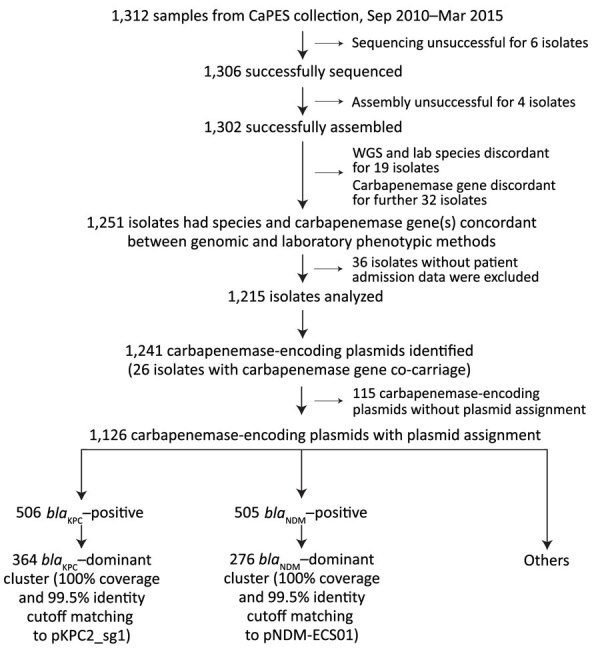
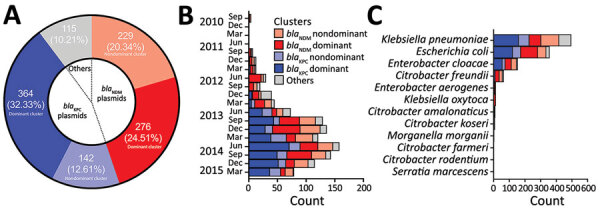
Description:Dissemination of carbapenemase-encoding plasmids by horizontal gene transfer in multidrug-resistant bacteria is the major driver of rising carbapenem-resistance, but the conjugative mechanics and evolution of clinically relevant plasmids are not yet clear. We performed whole-genome sequencing on 1,215 clinical Enterobacterales isolates collected in Singapore during 2010-2015. We identified 1,126 carbapenemase-encoding plasmids and discovered pKPC2 is becoming the dominant plasmid in Singapore, overtaking an earlier dominant plasmid, pNDM1. pKPC2 frequently conjugates with many Enterobacterales species, including hypervirulent Klebsiella pneumoniae, and maintains stability in vitro without selection pressure and minimal adaptive sequence changes. Furthermore, capsule and decreasing taxonomic relatedness between donor and recipient pairs are greater conjugation barriers for pNDM1 than pKPC2. The low fitness costs pKPC2 exerts in Enterobacterales species indicate previously undetected carriage selection in other ecological settings. The ease of conjugation and stability of pKPC2 in hypervirulent K. pneumoniae could fuel spread into the community.
-
Subjects:
-
Source:Emerg Infect Dis. 2022; 28(8):1578-1588
-
Pubmed ID:35876475
-
Pubmed Central ID:PMC9328930
-
Document Type:
-
Place as Subject:
-
Volume:28
-
Issue:8
-
Download URL:
-
File Type:
 [PDF - 3.02 MB]
 -
Collection(s):
-
Main Document Checksum:urn:sha256:9a859d30c3ab6757290f5a6e9768e0346a08297142a1f88a2a4dd1a9e249f42c
Supporting Files


File Language:
English
 Was this page helpful?
 Found an issue?


CDC STACKS serves as an archival repository of CDC-published products including
scientific findings, journal articles, guidelines, recommendations, or other public health information authored or
co-authored by CDC or funded partners.
As a repository, CDC STACKS retains documents in their original published format to ensure public access to scientific information.
As a repository, CDC STACKS retains documents in their original published format to ensure public access to scientific information.
You May Also Like
COLLECTION
Emerging Infectious Diseases