


Association of Increased Serum Lipopolysaccharide but not Microbial Dysbiosis with Obesity-related Osteoarthritis
Supporting Files

-
2 2022
-

File Language:
English
Details
-
Alternative Title:Arthritis Rheumatol
-
Personal Author:Loeser, Richard F.
 ;
Arbeeva, Liubov
;
Kelley, Kathryn
;
Fodor, Anthony A.
;
Sun, Shan
;
Ulici, Veronica
;
Longobardi, Lara
;
Cui, Yang
;
Stewart, Delisha A.
;
Sumner, Susan J.
;
Azcarate-Peril, M. Andrea
;
Sartor, R. Balfour
;
Carroll, Ian M.
;
Renner, Jordan B.
;
Jordan, Joanne M.
;
Nelson, Amanda E.
;
Arbeeva, Liubov
;
Kelley, Kathryn
;
Fodor, Anthony A.
;
Sun, Shan
;
Ulici, Veronica
;
Longobardi, Lara
;
Cui, Yang
;
Stewart, Delisha A.
;
Sumner, Susan J.
;
Azcarate-Peril, M. Andrea
;
Sartor, R. Balfour
;
Carroll, Ian M.
;
Renner, Jordan B.
;
Jordan, Joanne M.
;
Nelson, Amanda E.
-
Description:Objective.
To test the hypothesis that an altered gut microbiota (dysbiosis) plays a role in obesity-associated osteoarthritis (OA).
Methods.
Stool and blood samples were collected from 92 participants with BMI ≥ 30 kg/m2 recruited from the Johnston County Osteoarthritis Project. OA cases (n=50) had hand plus knee OA (Kellgren-Lawrence [KL] grade ≥2 or arthroplasty). Controls (N=42) had no hand OA and KL grade 0–1 knees. Compositional analysis of stool samples was carried out by 16S rRNA amplicon sequencing. Alpha and beta diversity and differences in taxa relative abundances were determined. Blood samples were used for multiplex cytokine analysis and measures of lipopolysaccharide (LPS) and LPS binding protein. Germ-free mice were gavaged with case or control pooled fecal samples and placed on a 40% fat, high sucrose diet for 40 weeks. Knee OA was evaluated histologically.
Results.
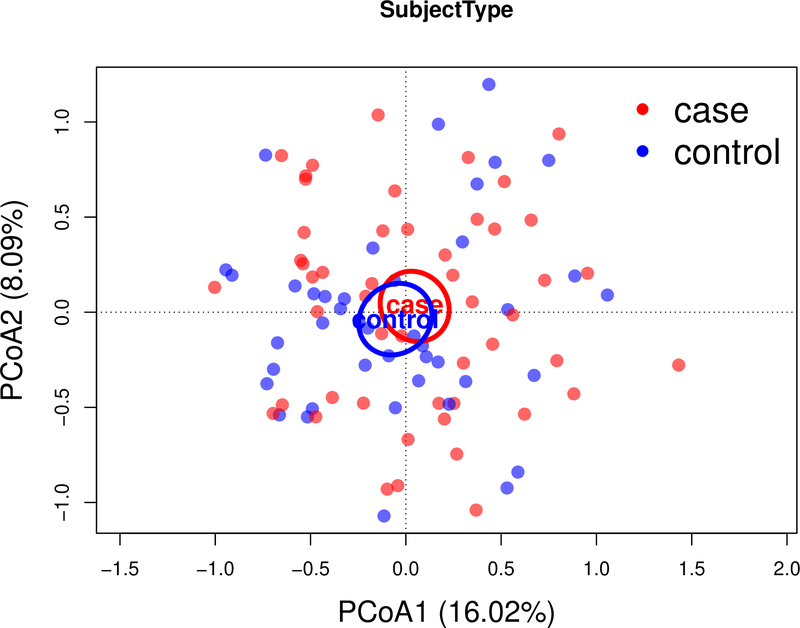
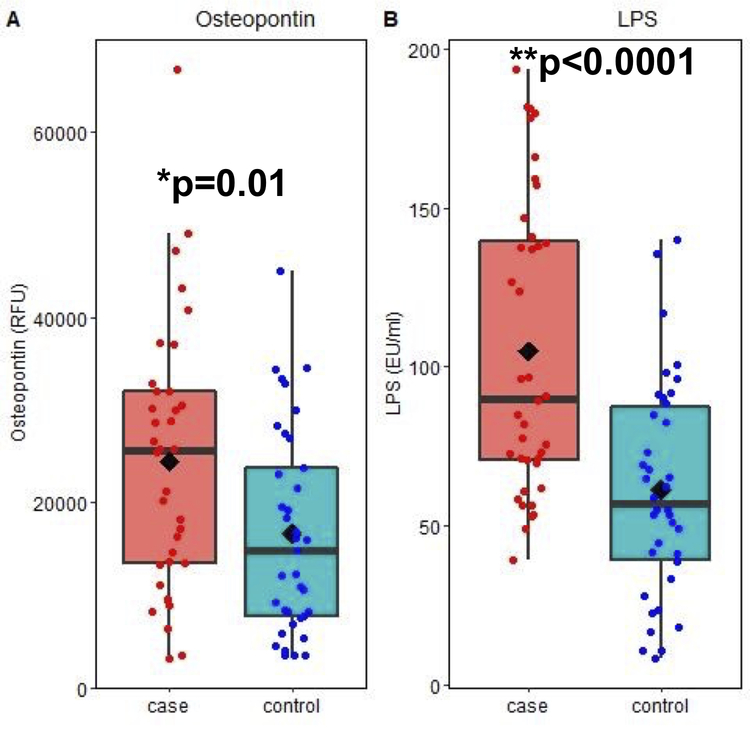
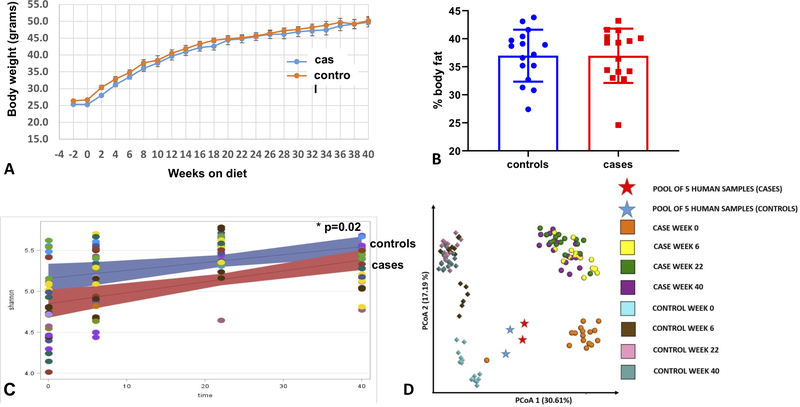
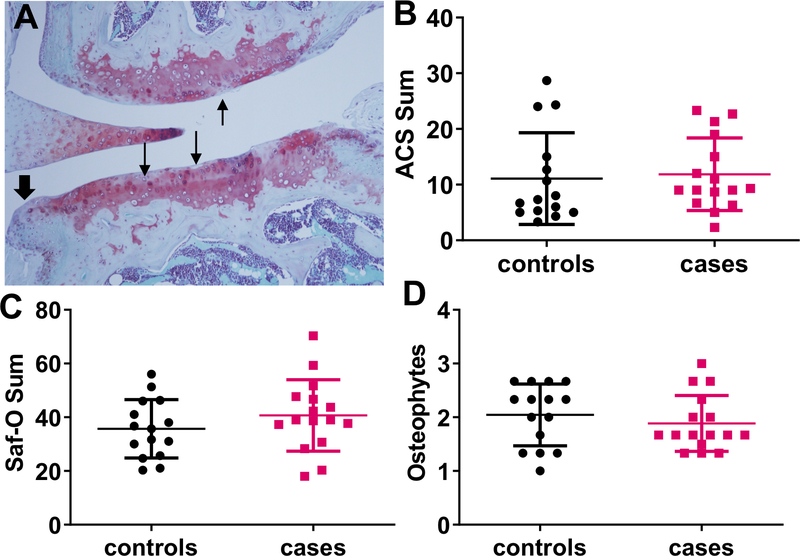
OA cases were slightly older with more females and higher BMI, WOMAC pain and KL grades than controls. There were no significant differences in alpha or beta diversity or genus level composition between cases and controls. Cases had higher plasma levels of osteopontin (p=0.01) and serum LPS (p<0.0001). Mice transplanted with case or control microbiota exhibited a significant difference in alpha diversity (p=0.02) and beta diversity but no differences in OA severity.
Conclusion.
The lack of differences in the gut microbiota yet increased serum LPS levels suggest the possibility that increased intestinal permeability allowing for greater absorption of LPS, rather than a dysbiotic microbiota, may contribute to development of OA associated with obesity.
-
Subjects:
-
Source:Arthritis Rheumatol. 74(2):227-236
-
Pubmed ID:34423918
-
Pubmed Central ID:PMC8795472
-
Document Type:
-
Funding:P30-DK-056350/DK/NIDDK NIH HHSUnited States/ ; P30-DK-034987/DK/NIDDK NIH HHSUnited States/ ; P30 DK034987/DK/NIDDK NIH HHSUnited States/ ; P30-AR-072580/AR/NIAMS NIH HHSUnited States/ ; UL1 TR002489/TR/NCATS NIH HHSUnited States/ ; UL1-TR-002489/TR/NCATS NIH HHSUnited States/ ; P30 AR072580/AR/NIAMS NIH HHSUnited States/ ; P40 OD010995/OD/NIH HHSUnited States/ ; U01 DP006266/DP/NCCDPHP CDC HHSUnited States/ ; U01-DP-006266/CC/CDC HHSUnited States/ ; P30 DK056350/DK/NIDDK NIH HHSUnited States/
-
Volume:74
-
Issue:2
-
Collection(s):
-
Main Document Checksum:urn:sha256:8fa6146031840974a1c6e7f7869193862ecf18387fe8b23c6130b9c8e2924836
-
Download URL:
-
File Type:
 [PDF
- 1.06 MB
]
[PDF
- 1.06 MB
]
Supporting Files


File Language:
English
ON THIS PAGE


CDC STACKS serves as an archival repository of CDC-published products including
scientific findings,
journal articles, guidelines, recommendations, or other public health information authored or
co-authored by CDC or funded partners.
As a repository, CDC STACKS retains documents in their original published format to ensure public access to scientific information.
As a repository, CDC STACKS retains documents in their original published format to ensure public access to scientific information.
You May Also Like
COLLECTION
CDC Public Access