



Portable XRF as a rapid determination tool to detect ppm levels of Ni, Zn, As, Se and Pb in human toenails: A South India case study
Supporting Files

-
10 05 2021
-
Available in CDC Stacks on October 05, 2022, 12:00 AM
File Language:
English
Details
-
Alternative Title:Environ Sci Technol
-
Personal Author:
-
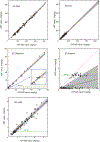
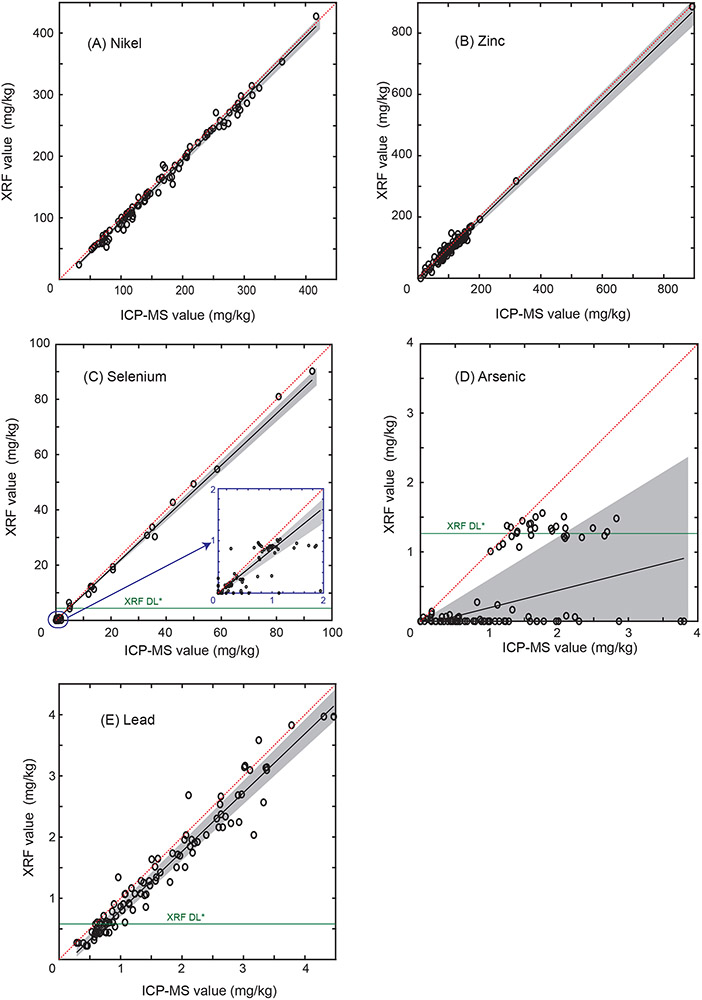
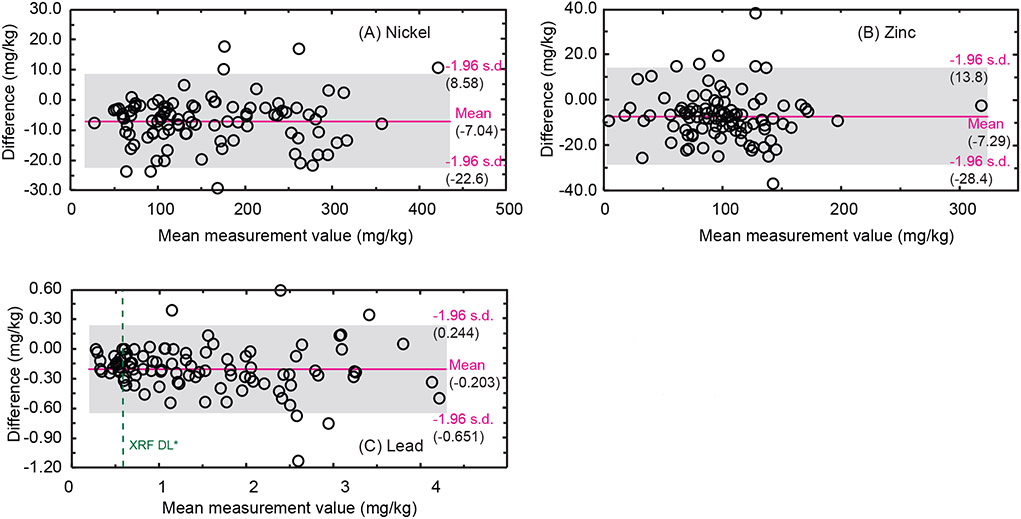
Description:Chronic exposure to inorganic pollutants adversely affects human health. Inductively coupled plasma mass spectrometry (ICP-MS) is the most common method used for trace metal(loid) analysis of human biomarkers. However, it leads to sample destruction, generation of secondary waste, and significant recurring costs. Portable X-ray fluorescence (XRF) instruments can rapidly and nondestructively determine low concentrations of metal(loid)s. In this work, we evaluated the applicability of portable XRF as a rapid method for analyzing trace metal(loid)s in toenail samples from three populations (| = 97) near the city of Chennai, India. A Passing-Bablok regression analysis of results from both methods revealed that there was no proportional bias among the two methods for nickel (measurement range ∼25 to 420 mg/kg), zinc (10 to 890 mg/kg), and lead (0.29 to 4.47 mg/kg). There was a small absolute bias between the two methods. There was a strong proportional bias (slope = 0.253, 95% CI: 0.027, 0.614) between the two methods for arsenic (below detection to 3.8 mg/kg) and for selenium when the concentrations were lower than 2 mg/kg. Limits of agreement between the two methods using Bland-Altman analysis were derived for nickel, zinc, and lead. Overall, a suitably calibrated and evaluated portable XRF shows promise in making high-throughput assessments at population scales.
-
Subjects:
-
Source:Environ Sci Technol. 55(19):13113-13121
-
Pubmed ID:34529917
-
Pubmed Central ID:PMC8582015
-
Document Type:
-
Funding:
-
Place as Subject:
-
Volume:55
-
Issue:19
-
Download URL:
-
File Type:
 [PDF - 851.14 KB]
 -
Collection(s):
-
Main Document Checksum:urn:sha256:1bc861630d183085b9610b21044b9fc2165e45d7d80c96c50e456fc9f1c78086
Supporting Files


File Language:
English
 Was this page helpful?
 Found an issue?

CDC STACKS serves as an archival repository of CDC-published products including
scientific findings, journal articles, guidelines, recommendations, or other public health information authored or
co-authored by CDC or funded partners.
As a repository, CDC STACKS retains documents in their original published format to ensure public access to scientific information.
As a repository, CDC STACKS retains documents in their original published format to ensure public access to scientific information.
You May Also Like
COLLECTION
CDC Public Access