


Perfluoroalkyl Substances and Cognitive Function in Older Adults: Should We Consider Non-Monotonic Dose-Responses and Chronic Kidney Disease?
Supporting Files

-
1 2021
-
File Language:
English
Details
-
Alternative Title:Environ Res
-
Personal Author:
-
Description:Background:
Although potential neurotoxicity of perfluoroalkyl and polyfluoroalkyl substances (PFAS) is suggested, previous epidemiologic studies have reported a ‘protective’ association between serum PFAS concentration and cognition function. Poor outcome assessment, residual confounding, non-monotonic dose-responses (NMDRs), and the role of reduced kidney function in PFAS excretion may be alternative explanations of these findings.
Objectives:
We examined the association of perfluoroalkyls with cognitive functions assessed using the Consortium to Establish a Registry for Alzheimer’s Disease word learning and recall; the Animal Fluency; and the Digit Symbol Substitution tests.
Methods:
We included 903 adults aged ≥60 years from the National Health and Nutrition Examination Survey (NHANES) 2011-2014. We computed a composite z-score as an average of four individual cognitive z-scores and used it as the outcome. Linear and generalized additive models were used to evaluate linear and non-linear associations.
Results:
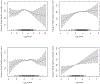
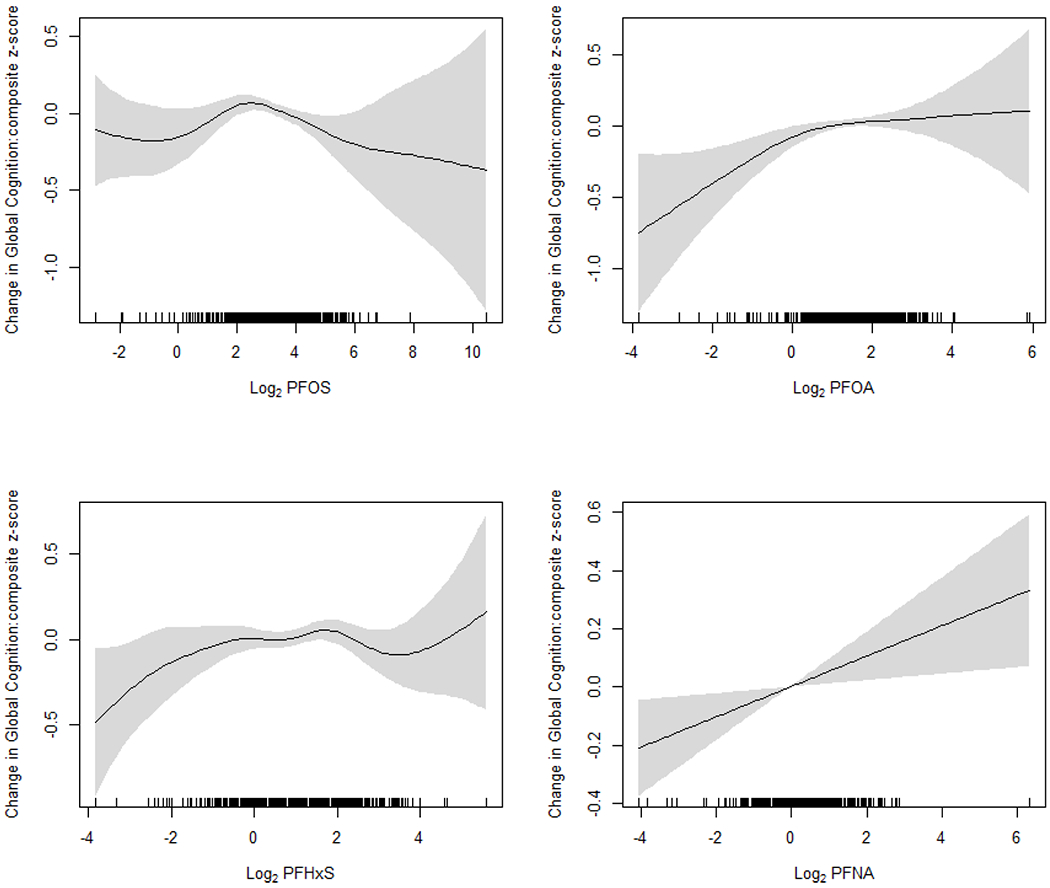
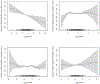
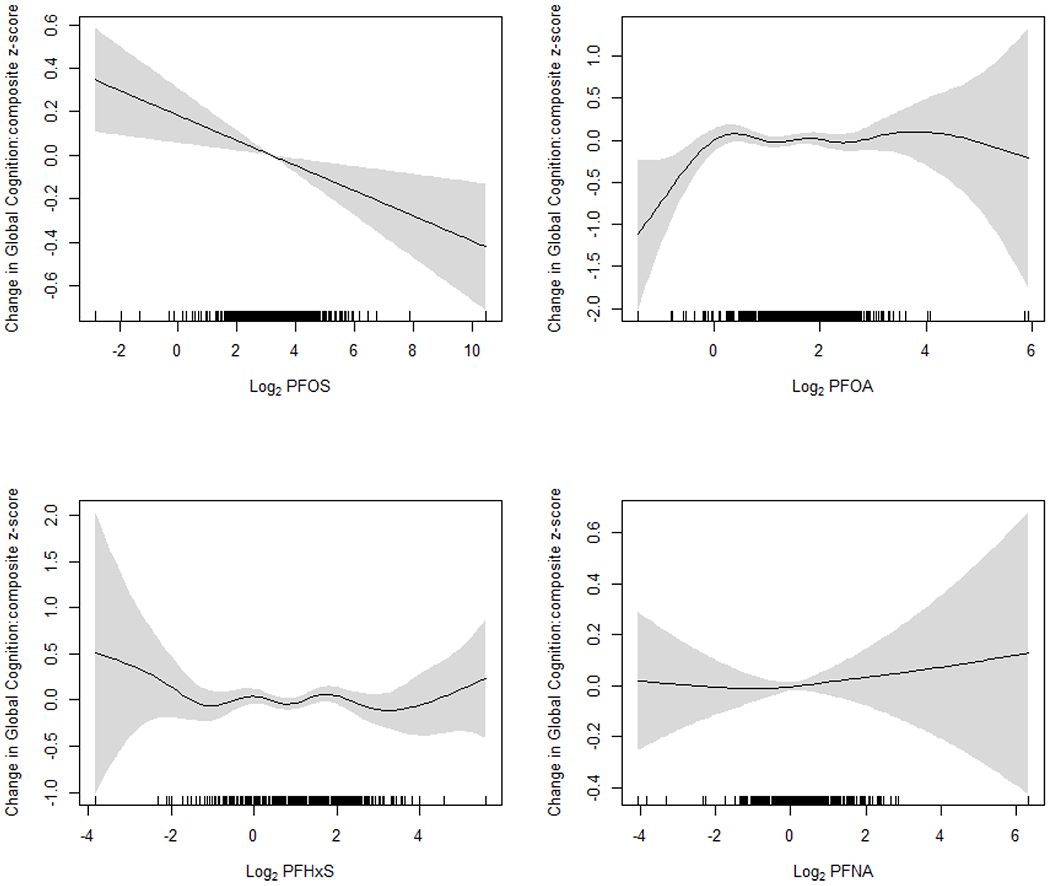
With the linearity assumption, perfluorooctanoate (PFOA) and perfluorononanoate (PFNA) were significantly positively associated with composite z-score after adjustment for age, sex, race/ethnicity, education, smoking, poverty-income ratio, health insurance, food security, alcohol, and physical activity. Smoothing plots suggested NMDRs, especially for perfluorooctane sulfonate (PFOS) with a U-shape dose-response. When restricting to participants without chronic kidney disease (CKD) (n=613), the positive associations for PFOA and PFNA observed in the whole population diminished, whereas PFOS was inversely and significantly associated with composite z-score. Also, negative confounding effects of fish/seafood consumption seem to be substantial. Effect estimates of composite z-score were −0.055 (95% CI: −0.097, −0.012, P=0.01) for a doubling increase in PFOS.
Discussion:
These findings suggest that the previous epidemiologic findings of a ‘protective’ association between PFAS and cognition may be explained by CKD, NMDRs and confounding by fish consumption. PFOS at the current population exposure level in the U.S. may be a risk factor for cognitive decline in older adults with normal kidney function.
-
Subjects:
-
Source:Environ Res. 192:110346
-
Pubmed ID:33068581
-
Pubmed Central ID:PMC7736478
-
Document Type:
-
Funding:
-
Volume:192
-
Collection(s):
-
Main Document Checksum:urn:sha256:35bc393eeadc7a4ee442ade947aba4df44b597022142b9a688b6d648b22b9c97
-
Download URL:
-
File Type:
 [PDF
- 564.71 KB
]
[PDF
- 564.71 KB
]
Supporting Files


File Language:
English
ON THIS PAGE

CDC STACKS serves as an archival repository of CDC-published products including
scientific findings,
journal articles, guidelines, recommendations, or other public health information authored or
co-authored by CDC or funded partners.
As a repository, CDC STACKS retains documents in their original published format to ensure public access to scientific information.
As a repository, CDC STACKS retains documents in their original published format to ensure public access to scientific information.
You May Also Like
COLLECTION
CDC Public Access