



Perfluoroalkyl Substances Exposure and Hearing Impairment in US Adults
Supporting Files

-
2020/08/01
-
Available in CDC Stacks on 2021-08-01T00:00:00Z
File Language:
English
Details
-
Alternative Title:Environ Res
-
Personal Author:
-
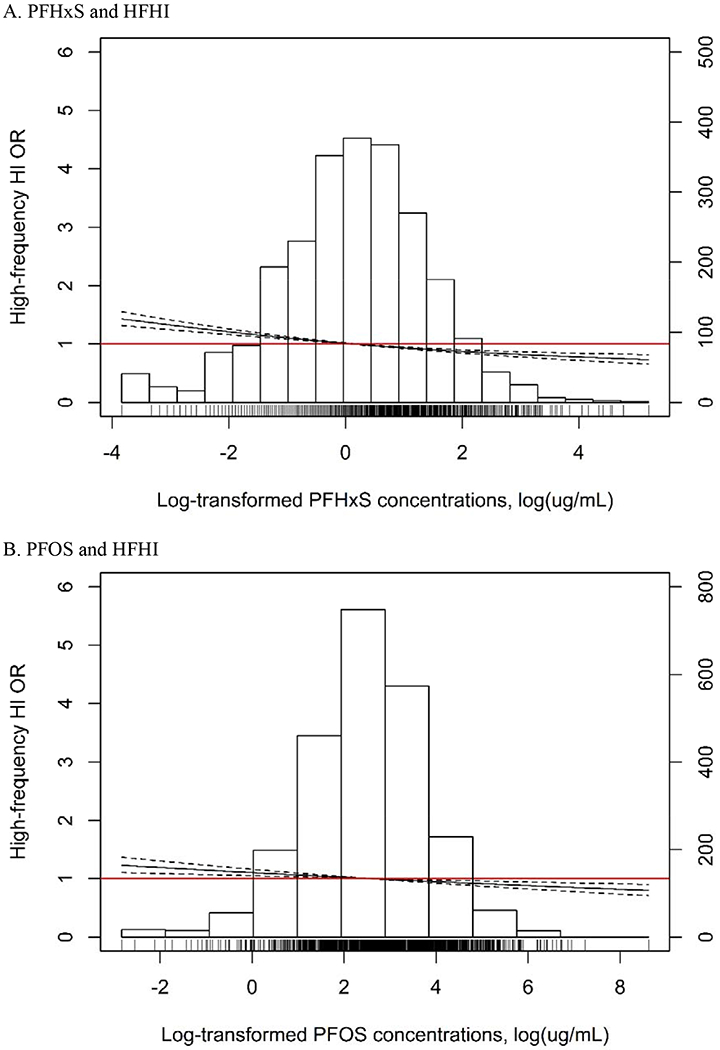
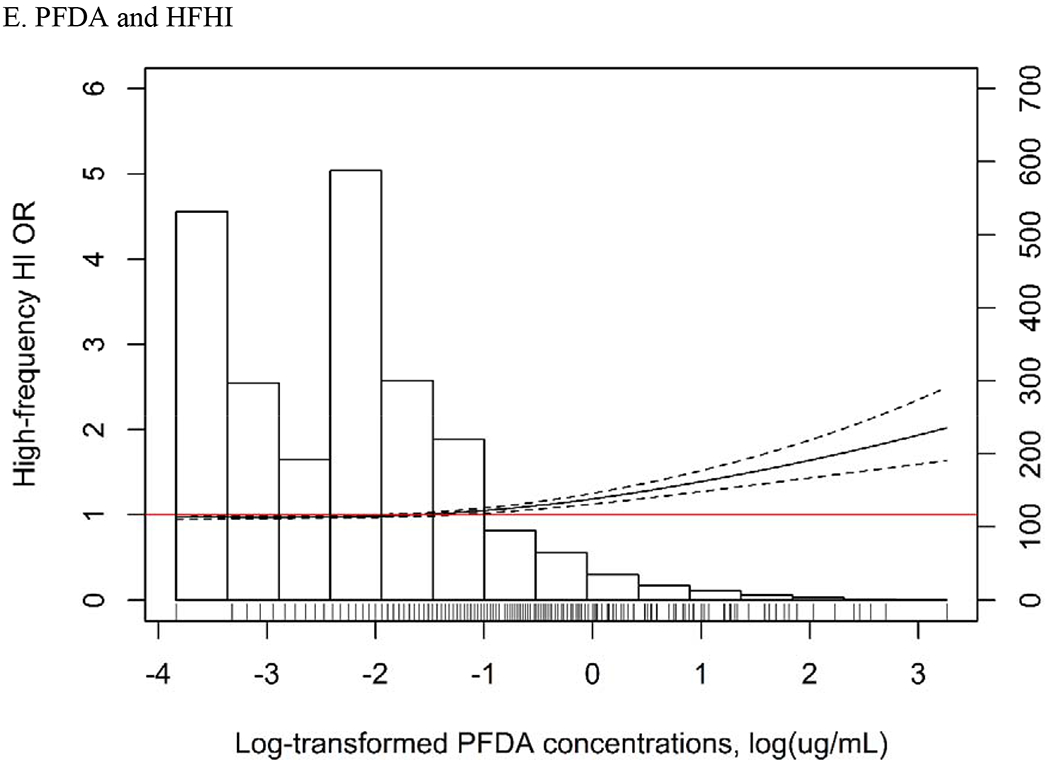
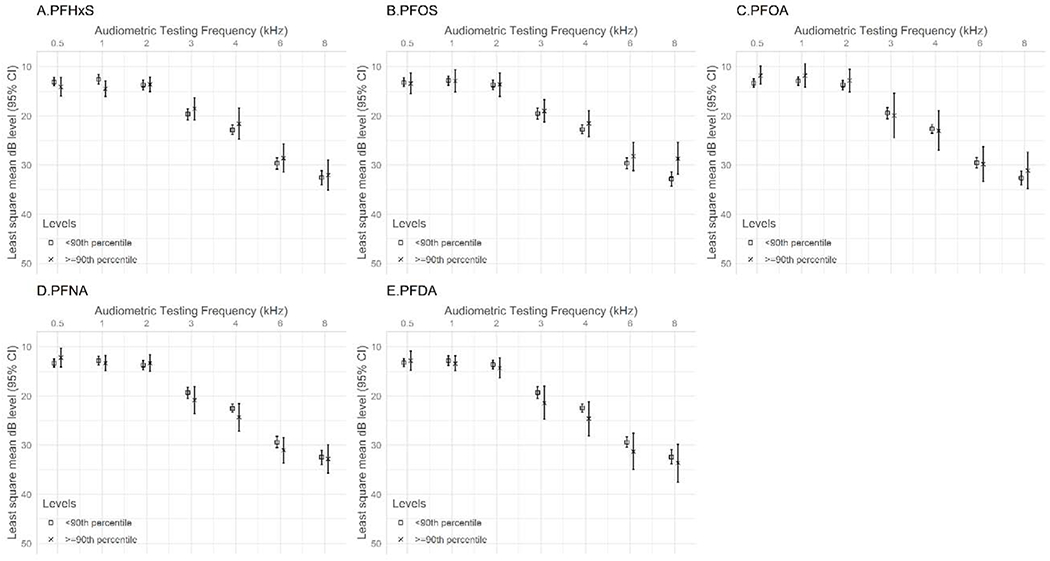
Description:Background: ; Per- and polyfluoroalkyl substances (PFAS) are widely applied in consumer and industrial products such as nonstick cookware, waterproof clothing, food packaging materials, and fire-fighting foams. These "forever chemicals" are hypothesized to impact neurobehavioral functions. Yet no previous study has explored the role of PFAS on audiometrically determined hearing impairment (HI). ; Objectives: ; To investigate the associations of serum concentrations of perfluoroalkyl substances with low-frequency HI (LFHI) and high-frequency HI (HFHI) in US adults. ; Methods: ; We evaluated the cross-sectional associations in 2371 adults aged 20-69 years who participated in the National Health and Nutrition Examination Survey (NHANES) 2003-2004, 2011-2012 and 2015-2016; and 449 adults aged ≥70 years from NHANES 2005-2006 and 2009-2010. Serum concentrations of perfluorohexane sulfonic acid (PFHxS), perfluorooctane sulfonic acid (PFOS), perfluorooctanoic acid (PFOA), perfluorononanoic acid (PFNA) and perfluorodecanoic acid (PFDA), were measured using solid-phase extraction coupled to High Performance Liquid Chromatography-Turbo Ion Spray ionization-tandem Mass Spectrometry. LFHI was defined as a pure-tone average (PTA) of thresholds across 0.5-1-2 kHz >25 dB; HFHI defined as a PTA across 3-4-6 kHz >25 dB in the worse ear. Survey-weighted logistic regression models were used to compute odds ratios (ORs) and 95% confidence intervals (CIs) with adjustment for age, age-squared, sex, race/ethnicity, education, poverty-to-income ratio, body mass index, smoking status, exposures to occupational, recreational and firearm noises, and NHANES cycles. ; Results: ; There were no significant associations when perfluoroalkyl variables were fitted as a linear (log-transformed) term. However, statistically significant associations of HFHI with PFNA (OR=1.70, 95% CI: 1.13-2.56) and PFDA (OR=1.75, 95% CI: 1.00-3.05) were observed when comparing participants with serum concentrations ≥90th vs. <90th percentiles of PFNA (90th percentile=1.8 ng/mL) and PFDA (90th percentile=0.5 ng/mL), respectively, in adults aged 20-69 years. No significant associations were observed for other compounds in adults aged 20-69 years and for all compounds in adults ≥70 years. ; Conclusions: ; Our study does not provide strong evidence to support the ototoxicity of PFAS exposure. Non-linear threshold dose-response associations between serum concentrations of PFNA and PFDA and HFHI need further investigation.
-
Keywords:
-
Source:Environ Res. 187:109686
-
Pubmed ID:32474307
-
Pubmed Central ID:PMC7331829
-
Document Type:
-
Funding:
-
Genre:
-
Volume:187
-
Download URL:
-
File Type:
 [PDF - 690.24 KB]
 -
Collection(s):
-
Main Document Checksum:urn:sha-512:841cbbc87c109548f3b1964fc2c750cad815108a8134089d336f5995dc86771c2a8626a0b394f4b3039acdb16b926bf38c33afa872a7e756679040fbeab3abd6
Supporting Files


File Language:
English
 Was this page helpful?
 Found an issue?





CDC STACKS serves as an archival repository of CDC-published products including
scientific findings, journal articles, guidelines, recommendations, or other public health information authored or
co-authored by CDC or funded partners.
As a repository, CDC STACKS retains documents in their original published format to ensure public access to scientific information.
As a repository, CDC STACKS retains documents in their original published format to ensure public access to scientific information.
You May Also Like
COLLECTION
CDC Public Access